
707 HP 1987 Shelby Charger Concept Turns “Goes Like Hell” Into “Goes Like Hellcat”
Carroll Shelby built his legend on the Cobra and the GT350, but in the 1980s, he put his name on front-drive Dodge hatchbacks that promised to “Go Like Hell.”

These lightweight turbocharged four-cylinders could keep up with plenty of V8 muscle cars of the era. The partnership wound down by the end of the decade, and the cars slowly slipped out of the spotlight.
Decades later, Dodge built an engine that could take that old promise a lot further. We couldn’t resist imagining what happens when a Shelby Charger meets it.
How Carroll Shelby Taught A Front-Drive Dodge To Go Like Hell

Shelby’s Dodge chapter started in earnest in 1982, when his old Ford friend Lee Iacocca was running Chrysler. Shelby reportedly signed on partly because he felt he owed Iacocca a favor. The deal lasted through 1989 and produced everything from the Shelby Dakota pickup to early groundwork for the Viper.
The Shelby Charger was one of its first products, a subcompact three-door hatchback built on Chrysler’s front-wheel-drive L platform from 1983 to 1987. It started out with a 107 hp 2.2-liter four-cylinder before the Turbo I engine bumped output to 146 hp for 1985.
For 1987, the Charger’s final year, Shelby bought the last 1,000 Shelby Chargers and shipped them to his Whittier, California, plant for upgrades. Each one got an intercooled 2.2-liter turbo rated at 175 hp and 175 lb-ft, sent through a five-speed manual. Koni adjustable dampers, Centurion wheels, and a curb weight of just 2,580 lbs made it a genuinely quick little car.
Every one wore black paint and a numbered, signed dash plaque, and Shelby swapped the Dodge badges for his own name, right down to the valve cover. He called it the GLHS, short for “Goes Like Hell S’more,” a cheeky follow-up to the earlier Omni GLH, or “Goes Like Hell.”
Our “Goes Like Hellcat” Concept Swaps A Turbo-Four For A 707 HP

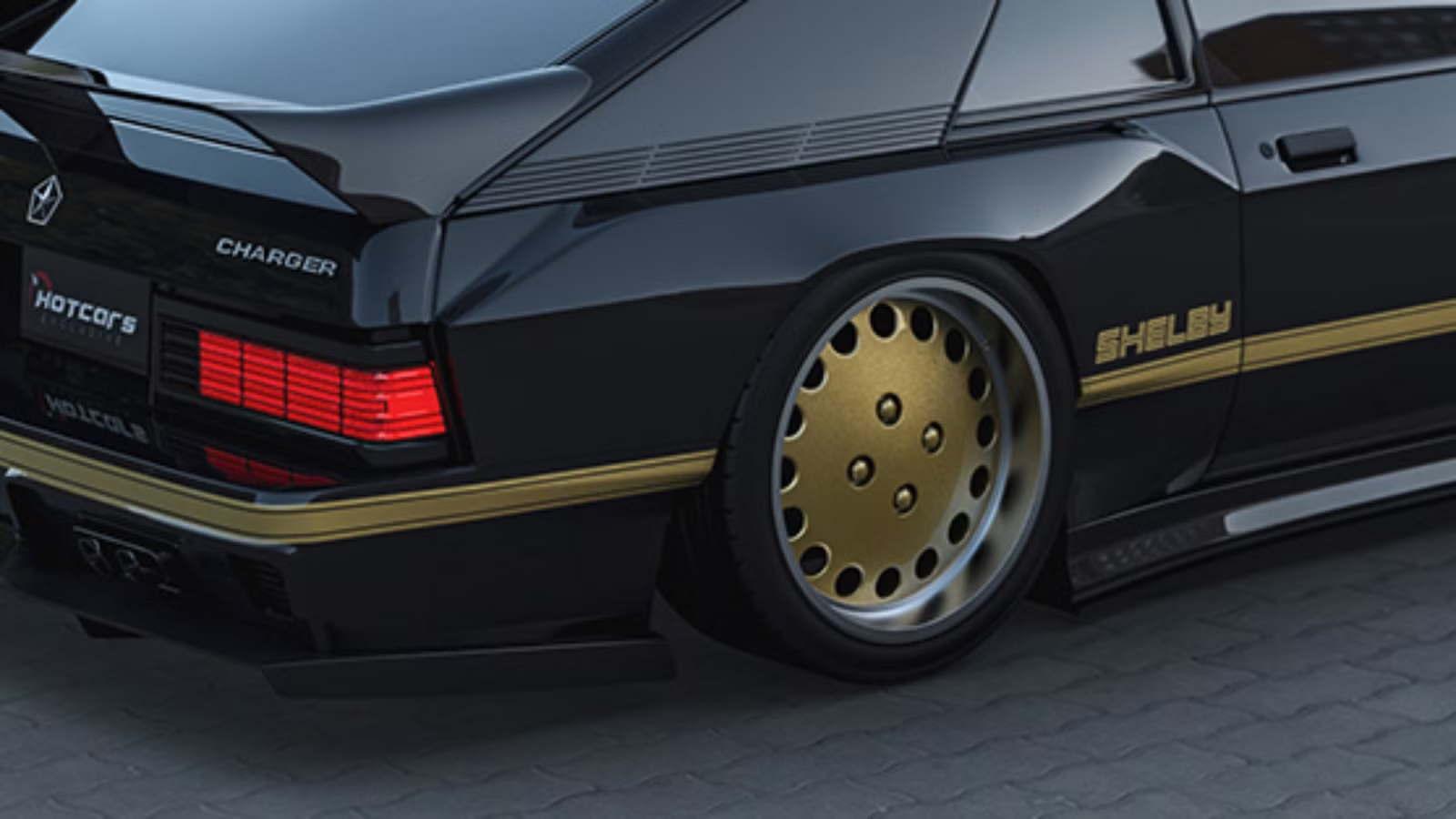
This HotCars Exclusive “Goes Like Hellcat” concept is a digital design that imagines a 1987 Shelby Charger with Dodge’s supercharged 6.2-liter Hellcat V8 shoehorned under the hood. The Hellcat has powered several badass modern muscle cars, but nobody has put it in an ’87 Charger, but the numbers make a strong case for it. In the 2015 Challenger SRT Hellcat, this engine made 707 hp and 650 lb-ft, enough for Dodge to bill it as the most powerful muscle car ever produced at the time.

That output comes from an Eaton-based twin-screw supercharger running up to 11.6 psi of boost. The Hellcat also brought a two-key setup, with the black fob limiting the engine to about 500 hp and the red fob unlocking all 707 hp. In a car this small, keeping the black key handy might not be a bad idea.
The original GLHS carried about 14.7 lbs for every horsepower, while four times the power would drop that figure to roughly 3.6 lbs per hp, even before the V8’s added weight. Sending it all through the front wheels would be a recipe for smoke and torque steer, so we imagine a rear-drive conversion paired with the Hellcat’s 8-speed automatic.

The styling makes that rear-drive swap look believable, with flared widebody arches, a deep front splitter, a rear diffuser, a big wing, and twin quad-tip exhausts. Gold stripes over black paint nod to the all-black 1987 cars, while “Shelby” script on the doors and gold deep-dish wheels add a retro touch. Slim LED headlights, a Pentastar on the nose, and louvered rear quarter glass finish the look without hiding the Charger’s wedge-shaped hatchback profile.
Why The Original Shelby Charger Is Still An Affordable Way Into Shelby Ownership

Original Shelby Chargers remain one of the more affordable ways into Shelby ownership, though prices swing a lot with condition and mileage. A 1987 GLHS sold for $9,350 at Barrett-Jackson in 2015, while a 19,000-mile 1986 Shelby Charger was bid to $16,000 at Mecum in 2025 without selling.
Rarity drives much of the appeal, since Shelby built only 1,000 GLHS Chargers, and each carries its numbered dash plaque. Unmodified examples are especially hard to find because many of these cars were tuned, raced, or simply driven hard. A clean, original, low-mileage GLHS is the one collectors chase.
Shelby’s turbo hatchbacks still offer a lot of history for the money. Our “Goes Like Hellcat” concept simply imagines what might have happened if he had a 707 hp Hemi to play with back in 1987.
Sources: Barrett-Jackson, Mecum Auctions

Related posts




Latest Post


No Comments