
The Harley That Makes Weekend Plans For You
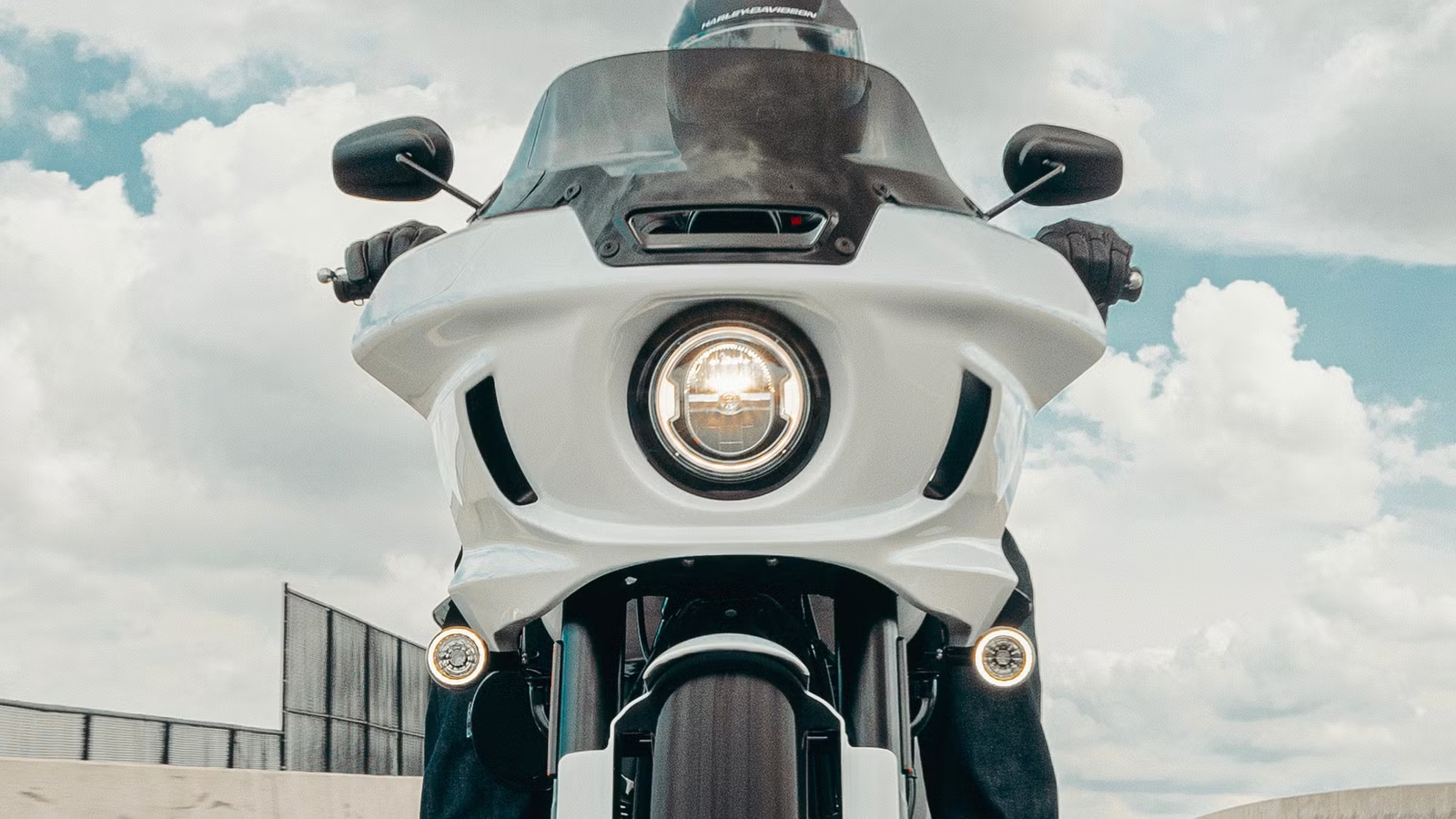
There is a certain point when planning a motorcycle weekend becomes almost as complicated as the trip itself. A full dresser can require serious luggage planning, while a stripped-down cruiser may leave you counting the miles after a couple of hours. Somewhere between those extremes is a motorcycle that can turn a vague idea into an easy decision: throw in a change of clothes, fill the tank and head toward the roads that look interesting. Keeping the above in mind, an American rider looking for a weekend getaway machine will inevitably end up at a Harley-Davidson showroom, given how many options are on offer.
The Gap Between “Ready To Ride” And “Ready For The Weekend”

There’s a specific kind of rider Harley-Davidson has spent the last few years chasing, and it isn’t the cross-country type with a route mapped across six states. It’s the rider who wants to be spontaneous: out the door Saturday morning, back Sunday night, no Tour-Pak, no intercom, no itinerary typed up in advance. Most of the brand’s Grand American Touring lineup doesn’t really speak to that person. Those bikes are built around the assumption that you’ve already decided to go somewhere specific, packed accordingly, and budgeted the miles.
Bridging The Gap Between Strip-Down Cruiser And Full Tourer

The tall-bike look that comprises high bars, a stubby fairing, and a stance that reads more West Coast custom shop than factory showroom, circulated in the aftermarket for decades before Harley put its own name on it. Builders were chopping and raising Softails and Dynas long before the factory noticed there was real, sustained demand for it.
What Harley eventually did was the smart move: rather than leave that look entirely to the custom world, it engineered a factory version with a warranty, a finance plan, and a dealer network behind it. No fabrication, no waiting on a builder’s schedule, no voided coverage the moment you swap a fender. That’s effectively the whole pitch of the bike at the center of this story, and it’s why the aftermarket crowd and the showroom crowd both ended up wanting the same motorcycle.

Why The Harley-Davidson Low Rider ST Is The Perfect Weekend Getaway Machine
At $23,999, It Undercuts The Cheapest Street Glide While Adding The Gear You Actually Need

That bike is the Low Rider ST, and it’s the closest thing Harley has to a clean answer for the spontaneous-weekend gap. Built on the Softail platform and styled after the 1980s FXRT Sport Glide, it’s the sportier, more fully dressed sibling to the Low Rider S, which skips the fairing and saddlebags entirely.
The ST asks $23,999 to start — a jump of five grand over the S, but still a few hundred dollars under the cheapest solo-trim Street Glide, which opens at $24,999 before you’ve even added a passenger seat. Chase the blacked-out trim or one of the newer colorways like Blood Orange or Aurora Blue Denim, and that number climbs quickly, which is worth knowing before you fall for one on the showroom floor.
The Milwaukee-Eight 117 High Output Is The Heartbeat
Pure Torque On Demand

The engine is a major part of why the Low Rider ST feels less like a touring compromise and more like a performance motorcycle that happens to travel well. The 1,923cc Milwaukee-Eight 117 High Output is an air-cooled, pushrod V-twin producing a claimed 114 horsepower at 5,000 rpm and 128 pound-feet of torque at 4,000 rpm. Harley-Davidson pairs it with a six-speed transmission and electronic fuel injection. These numbers are impressive on paper; however, the more important characteristic is how little effort the engine needs to generate forward momentum.
That huge torque figure means the ST does not have to be revved hard to make highway merges or overtakes. Harley-Davidson has given the 2026 model selectable ride modes alongside its electronic safety systems. The motorcycle can adapt its throttle response and intervention strategy for different riding conditions, adding a layer of versatility without asking the rider to turn the motorcycle into a technology project before every trip.
Factory Heavy Breather And 2-Into-1 Performance Exhaust

Harley calls the intake the “Heavy Breather,” a forward-facing setup that pulls in more air than the standard cruiser intake and feeds it straight to the High Output motor. Paired with it is a factory-tuned 2-into-1 exhaust that does double duty: it sharpens throttle response and gives the bike a genuinely distinctive exhaust note, one that doesn’t rattle your fillings three hours into a ride the way some aftermarket setups tend to. Both pieces come dialed in from the factory, which means you don’t have to spend an unnecessary dime.
What Actually Makes The Weekend Plan Itself
Two Cubic Feet Of Storage That Pop Off In Seconds When You Don’t Need Them

This is where the bike earns its headline. The lockable, clamshell-style saddlebags carry a combined two cubic feet of storage — roughly enough for a couple of days of clothes, a rain layer, and the odds and ends an actual trip requires, without turning the bike into a rolling suitcase. They’re not without complaints; riders who’ve lived with the bike for a while note the clamshell lids and interior straps can be fussier to load than a simple duffel would be. However, the trade-off is a bike that looks like a cruiser at rest and rides like one carrying real gear, and the bags pop off in seconds on days when you’d rather not carry them at all.
The FXRT Fairing Cuts Highway Fatigue Without Burying The Bike’s Silhouette

The fixed, frame-mounted fairing is the other half of the equation — a shape borrowed directly from the FXRT, with a six-inch smoked windshield and vents engineered specifically to cut down on head buffeting at highway speed. It won’t shield you the way a full batwing fairing does on a Street Glide since there’s no lower leg protection and no oversized windscreen to disappear behind.
What it does is take the edge off a long stretch of interstate without burying the bike’s silhouette under bodywork it was never meant to wear. Riders chasing extra comfort on longer days often add the Sundowner seat — a genuine Harley accessory rather than standard equipment — which trades a bit of that lean, stripped-down profile for real padding where it counts on hour four of a ride.
The Suspension And Electronics Harley Borrowed From Its Sport Bikes
Recalibrated Forks And 31.3 Degrees Of Lean Angle That You’ll Actually Use

The ST shares its 43mm single-cartridge inverted front fork with the Low Rider S, set at a 28-degree rake, but the internals are recalibrated here to account for the extra 17 pounds the fairing adds up front. Out back, a taller mono-shock than the standard Softail chassis raises the rear end, adding wheel travel and pushing lean angle out to 31.3 degrees on both sides — enough that it becomes a genuinely usable number on a backroad, not just a spec-sheet flex nobody tests. Dual 300mm front discs and Michelin Scorcher tires round out a chassis clearly tuned by people who ride these things hard.
Lean-Sensitive ABS And Traction Control That Work In The Corners, Not Just On Straights

Harley-Davidson equips the Low Rider ST with Rider Safety Enhancements, including ABS, traction control, drag-torque slip control, Cornering ABS, Cornering Traction Control, and Cornering Drag-Torque Slip Control. These systems use lean-sensitive intervention where applicable to help manage braking, acceleration, and deceleration. Add tire pressure monitoring on top, and you’ve got a bike that’s already configured for whatever the road throws at it on a Saturday you didn’t plan for. The electronics provide another safety net without becoming the focus of the motorcycle. That is exactly what good touring technology should do.
A Four-Inch Speedometer That Shows Everything You Need Without The Dashboard Clutter

Harley-Davidson has kept the cockpit remarkably simple. The Low Rider ST gets a four-inch analog speedometer with a digital display capable of showing gear position, fuel level, trip information, range, tachometer information, ride modes, TPMS, ABS, traction control and cruise-control status. There is no giant dashboard dominating the handlebar area, and that fits the motorcycle’s personality. A standard USB-C charging port is another small but meaningful addition. There is also cruise control, which matters more once the miles start accumulating.
The 2026 Low Rider ST has a five-gallon fuel tank, a claimed 47 mpg, a 63.6-inch wheelbase, and a 27-inch laden seat height. On paper, it is still a substantial Harley-Davidson. However, those specifications work together to create something more versatile than the average Softail cruiser. It can commute. It can play on winding roads. It can spend an afternoon crossing state lines. And, with a couple of bags packed, it can become a weekend machine without a major transformation. That is why the Low Rider ST fits the idea behind this headline so well.
Source: Harley-Davidson

Related posts




Latest Post



No Comments