
The Used Audi R8 V10 Enthusiasts Now Grab As Daily Supercars
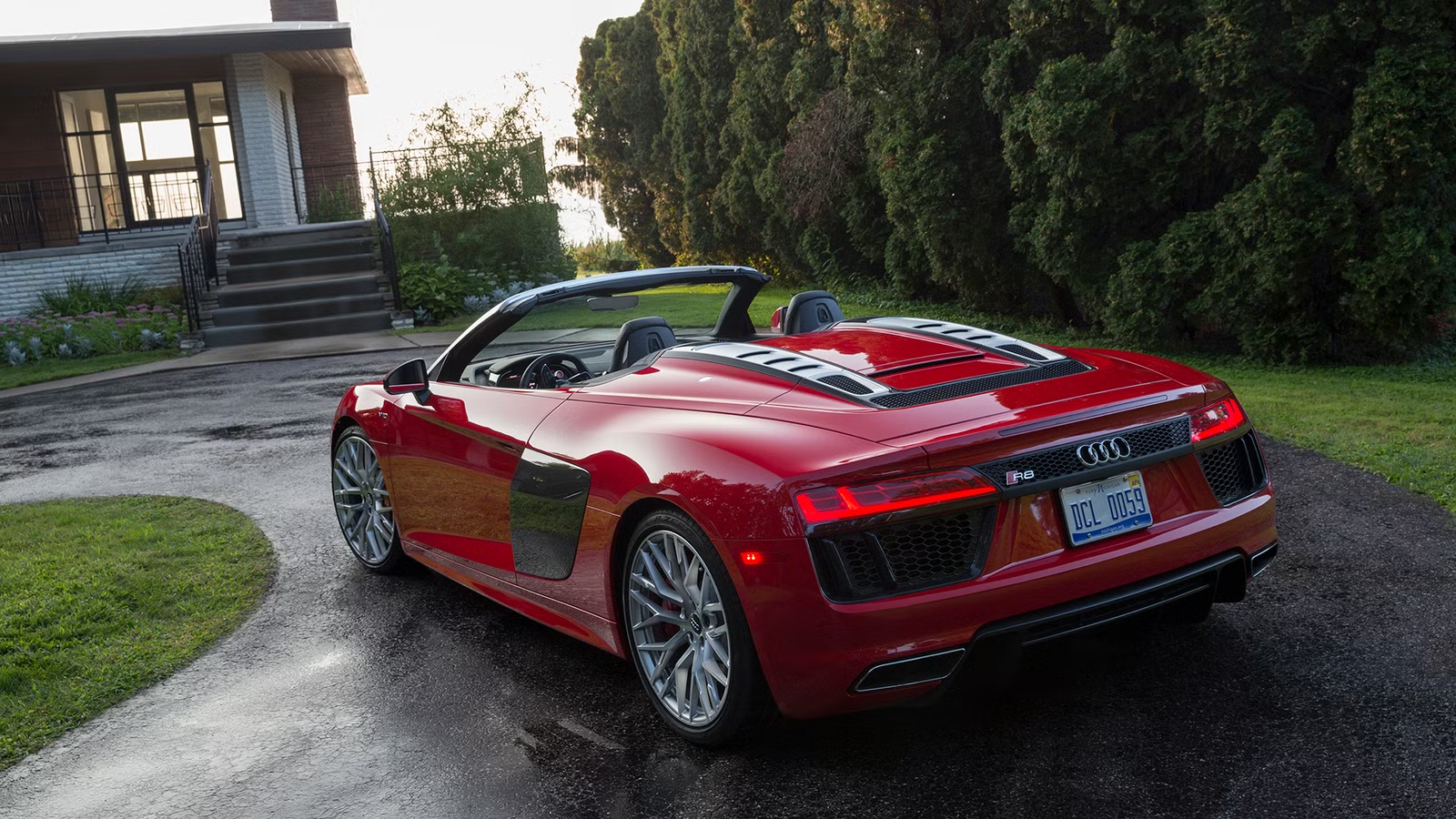
What a time to be alive! Gas prices have never been higher (at least since 2008), cars basically drive themselves, and the enthusiast landscape is ever-changing. The one thing that hasn’t changed in the decade of ever-evolving tech space for cars is how supercars are driven. Sure, they now come in full electric variants or even plug-in hybrids, but most of them don’t come with full self-driving capabilities, and quite honestly? They shouldn’t.

As technology continues to move forward, most enthusiasts still want one thing: the thrill of analog driving. The Audi R8 can provide that, but it can also provide you with daily driving abilities. Is it going to necessarily get you across country with 10 suitcases and more than two people? No. Is it going to get you to and from work with a book bag and lunchbox in tow for a semi-reasonable price? Maybe! Let’s find out.
From $43,500: How Two Generations Of R8 V10 Create Very Different Sweet Spots
The Audi R8 is what happens when a parent company like Volkswagen buys a supercar company like Lamborghini in 1998. The Audi R8 is basically a Lamborghini Gallardo with a four-ringed badge. Audi has always been known for sports performance, but this was the first time in modern history that they had been known to have a supercar worth drooling over. The Audi R8 is Audi’s two-seater supercar that is mid-engine, and, unlike supercars at the time, employs their patented Quattro all-wheel drive drivetrain. It only lasted two generations, from the model years 2008 to 2023.
Should You Get The First Or Second Generation?


That all depends on what you’re looking for, what your brand of styling is like, and how much money you can spend. The first generation is known as type 42 and was on sale from 2008 to 2015. Originally, it was launched with a 4.2-liter V8. Clearly, that wasn’t enough, so for 2010, they added a 5.2-liter naturally aspirated FSI V10 that makes up to 550 horsepower. It has more of an analog feel to it, with hydraulic power steering, an analog gauge cluster, and a more classic shape. Kelley Blue Book says you can obtain one at a fair purchase price of $43,500. That’s a considerable value for a supercar, especially because Italian brands like its sister company, Lamborghini, and competitor Ferrari hold their value for quite some time.
The second generation was on sale from 2017 to 2023 and has an upgraded 5.2-liter V10 that has a maximum output of 611 horsepower. It’s also been improved where it counts, with a 50 percent stiffer frame and a completely virtual cockpit that does not include an infotainment screen on the dashboard. These have held their value considerably and are much more sought after by buyers as they are the last generation and a bit more modern. While the MSRP was between $162,000 and $189,000, Kelley Blue Book has estimated that they have retained the greater part of their value with even a 2017 R8 Spyder convertible having a fair purchase price of $119,000.
Why The Transmission You Choose May Matter More Than The Generation

So not only are you going to have to choose between a modern and classic style, but this also pertains to your driving preferences. You could get a first-generation six-speed manual transmission that has an open-gate metal shifter (only available with the V8). However, this attracts a higher price premium over the first-generation automatic. The automatic is an R-Tronic single clutch six-speed automated manual. However, these are infamous for having clunky, low-speed shifts and poor maintenance records. Unfortunately for enthusiasts, the second generation only comes with a dual-clutch seven-speed automatic transmission, but it offers a much more user-friendly low-speed driving experience.
The V10 Can Hit 100,000 Miles — But Three Failure Points Could Cost You $15,000

Sure, the Kelley Blue Book fair purchase price of a $43,000 supercar does sound attainable, and it is! The only problem is the aftercare. If you’re going to buy a supercar, always make sure that you can afford the maintenance. Zooming out and looking at the big picture of the engine, the 5.2-liter V10 uses durable plasma-coated cylinder liners and a 10.5 quart dry-sump oil system. It has revving capabilities of between 8,250 and 8,700 RPM redline. With this exceptionally durable engine setup, you could easily drive over 100,000 miles.
Why Skipping The Turbo Makes The R8 One Of The More Reliable Supercars To Own

Naturally aspirated engines with high-revving capabilities are often known to last well over 100,000 miles. The average onlooker may think that a supercar has complicated systems, but at the end of the day, it’s still just an engine with high-grade materials. While it still may end up being costly, there are no complicated turbochargers or supercharged engines to speak of.
The S-Tronic dual clutch automatic transmission is also more likely to last longer than the first-generation single-clutch automatic transmission. They also have reasonably modest maintenance costs, with an oil change ranging anywhere between $350 and $500. The average annual maintenance cost is between $1,000 and $3,000 for a regular, everyday car. Of course, that is not reasonable for a typical car, but for a supercar, it is.
Carbon Buildup, Leaking Shocks, And An AC Fix That Requires Removing The Subframe

While the Audi R8 might look perfect on the outside, it’s not always perfect on the inside. The FSI direct injection system has intake valves that accumulate carbon deposits every 30,000 to 50,000 miles. If you don’t do regular walnut blasting, it could cost between $800 and $1,500. You could end up losing horsepower.
The MagneRide shocks on both the generation one and early generation two iterations will fail and end up leaking. This could cost anywhere between $2,000 and $3,500. If the AC compressor fails, you’re looking at between $4,000 and $8,000 with labor included, because you literally have to drop the subframe to access the compressor.
The Reality Of Dailying One

Let’s look at the data to decide whether this could actually be usable from a daily driving standpoint. If you’re looking to take a long road trip with this, good luck because you only have about 6.5 cubic feet of total storage between the front trunk and the rear interior shelf. In terms of headroom, you’re looking at about 38 inches. Supercars aren’t meant to be daily drivers anyway, unless you have a convertible, but even then they’re not particularly spacious.
The Audi R8, on the other hand, has super thin A-pillars and a low dashboard cowl that gives you much better visibility than a Lamborghini Huracán or a Ferrari 458. Because it has magnetic ride control, the R8 does also offer comfort modes to soften the blow whenever you go over a bump, which could help for daily commuting. Finally, it does have standard 18-way power sport seats. So the R8 errs on the more luxurious side compared to its Lamborghini cousin.
General Cost Of Ownership


The figure we are about to share is based on a number of different factors, not maintenance alone. According to Edmunds, the true cost to own could be anywhere between $15,000 and $25,000 annually. Of course, this depends on the depreciation of the mileage and if it’s financed or not. If you go for the second generation, then you’re looking at between $23,000 and $33,000 a year even just within the first year.
With the way gas prices are trending, you’re already looking at $5100 annually for 15,000 miles of driving. Insurance premiums could cost anywhere between $2,000 and $3,500. The only saving grace with owning one of these is that servicing it from a maintenance perspective is not nearly as expensive as maintaining a traditional supercar. Generally, insuring a Lamborghini or a Ferrari could cost anywhere between $4,000 and $12,000 per year.

Maintaining a Ferrari or a Lamborghini also really depends on what kind of engine they have. For example, if you have a Ferrari V12, major services could cost anywhere between $6000 and $20,000, or more depending on what kind of services you need. The point is, whether you decide to get low to the ground every day to and from work, the Audi R8 is a solid choice comparatively.
Sources: Audi, RepairPal, Edmunds, KBB, Car and Driver

Related posts





Latest Post


No Comments