
This Family Sedan Came With An Engine Built For Something Wilder
Modern and traditional family sedans have always been designed to be sensible options with dependable and efficient drivetrain systems. In-between these releases, there have been a few performance-oriented iterations aimed at pleasing driving enthusiasts who don’t want to sacrifice usability or practicality.

One standout among these is a German family sedan released with a Formula One–derived engine. It’s a combination so crazy, the Bavarian brand failed to replicate it again. While impressive, it came with its own set of long-term complications. Despite this, it remains an iconic cult classic.
BMW’s Historic Engine Development Department
BMW builds its performance reputation by transferring engineering directly from its dedicated racing divisions to its high-performance road vehicles. This technological process transfers track-tested developments straight into consumer engines, refining internal combustion architecture under extreme motorsport conditions.

The division adapts race-proven engineering solutions, such as individual throttle bodies, specialized dry-sump lubrication systems, high-revving valvetrain configurations, and advanced forced-induction cooling, to production engines. By utilizing lightweight forged internal components and rigid block designs originally intended for endurance racing, these engines maintain structural integrity while delivering immediate throttle response and high specific output.
Direct integration of motorsport hardware lets production cars retain the mechanical feedback, distinct exhaust acoustics, and linear power delivery of race cars. This continuous loop between competitive racing and road-car production directly reinforces the brand’s reputation among driver enthusiasts who demand motorsport-derived engineering in daily-driven vehicles.
The E60 M5’s F1-Bred V-10

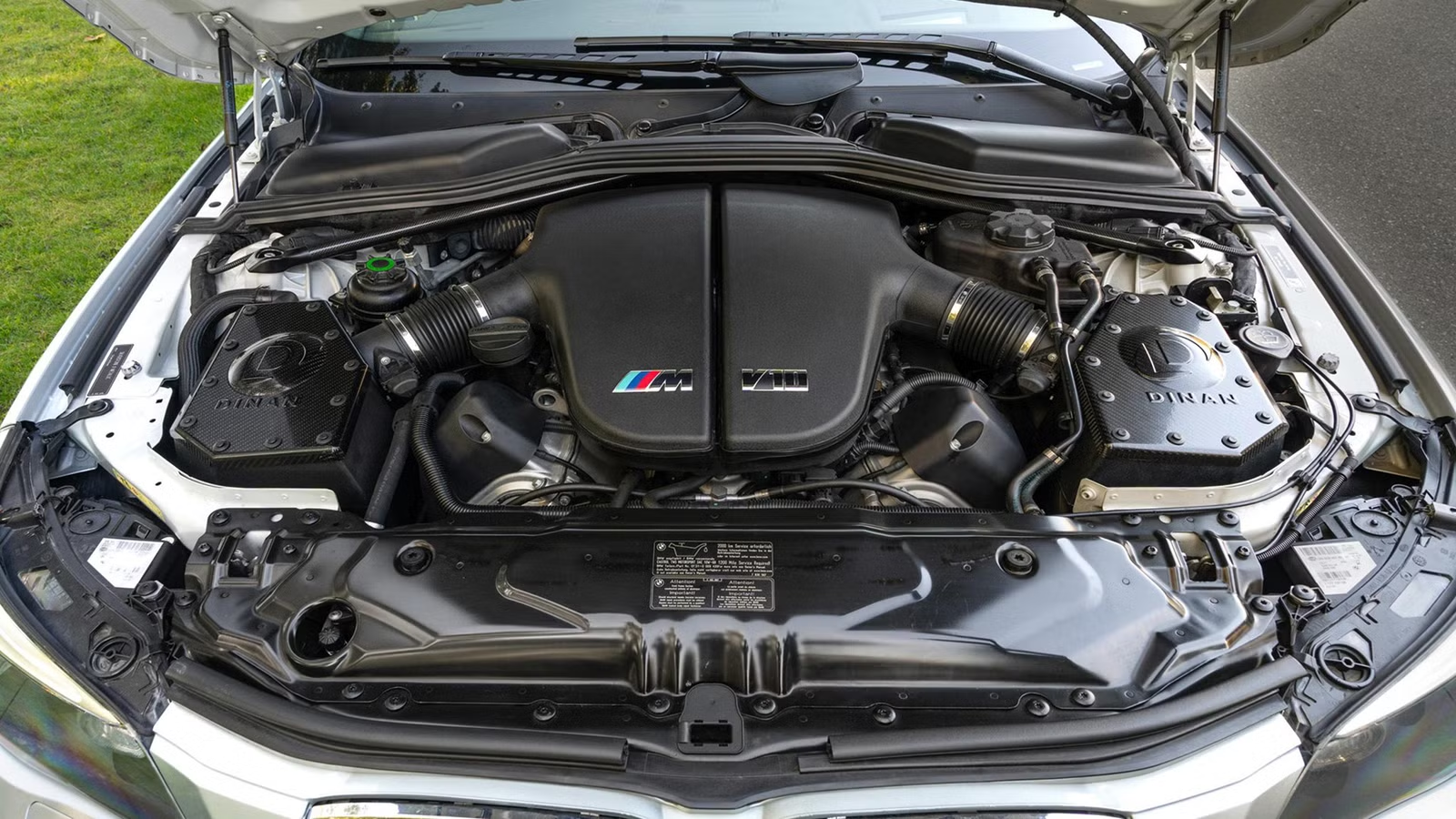
In 2004, the Bavarian brand launched the E60-generation BMW M5 with an insane S85 5.0-liter naturally aspirated V-10 engine. This unit incorporated Formula One-inspired mechanical engineering directly into a midsize luxury sedan platform. This high-revving engine produces 500 horsepower at 7,750 RPM and 383 pound-feet of torque at 6,100 RPM. Engine output routes exclusively to the rear wheels via an automated seven-speed Sequential Manual Gearbox with launch control.
The American market benefited from an exclusive six-speed manual option. With the SMG transmission engaged, acceleration from 0 to 60 MPH takes 4.1 seconds. Top speed remains electronically governed at 155 MPH in standard specification. However, opting for the factory M Driver’s Package raises this limit to 190 MPH, while unrestricted configurations allow the sedan to exceed 200 MPH.
Key Design Elements That Made It Outrageous

The S85 engine features an aluminum-silicon alloy bedplate block with a 92 mm bore and 75.2 mm stroke. This configuration provides a high-revving, short-stroke 90-degree layout. Lightweight forged aluminum pistons feature oil-spray cooling jets, while forged steel connecting rods attach to a cross-plane forged steel crankshaft with six main bearings. A cross-bedplate reinforcement replaces individual main bearing caps, increasing torsional rigidity to support an 8,250 RPM redline. Twin aluminum four-valve cylinder heads house double-overhead camshafts with dual-VANOS variable valve timing and hydraulic valve lifters.
Ten individual, electronically actuated throttle bodies optimize intake airflow, feeding high-velocity air into twin plenum chambers. A quasi-dry-sump lubrication system utilizes four oil pumps, including two electrically operated scavenge pumps, to prevent oil starvation during high lateral acceleration. Sodium-filled exhaust valves improve thermal dissipation, while a fully digital Siemens MS S65 engine management unit conducts millions of calculations per second to optimize ignition timing, ionic current knock control, and fuel injection across all ten cylinders simultaneously.
How BMW Optimized The Family Sedan’s Suspension

The E60 M5 replaces standard 5 Series suspension components with track-oriented hardware to manage high lateral forces and extreme velocity. Up front, a double-pivot MacPherson strut layout utilizes forged aluminum control arms, stiffened subframes, and recalibrated geometry to widen the track width over base models. The rear features an integral-IV aluminum multi-link setup paired with a variable M differential lock, which actively transfers power across the rear axle based on wheel slip. Dynamic Damper Control replaces fixed shocks, providing three distinct electronically adjustable damping modes. Stiffer anti-roll bars, firmer bushings, and reinforced mounting points improve structural rigidity and decrease body roll relative to non-M variants.
Braking performance relies on massive compound brake rotors measuring 12.7 inches at the front and 14.6 inches at the rear. These cross-drilled, radially vented cast-iron rotors attach to aluminum hubs via floating pins, reducing unsprung mass and preventing thermal warping under heavy track use. Two-piece aluminum floating calipers grab these rotors, providing superior stopping power and heat dissipation over single-piece steel setups on standard models. Steering feedback sharpens through a model-specific Servotronic hydraulic rack featuring two selectable assistance maps, replacing standard 5 Series steering units.
An Engine That Requires High Maintenance To Keep Going

Servicing the S85 V-10 engine requires strict adherence to strict preventive schedules due to its high-revving nature and tight tolerances. Routine oil changes require 10W-60 synthetic oil every 5,000 miles or 12 months, costing between $150 and $250 for DIY parts or $350 to $500 through specialized independent shops. Spark plug replacement occurs every 37,000 miles, with total costs ranging from $300 to $600 depending on labor. The ionic current ignition system uses ten dedicated ignition coils, which typically require replacement every 60,000 miles at a cost of $600 to $1,000.
Additionally, fluid services for the rear differential, manual or SMG transmission, and hydraulic steering systems need servicing every 30,000 miles, adding roughly $400 to $800 per interval. Annual routine maintenance costs for the S85 generally average between $1,500 and $2,500, excluding major component wear. Several critical factory defects plague the S85 engine, primarily stemming from tight internal clearances and electrical component degradation. Accelerated rod bearing wear poses the most severe mechanical threat. This is due to tight factory tolerances that strip lubrication from the rod bearing, leading to premature failure and catastrophic engine lockup.

Replacing rod bearings preventatively every 60,000 to 80,000 miles costs between $2,500 and $4,000, whereas engine replacement following failure exceeds $15,000 to $20,000. Throttle valve actuator failure represents another widespread issue caused by internal plastic gear wear and board circuit overheating. Replacing both units costs $1,200 to $2,200. The high-pressure VANOS system frequently experiences internal oil line leaks, pump gear failure, and solenoid breakdown. A full VANOS system overhaul, including line replacement and pump rebuilding, costs between $3,000 and $6,000.
Factory recalls affecting the early S85 engine focus primarily on lubrication systems and structural safety components. Early 2006 production models were subject to a recall concerning the high-pressure VANOS oil line, where flexible internal hoses could rupture under extreme oil pressures, leading to rapid pressure loss and immediate engine damage. Dealers replaced these lines under warranty with upgraded metal-braided hoses. Another major recall affected the engine’s auxiliary equipment, specifically targeting early electric battery cable connections in the trunk that posed a potential fire hazard and directly interrupted power supply to the Siemens MS S65 engine management unit.
Used Values Are Steadily Increasing

In its final 2010 model year, the E60 BMW M5 carried an original base MSRP starting at $85,700, though fully optioned examples quickly climbed past $90,000. On today’s used market, standard valuation platforms like J.D. Power and Edmunds report average trade-in and retail transaction values for typical high-mileage, driver-condition models ranging between $10,000 and $16,000.
However, collector interest creates a vast price divergence on auction platforms such as Bring a Trailer. On enthusiast market sites, well-maintained driver-quality examples with documented maintenance routinely fetch between $20,000 and $35,000, while highly desirable low-mileage cars or rare six-speed manual variants consistently sell from $45,000 to over $80,000. Exceptionally pristine, ultra-low-mileage museum-grade time capsules have even reached historic six-figure auction highs exceeding $150,000.
BMW Never Replicated The E60 M5 Strategy Again

The 2026 BMW M5 represents a complete design philosophy shift from the foundations created by the E60 generation. While the E60 relied on a motorsport-derived, high-revving, naturally aspirated 5.0-liter V-10 delivering linear power through a pure rear-wheel-drive layout, the 2026 model embraces modern electrification and forced induction. It pairs a twin-turbocharged 4.4-liter V-8 engine with an electric motor to form a plug-in hybrid powertrain that generates 717 hp and 738 lb-ft of torque. Unlike the raw, high-RPM atmospheric mechanicals of the E60, the new platform prioritizes immediate torque delivery, energy efficiency, and all-weather traction via a rear-biased xDrive all-wheel-drive system.
This hybrid technology drastically increases performance metrics, but it also elevates the vehicle’s curb weight to nearly 5,400 pounds. This is a stark departure from the lightweight, high-strung, purist character of the E60. Inside, analog driver feedback gives way to advanced digital chassis control systems, dynamic drive modes, and seamless torque vectoring. Ultimately, the 2026 M5 exchanges the unassisted, track-focused mechanical purity of its predecessor for hyper-car levels of hybrid output, everyday digital refinement, and heavy all-wheel-drive capability.
Sources: BMW, BMWBlog, RepairPal, Edmunds, J.D. Power, and Bring a Trailer.

Related posts



Latest Post


No Comments