
8 Forgotten American Cars That Were Way Ahead of Their Time
Credit where it’s due: American automakers have always had a streak of genuine audacity. Long before turbochargers, crossovers, and anti-lock brakes became industry fixtures, a handful of U.S. manufacturers were already building them into production cars that anyone could walk into a dealership and buy. These weren’t show cars or engineering exercises — they were real vehicles that arrived on the market years, sometimes decades, ahead of the technologies they pioneered.

Some of these cars failed commercially, others faded into niche collector circles, while a few paved the way for future models. Regardless, all of them helped move the needle in the right direction. In a time when most vehicles stuck to a formula, these outliers dared to challenge it. These are eight forgotten American cars that were way ahead of their time.
1962 Oldsmobile Jetfire
The First Turbocharged American Production Car
Before turbochargers became commonplace for both performance and fuel efficiency, the 1962 Oldsmobile Jetfire dared to be different. It was a true pioneer, holding the distinction as the world’s first turbocharged mass-produced model, beating European rivals to market and making it profoundly ahead of its time. Oldsmobile engineers strapped a Garrett AiResearch turbocharger to its 3.5-liter “Rocket” V8, boosting output from 185 hp to 215 hp and torque from 230 lb-ft to 300 lb-ft.


Its downfall — and the reason it became “forgotten” — stemmed from its unique “Fluid-Injection” system. To prevent pre-ignition at higher boost pressures, the engine required a special mixture of distilled water and methyl alcohol, dubbed “Turbo Rocket Fluid.” Owners frequently neglected to refill this fluid, leading to reduced performance and engine damage, which ultimately caused Oldsmobile to discontinue the feature quickly. Despite its mechanical quirks, the Jetfire undeniably laid the foundation for the widespread adoption of forced induction. Today, the Jetfire rarely surfaces in mainstream collector circles, and since most owners had the Turbo Rocket Fluid system deleted, finding one in original condition is exceptionally rare.
1963 Jeep Wagoneer
The Original Luxury SUV

Decades before the term “SUV” entered mainstream lexicon and luxury SUVs became a segment unto themselves, the 1963 Jeep Wagoneer redefined what an off-road vehicle could be. It wasn’t just a utilitarian workhorse; it blended genuine 4×4 capability with passenger-car levels of comfort and convenience, making it the undisputed first luxury SUV and placing it far ahead of its time in anticipating a massive market shift.

The Wagoneer pioneered several features now standard in SUVs. It was the first 4×4 to offer an automatic transmission, making it far more accessible to a broader audience than traditional, manual-only off-roaders. It also introduced amenities like an available independent front suspension, power steering, and air conditioning to the utilitarian 4×4 segment, effectively creating the blueprint for the modern, family-friendly SUV. Its body-on-frame construction made it tough and capable off-road, while its surprisingly sophisticated interior elevated the driving experience. Despite its foundational impact, many enthusiasts overlook the Wagoneer’s revolutionary status, making it a truly forgotten trailblazer.
1940 Oldsmobile Series 60 / Series 70
First Mass Produced Automatic Transmission

The 1940 Oldsmobile Series 60 and 70 models offered the world’s first mass-produced fully automatic transmission: the Hydra-Matic. Built by General Motors, this four-speed unit eliminated the clutch pedal and used a fluid coupling and planetary gearsets to shift automatically. The Hydra-Matic fundamentally changed how Americans — and eventually the world — drove. At a time when stop-and-go city driving made manuals tedious, it made getting behind the wheel easier and more accessible than ever.

While the system didn’t use a torque converter yet, its performance and ease of use set a new standard. Within two decades, automatics became the norm in the U.S., thanks to this foundational design. Today, few outside Oldsmobile circles remember which car started it all — yet the Hydra-Matic quietly reshaped the driving experience for the entire world.
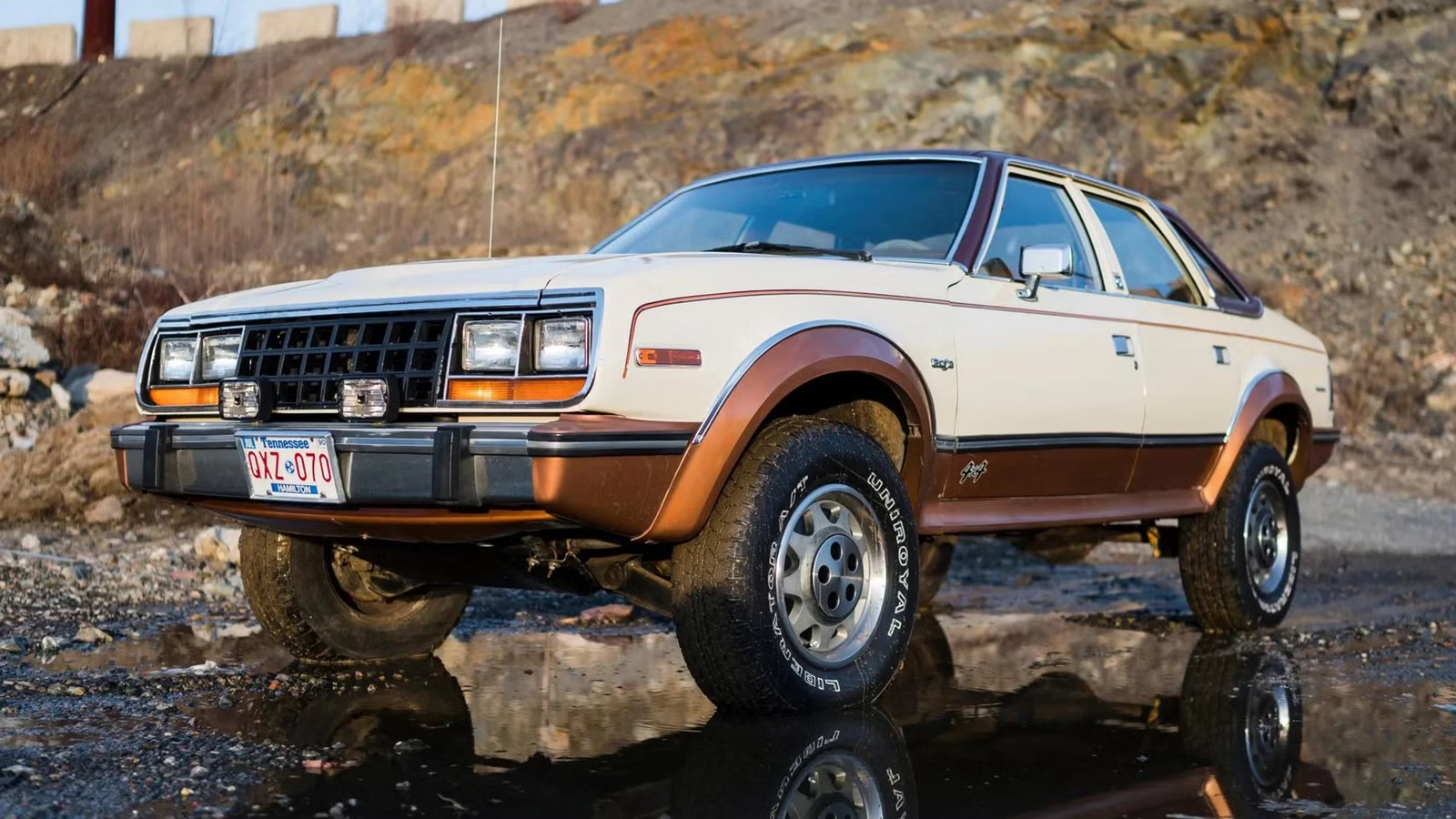
1980 AMC Eagle
The Crossover Pioneer

The 1980 AMC Eagle arrived decades before the term “crossover” existed, yet it laid the groundwork for the entire segment. Built on a unibody platform, it offered sedan and wagon body styles paired with a raised suspension and a full-time all-wheel-drive system. At its core was a viscous coupling center differential that split power between the axles without any driver input — a feature rare even in most 4×4 trucks of the era.

That setup delivered confident traction in poor weather while preserving the ride comfort, fuel economy, and handling of a traditional passenger car. The Eagle’s value wasn’t in outright horsepower or torque figures — it was in how it redefined everyday versatility. It quietly predated the Subaru Outback and modern crossovers by more than a decade. Despite its influence, the AMC Eagle rarely gets the credit it deserves for pioneering the crossover concept.
1934 Chrysler Airflow
The First Aerodynamic Streamliner Automobile

The 1934 Chrysler Airflow introduced America to the concept of streamlining, making it the first mass-produced car designed around aerodynamics. It was also marketed as the Airflow Imperial and the DeSoto Airflow. Developed with input from aircraft engineers and refined through wind tunnel testing at MIT, the Airflow’s teardrop shape sharply contrasted the upright, grille-dominated cars of the era. According to Hagerty, it reduced drag by as much as 20 percent over conventional designs — a figure that directly impacted both performance and efficiency.

For the Airflow, Chrysler also implemented unitized body construction, integrating the frame and body into a single structure. This improved structural rigidity, safety, and ride quality. Engineers moved the engine forward and positioned the cabin within the wheelbase, creating better weight balance and a more comfortable interior layout. Still, buyers rejected the unconventional look, and sales flopped. While its styling doomed it in the short term, the Airflow’s innovations would later become industry standards, paving the way for cars like the Tatra 87, McLaren Speedtail, Volkswagen XL1, and the Hyundai Ioniq 6.
1958 Cadillac Eldorado Brougham
First Car With Self-Leveling Air Suspension

The 1958 Cadillac Eldorado Brougham pushed the boundaries of luxury and innovation in ways few cars dared. It was the first production car to feature a self-leveling air suspension system, designed to maintain consistent ride height regardless of load. The system used pressurized air in place of steel springs and aimed to deliver a smoother, more composed ride. Though advanced for its era, the technology wasn’t fully mature — frequent failures led many owners to convert to conventional suspension setups.

Still, the Brougham didn’t stop there. It also featured power memory seats, a vacuum-actuated cruise control system, and an automatic trunk opener. In total, it packed over 40 standard features, many of which wouldn’t become common for decades. Despite its groundbreaking technology, high cost and maintenance issues meant that only 400 Eldorado Broughams were sold in its first model year, and even fewer — a mere 304 — in the year that followed. As a result, the Eldorado Brougham became one of those forgotten American cars that were way ahead of their time, quietly influencing luxury benchmarks for generations.
1971 Imperial
First Car With Early 4-Wheel ABS (Sure-Brake System)

The 1971 Imperial introduced a major leap in automotive safety with its Sure-Brake system — the first four-wheel electronically controlled anti-lock braking system on a production car. Developed by Bendix, Sure-Brake used wheel speed sensors and an onboard electronic control unit to detect when a wheel was about to lock up under heavy braking. It would then modulate hydraulic pressure at each wheel, reducing the chance of skidding and helping the driver maintain steering control.
Unlike the Ford Thunderbird’s earlier system, which only worked on the rear wheels, the Imperial’s setup managed all four. While it added complexity and cost, it brought a new level of active safety to American luxury sedans. Despite its significance, most drivers weren’t ready to appreciate the technology. Chrysler’s Sure-Brake system predated the modern ABS unit from Bosch, which debuted in the Mercedes-Benz S-Class in 1978. Few remember the 1971 Imperial today, but its role in the evolution of ABS makes it a clear example of a forgotten American car that was way ahead of its time.
1966 Oldsmobile Toronado
First Volume-Produced American Front-Wheel Drive Car

The 1966 Oldsmobile Toronado was the first volume-produced American front-wheel-drive luxury car in decades and the first to pair FWD with serious power. It used a 7.0-liter Rocket V8 producing up to 385 hp and 475 lb-ft of torque — figures that were virtually unheard of in a front-wheel-drive application at the time.
Oldsmobile engineered a unique solution to handle this: the Turbo Hydra-Matic 425 transmission with a chain-drive setup that packaged the transmission and differential into a single compact unit, eliminating the driveshaft and freeing up cabin space with a flat floor.

The 1966 Toronado proved that FWD could manage real power and deliver confident handling in a big, heavy coupe weighing around 4,500 pounds. Though it earned praise from engineers and critics alike, its drivetrain layout didn’t catch on in performance circles until years later.
Sources: Chevrolet, Chrysler, Cadillac, Hagerty, RM Sotheby’s, GM Heritage Archives, Mecum Auctions, SAE

Related posts


Latest Post


No Comments