
The Turbo Honda Hatch That Predicted Everything the Civic Si Became
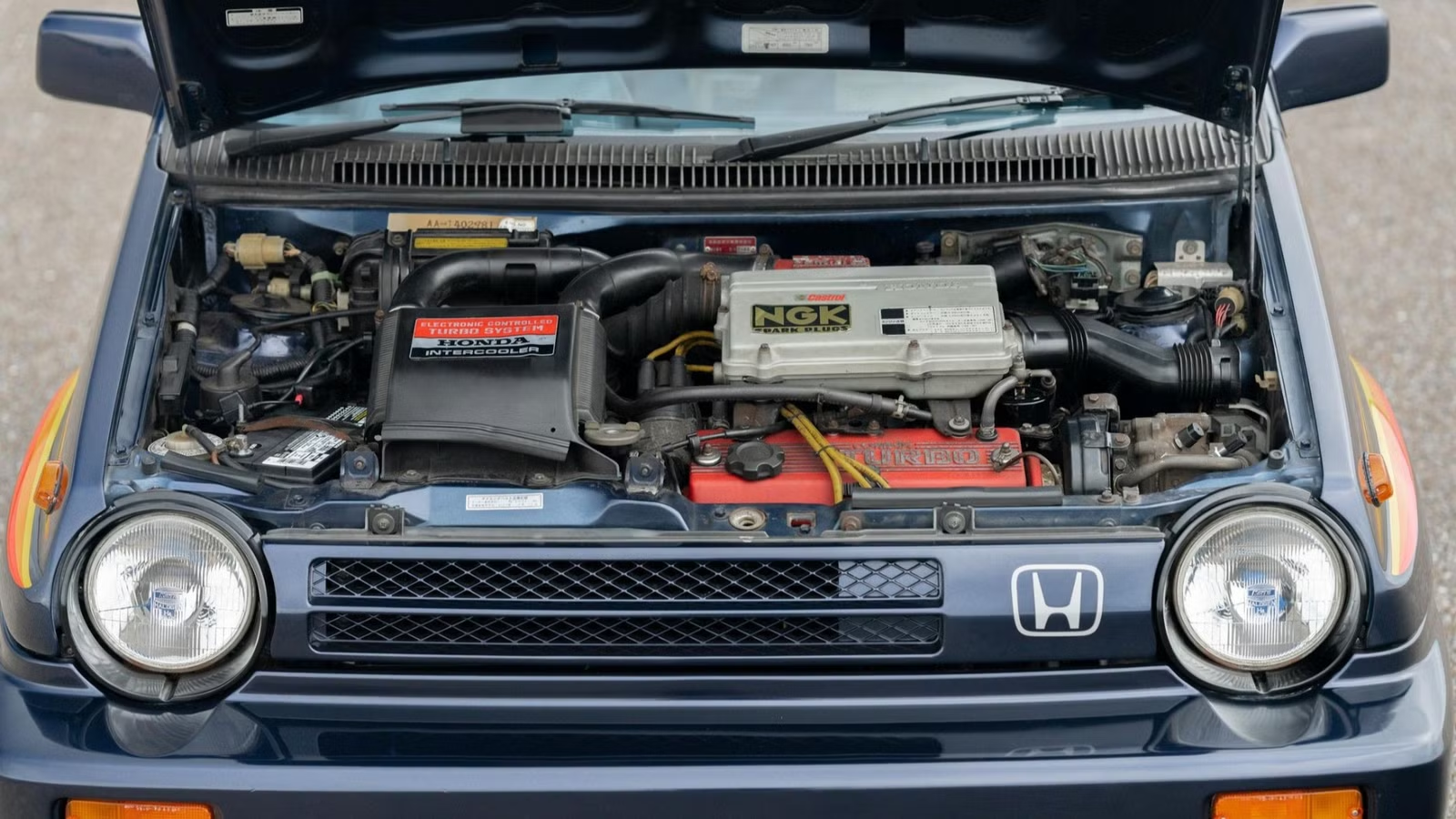
Ask a Honda fan where the brand’s hot hatch story begins, and you’ll usually hear about twin cams, VTEC, and red badges. That answer skips a chapter. In the early ’80s, before any of those famous names reached a showroom, Honda quietly built a tiny hatchback with an intercooled turbo, a factory overboost function, and a family connection to the most famous tuner in the Honda world. Most enthusiasts outside Japan still file it under novelty. The engineering says it deserves far more respect than that.
How Honda Entered The Turbo Era

Turbocharging wasn’t a natural fit for Honda. The company built its reputation on small, efficient engines that revved hard without help; turbos had, traditionally, not been Honda’s preferred route to performance. That made Honda’s eventual turbo debut all the more surprising, because the company didn’t start with a sports car or a luxury flagship.
When Honda finally committed, it went small rather than big. Its first turbocharged production car arrived in 1982 as a compact hot hatch, and Honda billed its engine as the world’s smallest turbo unit of its kind. That car also introduced PGM-FI, the electronic fuel injection system that would go on to feed generations of performance Hondas.
The bigger story came a year later. Honda’s follow-up pushed forced induction further than anyone expected from a car this size, and it did so with hardware no rival in its class had yet fitted.

The Unlikely Commuter Car Honda Chose To Turbocharge

The base car was about as unthreatening as Honda got. Its development team, whose engineers averaged just 27 years of age, set out to build the ultimate fuel economy car for the 1980s, with a tall, boxy body that fit four adults into an impossibly short footprint. It was clever, practical, and aimed squarely at young city drivers rather than track-day regulars.
The push toward performance came from inside the Honda family itself. Soichiro Honda’s son had spent years building race cars and running his own tuning company, and he saw something in this little commuter that the rest of the industry missed. His turbocharged prototype impressed Honda’s management enough to change the car’s future entirely.
The production version went on sale in 1982 and collected a shelf of Japanese honors, including first place among high-performance mass-market cars in Nikkei’s 1982 new model rankings. It was quick and well loved, but it was only the opening act. The car that matters here took that formula and added the one component no rival in its class had yet fitted.
The Honda City Turbo II ‘Bulldog’ Explained

Honda announced the City Turbo II on October 26, 1983, a full year before the first Civic Si arrived in Japan. Its turbocharged 1.2-liter CVCC four made 108 horsepower at 5,500 rpm and 118 lb-ft at just 3,000 rpm, according to Honda’s own factbook. Those are big numbers from a small engine, but the real story is what they had to move.
Honda listed the City Turbo II at 1,620 lbs, which works out to roughly 15 lbs per hp. That ratio put it among the best of any Japanese sports model of its day, and a period magazine test reportedly ran 0 to 62 mph in just under nine seconds, outpacing sporty models with 1.6-liter engines. Honda also widened the body by more than two inches, adding blistered fenders, a deep air dam, and 185/60 tires on 13-inch wheels, and the stocky stance quickly earned it the Bulldog nickname.
The Intercooler And Scramble Boost That Set It Apart

The intercooler is what made the Bulldog special. Honda’s official launch release called it the first intercooled car in its 1.2-liter class, and said it ran 0.85 kg/cm2 of boost, roughly 0.83 bar or 12 psi, which Honda claimed was the highest of any unleaded gasoline car in the world. Honda also let PGM-FI manage the wastegate, giving the electronics direct control over boost pressure.
Then there was Scramble Boost. Floor the throttle below 4,000 rpm, and the system raised boost by about 10% for up to 10 seconds—a factory overboost that worked automatically, with no button required. Inside, bucket seats and digital speedometer and tachometer readouts confirmed it was built to be driven hard.
The Bulldog’s Place In Honda’s Hot Hatch Bloodline

The Turbo II shares nothing mechanical with a Type R engine, and pretending otherwise would be wrong. It used a single-cam, three-valve CVCC four, while Honda’s later performance icons relied on twin cams and high-revving VTEC. A gearhead would rightly laugh at any claim of direct engine lineage.
The connection is philosophy rather than parts. The Bulldog took a light, cheap, ordinary Honda and squeezed startling specific output from it, roughly 88 hp per liter from a production engine in 1983. It treated the whole car as a performance package, with wider track, bigger brakes, and serious seats—which is exactly the recipe Honda’s later hot hatches followed.
The Mugen Connection Behind The City Turbo

That philosophy came from Mugen. Hirotoshi Honda, Soichiro’s son, founded the tuning firm with Masao Kimura in 1973, and the City Turbo itself began as Hirotoshi’s own creation. Honda was so impressed by his turbocharged prototype that it turned the idea into a production car, an early case of a Mugen performance concept going straight into a factory Honda.
Mugen stayed involved after launch, too. Honda and Mugen ran a one-make racing series for Mugen-prepared City Turbos, and for 1984 the series switched to Turbo IIR race cars with roughly 140 hp. A tuner’s idea becoming a factory model, then a factory-backed race series, shows how closely Honda and Mugen worked even then. Japanese Nostalgic Car goes as far as calling the City Turbo the forebear of modern Honda performance, and the Bulldog is its finest form.
What A Honda City Turbo II Costs Today

Every City Turbo II is well past the 25-year import rule, so right-hand-drive JDM imports now turn up at American auctions, and Tennessee’s Lane Motor Museum even keeps a City Turbo in its collection. Prices have climbed with the car’s cult status. A 1983 Turbo II sold for $21,000 in October 2025, listed with a Motocompacto, Honda’s modern electric take on the scooter rather than an original. The highest recorded sale reached $47,000 for a 1984 Turbo II sold with two Motocompos in March 2022.
That gap settles the Motocompo question. The 49cc folding scooter was designed to fit in the City’s cargo area, and Honda famously advertised the City with the British ska band Madness. Today the scooter isn’t a novelty extra; it’s part of the package. A Bulldog with an original Motocompo is the version to buy, and the record price went to a car sold with two of them.
For a car that once looked like a punchline, that’s quite a turnaround. The City Turbo II brought an intercooler, Scramble Boost, and Mugen’s thinking to a factory Honda a year before the Civic Si arrived, and collectors are finally pricing in that history.
Sources: Gazoo, Honda, Cars & Bids, Classic.com

Related posts


Latest Post


No Comments