
Honda’s Flat-Six Cruiser Had More Presence Than a Harley
Cruiser culture has always belonged to a very specific formula: a booming V-twin, acres of chrome, and a badge that carries decades of Americana behind it. Honda understood that formula perfectly well, and for years its own cruisers played along with it politely. Then, in the late 1990s, an engineering team inside the company decided the formula was entirely optional. What came out of that decision still confuses onlookers who spot one parked outside a diner, wondering exactly what they are looking at.
The Cruiser Class Everyone Thought They Understood

By the mid-1990s, the cruiser segment had settled into an unspoken agreement. Buyers wanted a V-twin, a low seat, and a silhouette that traced back to the 1950s. Manufacturers outside the United States had spent years chasing that formula with their own twins, hoping a slice of the market would notice the difference in fit, finish, and reliability.
Few people expected a serious challenge to arrive with six cylinders instead of two. Fewer still expected it to come from a company better known at the time for building sensible commuter bikes and touring rigs. The cruiser buyer’s mental image of what counted as authentic left almost no room for a smooth, high-cylinder-count engine wearing custom bodywork. That gap between expectation and reality is exactly where this story lives.
A Motor Built For A Different Kind Of Bike Entirely


The engine at the center of this story was never designed with a cruiser in mind. It started life as the powerplant for one of Honda’s most comfort-focused touring machines, a bike built for crossing continents rather than posing outside a bar. Smoothness was the entire point of its layout, and that layout was about as far from a traditional cruiser motor as an engineer could reasonably get.
A small group inside Honda saw an opportunity that the rest of the lineup had overlooked. If that touring engine could be stripped down, re-tuned, and dropped into a leaner, more aggressive chassis, the result might turn cruiser convention on its head. The idea was unusual enough that it took years of internal debate before Honda greenlit it for production. What emerged from that process would carry an engine layout no other cruiser on sale at the time could match.
The Honda Valkyrie Wears The Gold Wing’s Heart On Its Sleeve

The bike in question is the Honda Valkyrie, and it justified the internal debate that preceded it. Honda took the horizontally opposed six-cylinder engine from its fourth-generation Gold Wing, a 1,520cc unit designed for effortless, vibration-free touring, and reworked it for a naked custom cruiser instead. The engine produced 100 hp at 6,000 rpm and 96 lb-ft of torque at 5,000 rpm, figures that made it one of the most powerful cruisers money could buy when it launched. A period road test recorded a radar-measured top speed of 128 mph, a number few traditional cruisers of the era came close to touching.
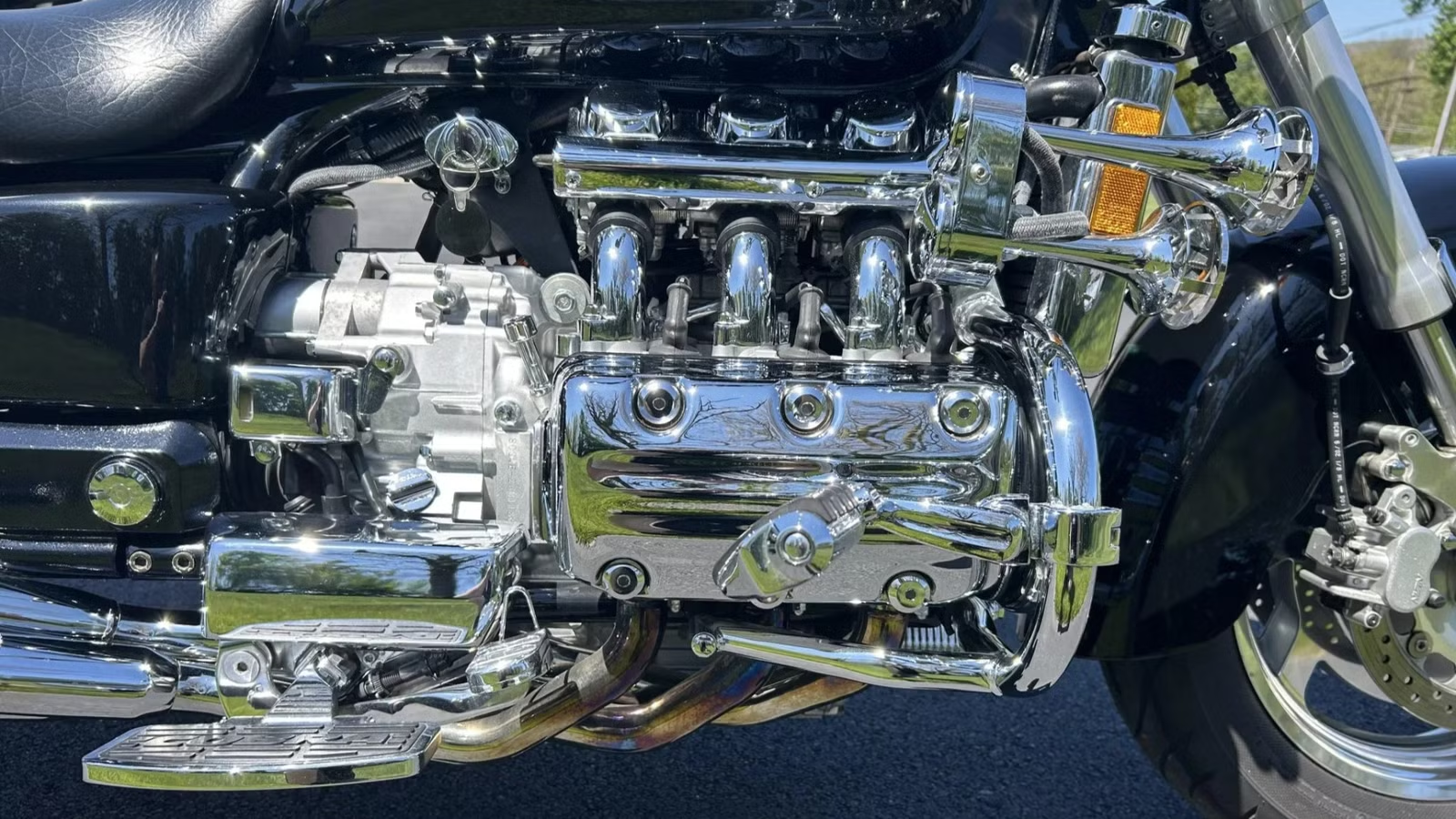
Those figures alone made the Valkyrie interesting. What made it disruptive was how that power arrived. A flat-six spins smoother than any V-twin ever could, and Honda leaned into that trait rather than hiding it. The engine sat fully exposed in the frame, chrome-plated and unmistakable, turning what could have been a niche engineering exercise into a rolling statement about what a cruiser was allowed to be.
Six Carburetors And A Sound Nothing Else Made

Honda fed the flat-six with six individual 28 mm Keihin carburetors, one per cylinder, rather than a simplified shared setup. That decision kept the engine responsive and smooth across its rev range, but it also gave the Valkyrie a mechanical signature no other cruiser on the road could replicate. Riders and mechanics who grew up on V-twins found the induction note genuinely startling the first time they heard it.
Maintaining six carburetors instead of one or two also meant more work at service time, and that reputation followed the Valkyrie throughout its production run. Enthusiasts largely accepted the tradeoff. A properly synchronized set of six carbs rewarded owners with a level of smoothness that a V-twin, by its very architecture, was never going to deliver.
Styling That Matched The Engineering Ambition

An engine this unusual needed bodywork willing to show it off, and Honda obliged. The frame left the flat-six almost entirely exposed, with wide, swept-back cylinder banks visible from either side of the bike. Paired with a teardrop fuel tank, a wide handlebar, and generous chrome trim, the Valkyrie looked every bit as substantial as the American cruisers it was aimed at, and in person it arguably looked heavier and more mechanically dramatic than most of them.
That presence is exactly why the comparison to Harley-Davidson holds up. A contemporary Harley-Davidson Fat Boy, one of the most recognizable American cruisers of the same era, ran a 1,340cc Evolution V-twin producing roughly 67 hp and 72 lb-ft of torque. On paper and on the road, the Valkyrie had more going on, both mechanically and visually, than the bike most buyers still considered the benchmark. Honda stopped building the Valkyrie decades ago, so the only market left is the used one, and broader market analysis suggests the Valkyrie’s average sale price lands near $4,984, while comparable Fat Boy sale data shows period examples trading in a similar range.
The Six-Into-Six Exhaust That Announced Its Arrival

Nothing sold the Valkyrie’s mechanical theater quite like its exhaust. Rather than merging six cylinders into a pair of mufflers, Honda ran a full six-into-six system, with six individual pipes sweeping back along each side of the bike. It was a genuinely rare layout on a production motorcycle, and it turned every start-up into a small event.
Owners who wanted an even louder statement often swapped in aftermarket six-into-six setups, and the bike’s whole design seemed to invite that kind of attention. Few cruisers, regardless of badge, offered an exhaust layout this visually and audibly distinctive straight from the factory floor.
Why This Engine Never Really Went Away

The Valkyrie never outsold the traditional V-twin cruisers it was aimed at, and Honda eventually let the model wind down in the early 2000s. That commercial reality does not diminish what the bike proved. A flat-six engine, borrowed from a touring machine and reworked for a naked custom, could hold its own against the segment’s biggest names on power, smoothness, and sheer road presence.
Its legacy persists among riders who value mechanical originality over badge loyalty, and clean examples remain a favorite with owners looking for something a V-twin simply cannot replicate. Against the cruisers it was built to challenge, the Valkyrie still stands as proof that presence was never solely a matter of displacement or heritage. Sometimes it just took an engineering department willing to break the formula entirely.
Sources: Bring a Trailer, Classic.com.

Related posts


Latest Post


No Comments