
Before Turbo Fours Took Over, These Three Family-Sedan V6s Ran Mid-5s To 60
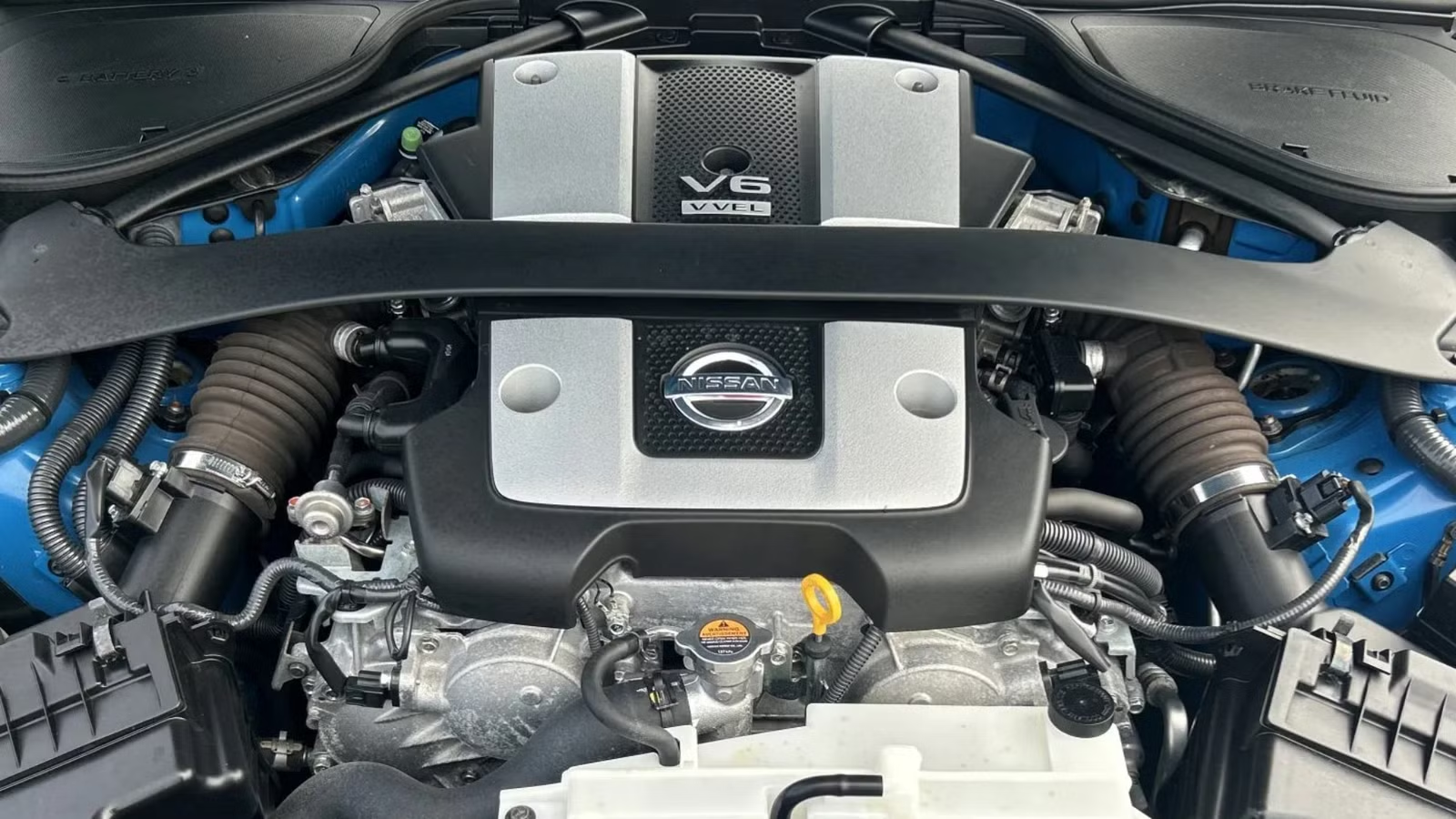
For a brief stretch of the 2000s and 2010s, the family sedan became a wonderfully strange place to find serious performance. Automakers were still putting naturally aspirated V6s into ordinary four-doors, giving commuters enough power to make some sport sedans look a little less special in a straight line. The funny part was that these cars rarely looked the part. They were built for families, groceries and daily commutes, yet some could reach 60 mph in the high-five-second range. Before turbocharged four-cylinders became the default answer, three very different V6s showed just how entertaining a boring sedan could be.
The Family Sedan Was Still Allowed To Be A Little Ridiculous

There was a time when buying a family sedan didn’t automatically mean accepting a small turbocharged four-cylinder under the hood. If you wanted something sensible, manufacturers would happily sell you one with four cylinders. But if you wanted a little more shove, there was often a naturally aspirated V6 sitting higher up the range.
These engines didn’t need turbochargers to make useful power. They simply gave ordinary sedans enough engine to make the daily drive considerably more interesting. And because the V6 was usually an option rather than the whole point of the car, you could have serious pace without driving around in something that screamed “performance model.” That was the magic of these cars. The styling could stay conservative, the ride could stay comfortable and the cabin could remain perfectly happy hauling a family across town. Under the hood, though, there was enough muscle to turn an ordinary on-ramp into something worth looking forward to.
The sleeper effect was almost unavoidable. There was no giant wing, no enormous exhaust outlet and nothing to suggest it was hiding close to 300 horsepower worth of attitude. Park one next to a more obvious performance car and it could disappear into the background. Then you pulled away from a stoplight.

The Six-Cylinder Formula Was About More Than Horsepower
The appeal of these V6s wasn’t just the number printed on the specification sheet. Naturally aspirated engines delivered their power differently from the turbocharged fours that would eventually replace them. There was no waiting for boost to arrive. Press the throttle and the engine responded, with power building in a predictable, linear way as the revs climbed.
A good naturally aspirated V6 also had a smoothness that suited a family sedan perfectly. It could be quiet and relaxed when you wanted it to be, then turn much more eager the moment you leaned on it. There was also the character. Six cylinders have their own sound and rhythm, and an engine that’s happy to rev can make an otherwise ordinary commute feel like something more than a trip to the grocery store.

None of that means these cars suddenly became BMW 3 Series rivals simply because they had strong acceleration. Most were front-wheel drive, tuned primarily for comfort and daily usability, and nowhere near a dedicated sport sedan when it came to handling, steering or chassis balance. But that was almost the point. They didn’t need to be sports cars. They only needed to be unexpectedly quick.
Honda Hid A Serious V6 Inside An Ordinary Accord

The eighth-generation Honda Accord, sold from 2008 to 2012, was one of the clearest examples of the formula. From the outside, there was little reason to get excited about the family sedan sitting in the driveway. Honda had built its reputation around sensible transportation, and that was exactly what most buyers wanted from it.
Under the hood, however, things got a lot spicier. The U.S.-spec Accord V6 used Honda’s 3.5-liter J35-series engine, rated at 268 horsepower and 248 lb-ft for 2008, the most power Honda had ever put in an Accord. The brand revised those figures to 271 hp and 254 lb-ft from 2009 without touching the hardware. Honda said production testing had revealed that the engines were producing more power than originally estimated. That torque made the car feel effortless in everyday driving, while the V6’s willingness to rev gave it a personality the four-cylinder models simply couldn’t match.

The sedan was the real sleeper here. Honda didn’t give it the visual drama of a dedicated performance model, and it looked like an Accord because it was an Accord. The coupe made the enthusiast case even more obvious. With a six-speed manual available alongside the V6, it could hit 60 mph in the high-five-second range in period testing. The automatic-only sedan was slower, with results varying by test and year.
There’s one important asterisk for anybody looking at one today. Automatic V6 Accords use Honda’s Variable Cylinder Management, and the system’s habit of fouling spark plugs and triggering misfires led to a class-action settlement covering specified model years and an extended warranty for qualifying misfire-related issues. The twist is that the six-speed manual coupe skipped VCM entirely, which gives enthusiasts one more reason to hunt down the three-pedal car.
Nissan And Volkswagen Took The Same Idea In Very Different Directions

Honda wasn’t alone in figuring out that a family sedan could handle far more engine than its styling suggested. Nissan took the formula and pushed it to an even 300 hp with the 2016 Maxima 3.5 SR. Its naturally aspirated 3.5-liter VQ-series V6 made 261 lb-ft of torque and sent everything through the front wheels and a continuously variable transmission. On paper, that sounds like an odd combination. In reality, it made the Maxima a seriously quick family sedan.
Depending on the test, the 2016 Maxima could run from 0 to 60 mph in the high-five-second range. Nissan even leaned into the idea by calling the Maxima a “4-Door Sports Car,” and it embossed “4DSC” into the headlights and taillight reflectors so nobody forgot it. The SR trim gave the car a sportier personality, adding paddle shifters and even deleting the panoramic sunroof to save weight and lower the center of gravity. Underneath, it was still a practical four-door with room for passengers and a usable trunk. The difference was that its V6 had enough muscle to make the commute a lot less boring.

Volkswagen went in a completely different direction with the Passat. The 3.6-liter VR6 was the oddball of this group, and arguably the most technically interesting engine here. Volkswagen’s narrow-angle VR6 design used a bank angle of just 15 degrees, allowing six cylinders to be packaged unusually compactly. That was particularly useful for Volkswagen’s transverse-engine layouts, where space under the hood was hardly unlimited. In U.S. specification, the Passat 3.6 produced 280 hp. It was a very different proposition from the Maxima, leaning harder into the refined, understated European-sedan idea, and it looked almost painfully sensible doing it.
The acceleration figures need a little context, though. Early Passat 3.6 testing, with a conventional six-speed automatic, was slower than the later cars, while a 2016 Passat V6 SEL Premium with the dual-clutch DSG transmission managed a 5.7-second 0-60 mph run. Transmission and model-year differences matter here, so treating every Passat 3.6 as a guaranteed 5.7-second car would be misleading. That variation actually makes the Passat’s story better, not worse. Volkswagen kept refining the formula right up to the 2018 Passat GT, a one-year-only model that turned out to be the VR6’s last stand in a U.S.-market Volkswagen car.
The Turbo Four Didn’t Make Them Slow, It Made Them Disappear

The funny thing about the death of these cars is that they didn’t become obsolete because they were slow. Quite the opposite. Turbo fours became extremely good at producing the kind of low-end torque and outright acceleration that buyers wanted, while giving manufacturers advantages in fuel economy, emissions, packaging and parts commonality. Once a smaller turbocharged engine could deliver performance comparable to an old naturally aspirated V6, the business case for keeping the bigger engine around became much harder to defend.
Turbo Fours Changed The Performance Equation

Honda proved the point when it dropped the Accord V6 for 2018. Its 2.0-liter turbo-four replacement, in Touring trim, ran to 60 mph in about 5.6 seconds in period testing, a tenth quicker than the last V6 Accord sedan. Volkswagen’s exit was less flattering. When the VR6 left the Passat for 2019, the only engine left was a 174-hp 2.0-liter turbo-four, a sign that falling sedan sales were calling the shots as much as engine technology. Nissan’s own Altima dropped its V6 for 2019 too, swapping in a variable-compression 2.0-liter turbo-four instead.
The Maxima lasted longer, keeping its naturally aspirated V6 through its final 2023 model year. That’s important because the V6 family sedan didn’t simply disappear overnight. The market moved gradually, with turbocharging, fuel-economy requirements, emissions regulations and changing consumer tastes all pushing manufacturers toward smaller engines.
And then there was the growing popularity of SUVs and crossovers, which made the traditional family sedan itself less important. That’s what makes these V6s worth remembering. They were family cars that happened to have enough engine to make the person behind the wheel grin. There was something wonderfully unnecessary about that. For a while, manufacturers were willing to give ordinary buyers more engine than they strictly needed.
The V6 Family Sedan Had One Last Hurrah

Turbo fours won the spec-sheet battle. But something disappeared along with the V6. It was the effortless shove, the linear power delivery and the simple absurdity of finding a serious six-cylinder hiding inside a car that looked like it had been designed entirely around practicality.
The modern turbo four might be faster. It might be more efficient. It might even be the smarter choice. But there was a time when the family sedan could be smart and slightly ridiculous at the same time. Those V6s were the ridiculous part, and that’s exactly why enthusiasts still remember them.
Sources: Bring A Trailer, Volkswagen, Nissan, Honda

Related posts

Latest Post


No Comments