
The Honda Cruiser Quietly Outlasting Harley and Indian Past 100,000 Miles
In the cruiser world, plenty of ink gets spilled over torque figures, exhaust notes, and brand heritage. But when the dust settles, it’s the stress-free, long-mileage runs that build real trust in yourmotorcycle. In this regard, for decades, Japanese brands have built a reputation for delivering exactly that.

Sure, you can rave about the authentic American V-twin rumbles and the iconic styling of Harley-Davidson and Indian. However, hidden behind all that passion is a quieter story that rarely makes headlines. We’re talking about a reliability legend from Honda that doesn’t command attention with a massive displacement figure. Instead, its dependable V-twin has earned a reputation for routinely sailing past 100,000 miles with minimal fuss.
How Honda Built Its Renowned Reputation For Longevity
Like trust itself,Honda’s reputation for reliability was not earned overnight. The company spent decades developing motorcycles designed to deliver a consistent long-term ownership experience. When most manufacturers leaned into larger engines or aggressive styling, Honda stayed focused on creating machines that started every morning, required minimal intervention, and accumulated mileage with little to no drama. As a result, low-maintenance dependability became one of its strongest selling points.
A Legacy Rooted In Simple Engineering


One of the main reasons why Honda’s machines have such a loyal following is due to an inherent emphasis on mechanical simplicity. Of course, that does not mean you are getting outdated technology. Rather, it means you get proven componentry that balances performance, durability, and ease of ownership. The secret recipe, however, prioritizes simple engineering solutions paired with impressive build quality that reduce the number of things that can go wrong over time.
Decades Of Proven Benchmark Examples

Over the years, many real-world examples have proven the brand’s reliability. It started with the legendary Super Cub, considered the most durable motor vehicle, surviving extreme abuse with minimal maintenance. Later, the iconic CB750 ushered in the UJM era by bringing smooth and bulletproof inline-four power. Meanwhile, the Gold Wing sets the gold standard for long-haul reliability, and the XR650 is the trusted companion for off-roading. However, among these giants, we are focusing on an understated cruiser that has been quietly racking up miles while outlasting popular American examples.
Honda’s VT 750 Shadow Cruiser Quietly Outlasts American Icons

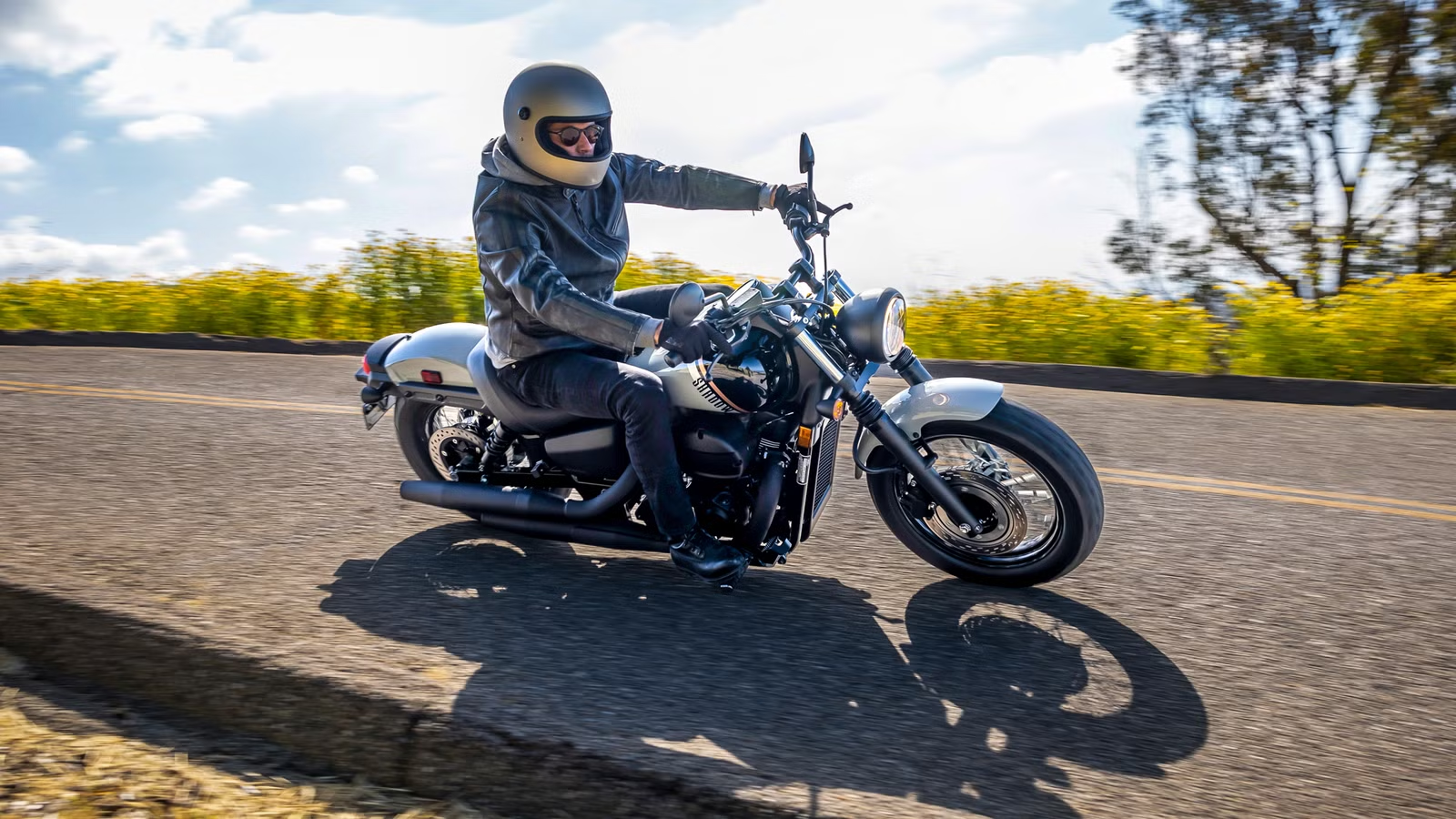
As a direct competitor to Harley-Davidson and Indian cruisers, Honda launched the Shadow platform back in 1983. Built to deliver Japanese reliability and classic American styling, it quickly became one of the most dependable middleweight cruisers. Over the years, the VT 750 platform has evolved through multiple variants while consistently keeping its dependability factor intact. Today, the Phantom model, introduced in 2010, features a blacked-out bobber aesthetic and has remained largely untouched for over a decade. However, a recent major overhaul gave it modern features without altering its time-tested powertrain core.
The Paradox of the “Un‑American” Cruiser

You might wonder how a mid-sized Japanese cruiser can quietly outperform the heavyweights when it comes to sheer longevity. The irony is hard to ignore. While American icons fight the high-stakes battle for brand character and maximum torque, Honda’s middleweight has been busy setting the deepest mileage records. On the surface, though, it looks every bit like a traditional cruiser with a low-slung profile, relaxed riding position, and minimalist styling.
Liquid-Cooled And Shaft-Driven Powerhouse

Central to the Shadow’s endurance story is its proven745cc 52-degree SOHC V-twinmotor that simply refuses to quit. This short-stroke mill features a 79mm bore and 76mm stroke paired with a lower 9.6 compression ratio, prioritizing low-stress operations over high-rpm horsepower. Plus, its liquid cooling helps maintain uniform temperatures, and electronic fuel injection ensures precise fueling and throttle response.

On paper, output stands at 45 hp at 5,500 rpm and a peak torque of 47.9 lb-ft at 3,500 rpm. Though the numbers might seem modest compared to big-bore V-twins, its low-end and mid-range grunt make it highly usable. Meanwhile, power flows through a simple five-speed gearbox and an enclosed shaft drive, helping mitigate frequent chain maintenance.
Documented Examples Pushing Past 100,000 Miles

The strongest grounds for the VT 750’s durability come from its documented ownership history across online forums. Numerous documented owner reports show that the Shadow surpassing 100,000 miles is quite common. In fact, well-maintained examples have documented histories stretching beyond that mark with no major engine overhauls required. Those numbers become even more significant when you factor in years of endurance from commuting, touring, and everyday usage.
Harley’s Modern Milwaukee-Eight Adds Refinement But With Caveats

Back in the day, Harley-Davidson practicallyinvented the cruiser category, but earlier air-cooled mills often required constant mechanical fiddling. That changed with the introduction of the Milwaukee-Eight platform, which represented a massive leap forward. You get smoother operation, improved efficiency, and hydraulic valve lifters that reduce routine valve maintenance. As a result, the V-twin offered noticeable improvements in refinement compared to earlier generations. Still, its reliability story is not entirely without blemishes.
Setbacks From 2017 To 2019 Oil Sumping Issues

Early Milwaukee-Eight units, specifically those built between 2017 and 2019, developed well-documented mechanical issues that frustrated long-distance riders. Chief among them were oil sumping and transmission fluid transfer concerns that could allow oil to migrate improperly within the engine. However, not every motorcycle suffers from these issues. For owners who experienced it, this meant unexpected repairs and extra mechanical attention.
Corrected Course With Later 2020 Models

To Harley’s credit, the company addressed these oiling issues in later models. Beginning with the 2020 model year, updates to the motor helped rectify the sumping and fluid migration problems. The good news for buyers, however, is that 2020 and later Milwaukee-Eight cruisers are now widely regarded as the most refined, dependable big-twin platform you can count on for high-mileage cross-country riding.
Indian’s Thunderstroke And PowerPlus Are Bulletproof Yet Buggy

Like Harley, Polaris-owned Indian Motorcycle also holds a very high place in the American cruiser landscape. But its V-twin engine story follows a slightly different arc. Both the air-cooled Thunderstroke and newer liquid-cooled PowerPlus engines are renowned for raw mechanical toughness. So much so that one widely famous Chieftain reportedly logged over 500,000 miles before being taken out of service by a crash rather than mechanical failure. Instead, reliability challenges often originate outside the engine.
Electrical Frictions Of Battery Drain And Faulty Sensors

Where Indian ownership can become more complicated is in the electrical systems. Some owners have reported issues involving parasitic battery drain, faulty gear position sensors, and occasional infotainment resets. Of course, none of these concerns are related to engine design, but they can still affect everyday riding. In many cases, the motorcycle continues running perfectly fine even as electrical gremlins require attention.
Demanding Upkeep With Maintenance Intervals

Maintenance schedules also add another layer to that picture. Thunderstroke-powered models typically call for oil changes every 5,000 miles, while some Scout models can stretch service intervals further. Though these intervals are not excessive by cruiser standards, keeping an American cruiser in top shape demands a more attentive ownership experience.
How Shadow’s Mechanical Simplicity Wins The Long Game Battle

When you step back and weigh all three brands, a clear pattern emerges. Naturally, Harley’s and Indian’s big V-twin cruisers sit in their own league in terms of performance numbers and premium finishes compared to Honda’s middleweight metric. That said, the Shadow keeps things simple and dependable, meaning fewer headaches and the confidence that your bike won’t leave you stranded. And then there’s accessibility. With healthy power output, a low 25.6 seat height, and a manageable 553-pound wet weight, it’s beginner-friendly and still exciting for seasoned riders.
Character Versus Low Drama Ownership

There is no denying the heritage and emotional appeal of both American brands. Adding to their charm are the distinct V-twin characters that defined American cruiser culture altogether. Yet the VT 750 Shadow appeals to a different type of rider, one who values consistency above all. Its signature edge lies in its ability to start day in and day out, built to last, and simply add miles without drama. Sure, it might sound less romantic, but it becomes valuable once you enter your second or third decade of riding.
The Numbers Support Honda’s Reliability Reputation

The broader data further backs up what VT 750 owners have been raving about for years. Historical reliability studies consistently place Honda at the top, with reported failure rates of around 12 percent over four-year owner surveys. Harley-Davidson’s historical 26-percent failure rate during similar survey periods shows a gap of more than double. However, to be fair, Harley and Indian have closed much of that gap in recent years.

Furthermore, with a starting price of $8,699, the Shadow Phantom is one of the most affordable ways to get into a V-twin cruiser. In comparison, both the entry-levelHarley-Davidson Nightsterand the Indian Scout Sixty Bobber require you to shell out an additional $1,300. More importantly, when you factor in lower total cost of ownership per mile driven over a 100,000-mile lifecycle, Honda stays lighter on your pocket. Put it all together, and it is easy to see why the VT 750 lineage quietly outlasts its American counterparts, racking up six-figure odometer readings effortlessly.
Sources: Powersports Honda, Harley-Davidson, Indian Motorcycle

Related posts


Latest Post


No Comments