
The Harley-Davidson Engine That Changed the Brand Forever
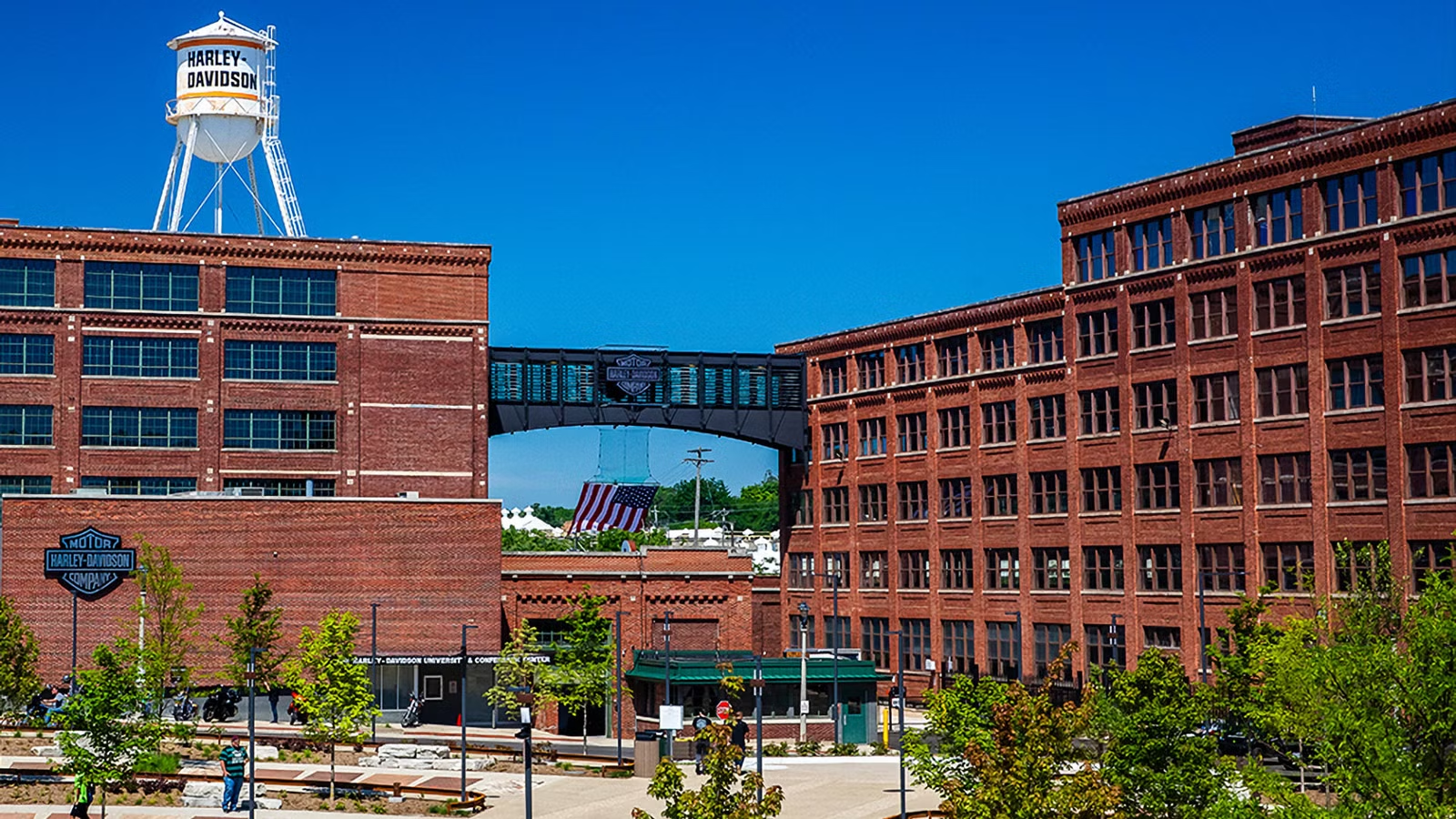
Harley-Davidson’s first production engine was a 24.74-cubic-inch F-Head single-cylinder developed in 1903. You could argue this was the engine that changed the brand forever, since adding an engine to a bicycle launched the company from bicycle manufacturing into motorcycle manufacturing. More than a century of engine development followed, with each generation addressing the limitations of the one before it. But one engine stands apart, not because it was first, the biggest, or the most powerful, but because it arrived when Harley-Davidson needed a mechanical reset.
The Engines That Led To A Turning Point
From Flathead To Overhead Valve

Harley-Davidson spent decades refining its V-twin, with each major generation bringing a meaningful change. The Knucklehead, introduced in 1936, was the company’s first production overhead-valve V-twin. Moving the valves into the cylinder heads improved breathing and allowed the engine to make more power than the flathead designs it replaced, establishing the overhead-valve V-twin layout Harley would continue developing for decades.

The Panhead arrived in 1948 with aluminum cylinder heads that transferred heat more effectively than the earlier iron heads. Hydraulic valve lifters also reduced the need for routine valve adjustment, addressing two practical concerns for riders: controlling engine temperatures and reducing maintenance.
The Shovelhead Raises The Stakes

The Shovelhead, introduced in 1966, took another step toward greater performance. Revised cylinder heads improved the engine’s ability to breathe, and displacement eventually reached 80 cubic inches. But getting more power from an air-cooled engine also made heat management more important, while oil control remained an area where Harley had room to improve.


By the late 1970s and early 1980s, those shortcomings mattered more. Harley-Davidson was competing against motorcycles with increasingly reliable, efficient, and refined engines, while the company’s own manufacturing and quality problems had damaged customer confidence. After management bought Harley-Davidson back from AMF in 1981, the company needed an engine that addressed the weaknesses of the Shovelhead rather than simply adding another incremental improvement.

Harley didn’t need another engine that was simply better than the one before it. It needed one good enough to help convince riders that Harley-Davidson itself had a future.
The Evolution Changed What A Harley Could Be
A New Approach To A Familiar Formula

That engine was the Evolution. Introduced for the 1984 model year, the 80-cubic-inch Evolution kept the basic Harley formula: a 45-degree, air-cooled V-twin with overhead valves and pushrods. The important changes were in the details that made that formula work better. Aluminum cylinders and heads improved heat transfer and reduced weight, while redesigned combustion chambers, improved oiling, electronic ignition, and tighter manufacturing tolerances addressed weaknesses that had followed Harley’s big V-twin for years.
Why The Engineering Mattered

Those changes mattered in ways a rider could understand. Aluminum moves heat away from the combustion area more effectively than the iron cylinders used previously, which is particularly important when an engine has no radiator to carry heat away. Better oil control reduces leakage and keeps lubrication where it belongs, while more consistent machining and assembly make the engine’s internal clearances more predictable, improving durability and reliability.

The Evolution project had started during the AMF era, alongside the much more ambitious Project Nova. Nova called for a family of liquid-cooled engines, but Harley-Davidson’s resources were limited after the 1981 buyout, and the company could not realistically pursue every engineering direction. The Evolution offered a more practical way to modernize the existing Big Twin while retaining the architecture that made a Harley recognizable.
The Engine Harley Couldn’t Afford To Get Wrong

That decision mattered. The Evolution arrived with the new Softail chassis for 1984, pairing a substantially improved engine with a motorcycle that retained the appearance of a traditional Harley. It was still an air-cooled, pushrod V-twin, but it was a much better-executed version of that formula.
The Evolution did not single-handedly save Harley-Davidson. Manufacturing changes, quality-control improvements, better production methods, and a stronger business strategy were all part of the recovery. But the new engine gave the company something it desperately needed: a Big Twin that riders could reasonably expect to be durable, dependable, and recognizably Harley-Davidson.

For a company trying to rebuild its reputation, that distinction mattered. Harley didn’t have to convince riders that it could build the most technologically advanced engine in the world; it had to convince them that buying a new Harley was no longer a gamble.
The Evolution Took Several Forms
The Big Twin Evolution

The Big Twin Evolution was the engine most closely associated with Harley’s recovery, but the company also developed a separate Evolution for the Sportster. The two were different engines designed for different motorcycles, but both reflected the same move toward better materials, improved oil control, and more consistent engineering.

The 1,340 cc Big Twin Evolution replaced the Shovelhead and eventually powered Softail, Dyna, FXR, and Touring models. It remained in production through 1999, giving Harley a single Big Twin platform that served an unusually broad range of motorcycles. Its longevity is significant because Harley didn’t need to replace it simply because a newer design was available; the Evolution remained effective at doing its job.
The Sportster Evolution

The Sportster Evolution arrived in 1986 at 1,100 cc, with 883 cc and 1,200 cc versions following. Unlike the Big Twin, the Sportster Evolution used unit construction, combining the engine and transmission in one case. It also suited the Sportster’s lighter, more responsive character, giving Harley a modern V-twin for a motorcycle that asked something different of its engine.

The two versions therefore served different purposes. The Big Twin provided the low-speed torque and durability expected from Harley’s larger motorcycles, while the Sportster Evolution gave a lighter motorcycle an engine capable of working at higher engine speeds without abandoning the air-cooled V-twin configuration.
Why The Evolution Lasted

More importantly, both demonstrated that Harley could improve its engine technology without abandoning the architecture its customers associated with the brand. That was the real breakthrough.
The Big Twin Evolution’s 1984-to-1999 production run carried Harley through its recovery and into a period when the company was strong enough to develop the next generation. By then, Harley wasn’t simply trying to replace a troubled engine. It had the breathing room to decide what the next engine needed to accomplish. That is a very different position from the one the company occupied in 1981.
The Evolution’s Influence Reaches Today’s Engines
Twin Cam Moves Harley Forward

The Big Twin Evolution gave way to the Twin Cam for 1999. The new engine used two camshafts, increased displacement, and revised cylinder heads and intake and exhaust systems to improve performance, emissions, and economy. It shared little hardware with the Evolution, but the basic objective remained the same: improve the engine while retaining the characteristics riders expected from a Harley.

The Milwaukee-Eight, introduced for 2017, pushed that process further. Harley returned to a single camshaft, but the new engine used four valves per cylinder, improving airflow through the heads. Counterbalancing reduced vibration, while improved cooling and electronic engine management allowed Harley to increase performance without simply relying on more displacement. Variable valve timing later gave the engine another way to balance power, efficiency, and emissions.
Revolution Max Breaks With Tradition

The Revolution Max represents a much bigger departure. Introduced in 2021, it uses a 60-degree liquid-cooled V-twin with dual overhead camshafts, four valves per cylinder, variable valve timing, and a shared engine-and-transmission case. It was designed around a broad powerband and higher-RPM performance rather than the low-RPM character traditionally associated with Harley’s Big Twin.

On paper, the Revolution Max has little in common with the Evolution. That difference shows how far Harley-Davidson’s engineering has progressed. The company can now build a sophisticated liquid-cooled V-twin with overhead cams and variable valve timing, while still offering the Milwaukee-Eight for riders who want the traditional Big Twin configuration.
The Lesson Harley Carried Forward

The Evolution was the point where Harley demonstrated that modernization didn’t require abandoning that identity. The company could improve cooling, oil control, combustion, durability, and manufacturing while keeping the basic character of its V-twin intact.
That’s why the Evolution matters more than its specifications suggest. It wasn’t Harley-Davidson’s most powerful engine, and it wasn’t its most technologically advanced. It arrived when the company needed to make its traditional V-twin substantially better, and it stayed in production long enough to provide the foundation for what came next.

The F-Head started Harley-Davidson’s engine story in 1903. The Knucklehead established the overhead-valve V-twin, the Panhead improved cooling and maintenance, and the Shovelhead pushed performance further. The Evolution took those lessons, corrected enough of the weaknesses, and gave Harley-Davidson an engine it could build its recovery around. That is why the Evolution changed Harley-Davidson forever.
Source: Harley-Davidson

Related posts
Latest Post


No Comments