
Why This Affordable Luxury Sedan Is The Talk Of The Town
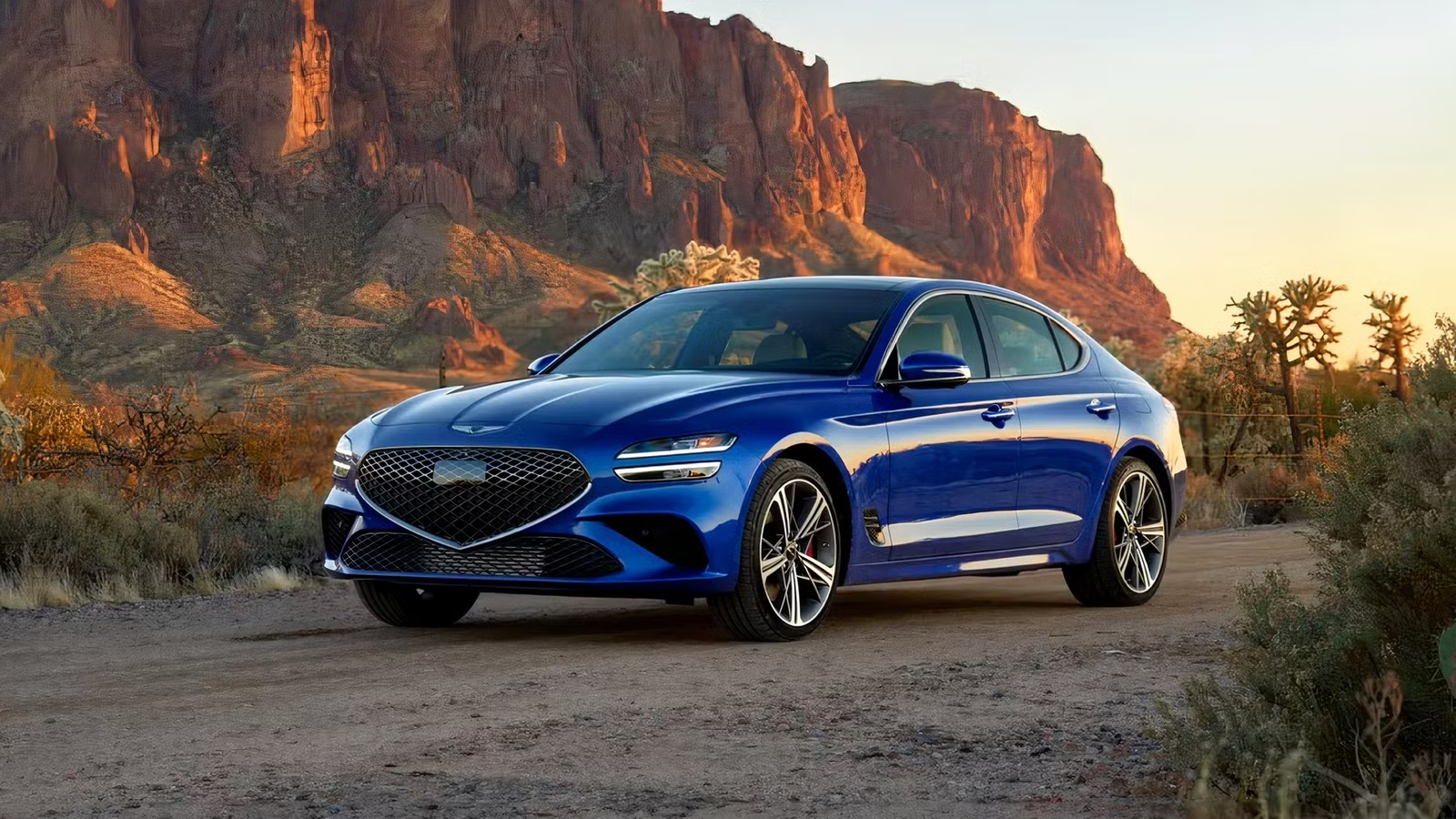
The luxury sedan segment has never been more competitive — or more expensive. European stalwarts keep pushing their entry prices higher, and buyers who want genuine premium quality without a six-figure shock at the dealership are increasingly looking elsewhere. That is exactly the opening Genesis has exploited with the G70: a compact luxury sedan that punches squarely at the Germans on style, technology, and performance, yet undercuts most of them on price. If you have been wondering what all the noise is about, we have broken down the pricing, the trim choices, the standout features, and how it measures up against the class leaders.
Combining Luxury And Affordability: The 2026 Genesis G70

Created to take aim at the German stalwarts of the luxury sedan market, Hyundai’s luxury arm, Genesis, has done it again with the 2025 Genesis G70. A sporty-looking, refined, tech-laden, and genuinely quick luxury sedan that delivers serious on-road thrills while undercutting most of the segment’s leading rivals on price.
2026 Genesis G70 Starting Price: $43,450
Aside from Genesis’ increasingly respected reputation across the auto world, what the G70 brings to the market is a more accessible entry point into luxury driving. Currently, the average price of a new vehicle in the U.S. sits just under $50,000 ($49,855 as of July 2026, to be precise), with the compact luxury sedan segment commanding prices ranging from $35,000 to $60,000.
The 2026 Genesis G70 has a starting MSRP of $43,450, but that does not mean you will be missing out on what you would expect from a luxury sedan. Multiple trims are available, and even the most “basic” trim delivers a generous suite of luxury features, a capable engine, strong safety technology, and premium interior materials and design.
How The G70 Is Taking On The Luxury Sedan Market For Price


Yes, ~$44,000 is not a small sum, and considering you can buy some new SUVs for under $30,000 that offer bags of versatility and comfort, it may seem like a lot for a car that you cannot take off-roading or use for serious towing. But compared to other high-end compact luxury sedans in 2025, it becomes clear why so many buyers are paying attention.
- 2025 Alfa Romeo Giulia. MSRP: $43,995.
- 2025 Audi A4. MSRP: $44,100.
- 2025 BMW 330i. MSRP: $45,950.
- 2025 BMW M340i. MSRP: $60,200.
- 2025 BMW M3. MSRP: $76,700.
- 2025 Mercedes-Benz C-Class. MSRP: $48,450.
Price-wise, the G70 beats out a lot of segment stalwarts, though it is worth noting that it remains slightly more expensive than models like the 2025 Cadillac CT4 and the Acura Integra, which carry MSRPs of $36,390 and $33,000, respectively. Against the European brands that typically dominate the conversation, however, the G70 holds a clear advantage.
The Different Trims Of This Year’s G70

It is not just the competitive price that makes this year’s G70 appealing — it is the breadth of choice on offer. Including the base trim, eight configurations are available, spanning two powertrains and a choice between rear-wheel drive and all-wheel drive, all with a generous standard features list. The base trim, named the 2.5T RWD, pairs rear-wheel drive with a 2.5-liter turbocharged inline-four, while the seven other trims include:
- 2025 Genesis G70 2.5T AWD
- 2025 Genesis G70 2.5 Sport Prestige RWD
- 2025 Genesis G70 2.5 Sport Prestige AWD
- 2025 Genesis G70 3.3T Sport Advanced RWD
- 2025 Genesis G70 3.3T Sport Advanced AWD
- 2025 Genesis G70 3.3T Sport Prestige RWD
- 2025 Genesis G70 3.3T Sport Prestige AWD
Even the range-topping trim can be considered well-priced given everything it delivers, particularly the performance on tap from its engine.
Genesis G70 Performance Specifications
Two engines are available across this year’s lineup, identified by the trim name: “2.5” models use a 2.5-liter turbocharged inline-four, while “3.3” models are powered by a 3.3-liter twin-turbocharged V-6.
|
Engine |
2.5-Liter Turbocharged Inline-Four |
3.3-Liter Twin-Turbocharged V-6 |
|
Transmission |
Eight-Speed Automatic |
Eight-Speed Automatic |
|
Horsepower |
300 Horsepower |
365 Horsepower |
|
Torque |
311 LB-FT |
376 LB-FT |
|
Driveline |
Rear-Wheel Drive or All-Wheel Drive |
Rear-Wheel Drive or All-Wheel Drive |
|
0-60 MPH |
5.9 Seconds |
4.5 Seconds |
|
Top Speed |
155 MPH |
160 MPH |
Value-wise, if you opt for the starter trim at MSRP, you are paying roughly $142 per horsepower. Opt for the cheapest 3.3-liter model, however, and the math actually improves. The 3.3T Sport Advanced RWD has an MSRP of $50,950 and produces 365 horsepower, working out to approximately $139.59 per horsepower.
If horsepower is your primary motivation for buying a luxury sedan, you are technically getting a better deal by stepping up to the more expensive option — life math!
So, the G70 carries a profile reminiscent of a Jaguar XJ yet with a more contemporary feel; it offers two engines capable of impressive power outputs and sports-car-quick 0–60 times, and it starts at a competitive price for the segment. The more potent variants will cost considerably more, but what exactly is generating all the buzz around the G70?
The Features Creating A Buzz For The Genesis G70

There is almost too much to cover, but the exterior design demands attention first. Up front, you get a wide Genesis Crest Grille flanked by sharp, crystal-clear LED headlights, broad air intakes below and to the sides, and a sculpted hood with strong character lines running its length — it is a car you will notice in your mirror.
Every trim comes equipped with 19-inch alloys, but the 2.5T adds dark chrome trim, sportier-looking wheels, and a wider sunroof for more light in the cabin and a pseudo-open-top feel. The 3.3T Sport Advanced steps things up further with a variable exhaust valve and sporty aluminum exterior trim that signals its performance credentials, while the top-of-the-range 3.3T Sport Prestige adds exclusive dark-chrome detailing, a mesh grille, sports alloys, and red Brembo brake calipers for an athletic yet refined stance.

If you are a technophile, the G70 will not disappoint. Standard features at the entry level include:
- A 10.25-inch touchscreen
- Heated seats
- Keyless entry
- A six-speaker audio system
- Dual-zone climate control
- Smartphone connectivity
- A rearview camera
- An 8-inch HD instrument cluster
The 2.5T Sport Prestige adds a larger 12.3-inch HD digital instrument cluster, a 15-speaker Premium Lexicon sound system, and ventilated seating. The 3.3T Sport Advanced introduces the Genesis Digital Key 2, which lets you unlock and start the car via your smartphone. The 3.3T Prestige tops things off with a head-up display and additional ambient lighting throughout the cabin for a more personalized atmosphere.

If that is not enough, the G70 is built to perform on twisty roads, not just look the part. The RWD models deliver classic rear-drive sports-sedan dynamics, while AWD variants improve grip and traction in slippery conditions. Ventilated brakes are fitted as standard across all trims for confident stopping power. All models also come with Drive Mode Select, offering Eco, Comfort, Sport, Sport+, and Custom settings. The Sport and Sport+ modes hold gears longer, sharpen downshifts, and stiffen the suspension so you can make the most of whichever powertrain you choose.
For those who want the full athletic package, the Sport trims add variable gear-ratio steering and a limited-slip differential. The 3.3T Sport Prestige goes further still with Brembo brakes for more authoritative stopping power, and adaptive suspension that smooths out rough roads while tightening up when you push harder. In short, even the entry-level G70 has a compelling amount going for it.
Where The G70 Fits Into Genesis’ Lineup

Genesis is the brand that has been outranking Lexus for innovation for the last four years. And though Lexus is one tough competitor to unseat, Genesis is making inroads by rolling out vehicles packed with the latest technology that actually works — a genuine differentiator in a market where feature bloat is a common complaint.
The G70 is positioned as an “entry-level” luxury sedan, largely due to its lower starting price, but it is arguably a great deal more than that label suggests. The current Genesis sedan lineup is impressive across the board: the G70 is the most affordable entry point, with the G80 and flagship G90 carrying MSRPs of $57,100 and $89,700, respectively. For buyers looking to get into the Genesis family without stretching to those figures, the G70 makes a compelling case.
What Everyone Thinks Of The New G70

But do not just take our word for it — the G70 has earned genuine critical acclaim from multiple respected sources.
According to Car & Driver, the G70 is a highly capable all-rounder. Their testers praised the steering feedback, the balanced ride, the classic styling, the competitive pricing, and the dual-engine lineup, though they noted the absence of a hybrid option and flagged the modest 10.5-cubic-foot trunk as a minor shortcoming. Overall, it still earns a strong rating of 4.5 out of 5.
Owner and expert reviews on Kelley Blue Book are equally enthusiastic, with owners awarding it 4.9 out of 5 and expert testers giving it 4.6 out of 5. The standout quality cited by both groups is not just the technology itself, but how intuitive it is to use — credit goes to the steering wheel controls and the central touchscreen layout. Ninety-five percent of owners recommend the G70, with 85 percent awarding it five stars and the remaining 15 percent giving it four stars — nothing lower appears in the ratings.
Beautiful, comfortable, fast, good price, reliable, great service, excellent performance. I love it.
– Owner review of their Genesis G70 on Kelley Blue Book
How The G70 Competes With Other Luxury Sedans This Year

It is clear why the Genesis G70 is generating so much attention, but in the interest of balance, the less flattering side deserves a look too. The main weakness is fuel economy. No variant is particularly efficient — not terrible, but there is room for improvement, and the lack of a hybrid option is a fair criticism. The rear-wheel-drive 2.5-liter model is the most frugal, with a combined rating of 24 MPG, translating to roughly $2,550 per year in fuel costs. The AWD 2.5-liter manages 23 MPG combined; the RWD 3.3-liter models return 20 MPG combined. The thirstiest variant is the AWD 3.3-liter, which achieves just 19 MPG combined, costing approximately $3,250 annually in fuel on average.
Fuel consumption aside, the G70’s combination of competitive pricing, strong performance specs, and favorable dollar-per-horsepower ratio makes it a genuine thorn in the side of many 2025 luxury sedans. It may be outpowered and out-sprinted by a handful of rivals, but as a complete package, it is difficult to beat at this price point.
|
Model |
2025 Genesis G70 3.3T Sport Advanced |
2025 BMW 330i xDrive |
2025 Mercedes-Benz C-Class |
2025 Alfa Romeo Giulia (Base) |
2025 BMW M3 Competition xDrive |
|
Engine (Most Powerful) |
3.3-Liter Twin-Turbocharged V-6 |
2.0-Liter Turbocharged Inline-Four Mild Hybrid |
2.0-Liter Turbocharged Inline-Four Mild-Hybrid |
2.0-Liter Turbocharged Inline-Four |
3.0-Liter Turbocharged Inline-Six |
|
Horsepower |
365 Horsepower |
255 Horsepower |
255 Horsepower |
280 Horsepower |
523 Horsepower |
|
Rating (Kelley Blue Book) |
4.6 |
4.4/5 |
4.5/5 |
3.7/5 |
4.4/5 |
Sources: Genesis, KBB, CarEdge, J.D. Power, EPA, and Joseph Auto Reviews’ YouTube Channel.

Related posts






Latest Post


No Comments