The Toyota Hybrid Crossover That Loses Just 5% Of Its Value In Three Years
10 minutes reading
Friday, 26 Jun 2026 12:01 0 128 autotech
The used car and SUV market has experienced a dramatic shift in trends over the last few years, especially when looking at hybrids. Pre-owned car shopping was once a straightforward process that saw the initial owner suffer from a steep value drop after the first year. As of today, consumers demand more financially attractive vehicles for personal use. New car prices remain high in 2026, with even some of the cheapest models available now being out of reach for most Americans. This has increased demand for the used market .
Today’s used and new dealership inventory constraints and highly optimized manufacturing processes have disrupted car deliveries to consumers. There are certain segments that defy conventional trends entirely, turning the used market into a high-stakes arena where window-sticker discounts are few and far between. Long-term retention is a primary factor for purchasing appeal in this case. For buyers seeking electrified efficiency, navigating this landscape requires looking past superficial price cuts and instead focusing on the underlying financial playbook of residual value.
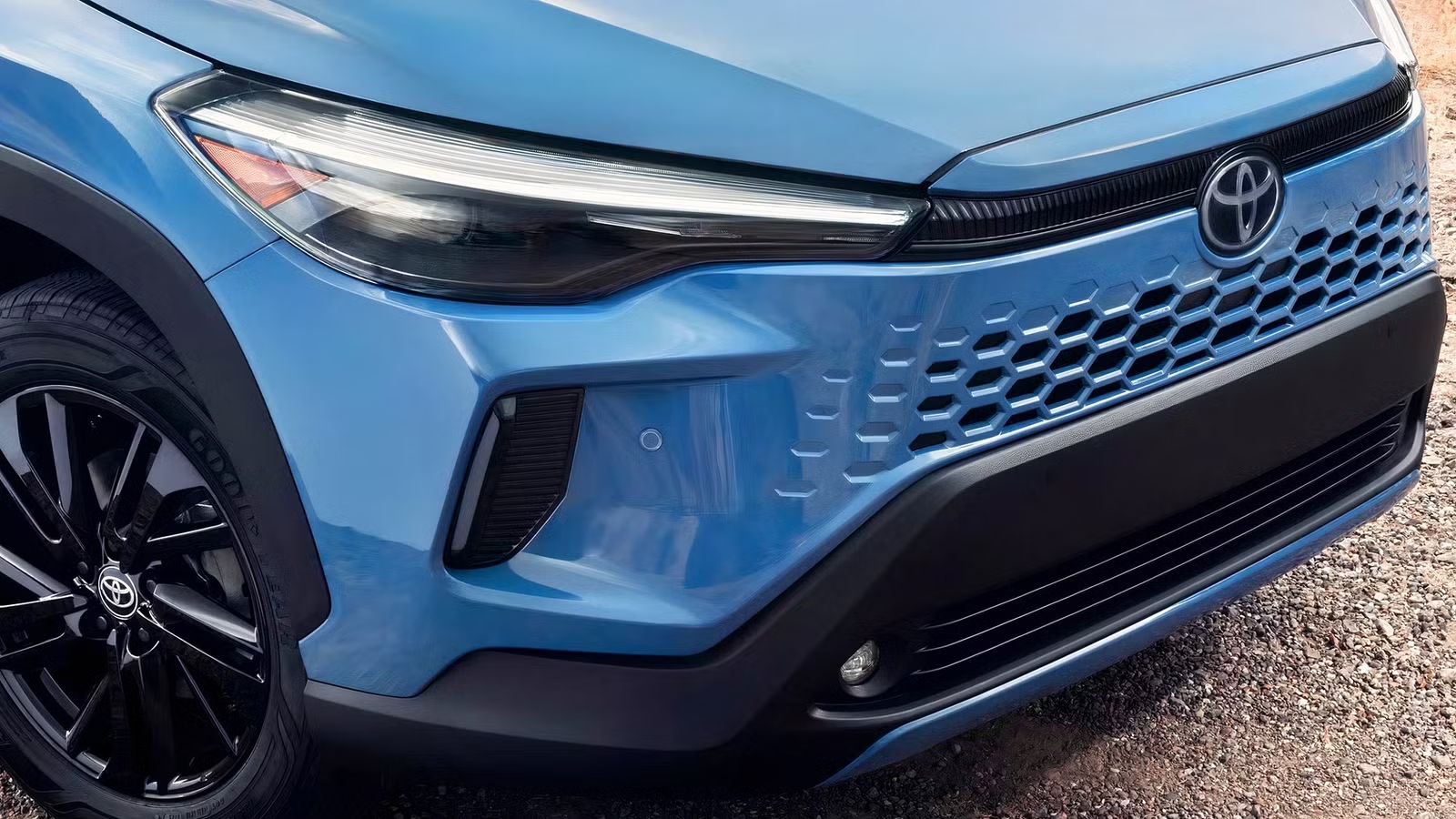
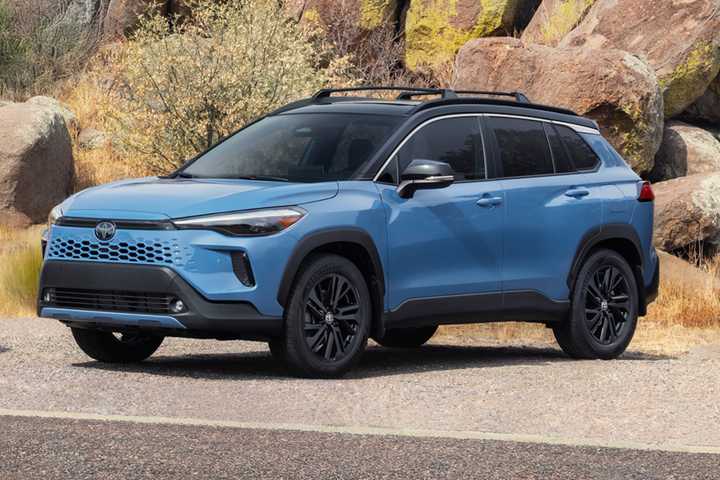
2026 Toyota Corolla Cross Hybrid XSE front quarter shotAmee Reehal | TopSpeed
The compact hybrid crossover segment is rapidly becoming the most contested one in the U.S. This performance has effectively set a new standard for measuring whether a pre-owned purchase makes financial sense. Generic market trackers often recycle pricing statistics as a representation of current inventory. However, a deeper look at the data reveals that there are some examples that are quietly pushing back against poor second-hand value retention rates.
This trend brings up the debate about whether it’s worth paying a premium for alternative options when real-world financial scenarios prove that there are some vehicles worth buying new. It’s an interesting topic when you consider how these vehicles don’t inspire aspiration or have the same qualities as sought-after collector cars that typically rise in value due to their more special nature.
The Toyota SUV That Outsells Expectations And Undercuts Every Rival On Price
Toyota hit the sweet spot of reliability, value, and price with a small, and useful SUV. Which Toyota SUV gives you the most value for the price?
2026 Toyota Corolla Cross – Defying The Compact SUV Depreciation Curve
2026 Toyota Corolla Cross gas modelAmee Reehal | TopSpeed
The 2026 Toyota Corolla Cross is a macroeconomic example of how a new hybrid crossover can defy modern depreciation trends, based on used sales data and analytics alone. According to iSeeCars data, standard compact SUVs typically suffer a harsh 39.9 percent depreciation hit over a five-year period. However, looking at historical sales data for pre-owned Toyota Corolla Cross Hybrid models reveals a five percent value loss average after three years.
Three-year-old models typically sell for an average of $23,776 and go on to lose 26.7 percent of their value after five years. Even when cross-referencing different analytical models to account for industry variables, the five-year residual outlook for the Toyota Corolla Cross remains strong. The hybrid crossover spans a tight range from iSeeCars‘ $18,358 projection and Kelley Blue Book’s $17,648 to $17,948 valuation, up to CarEdge’s more optimistic $20,456 estimate.
The Toyota Corolla Cross Hybrid Is the Smart SUV Most Buyers Overlook
This overlooked hybrid SUV delivers 45 mpg, standard AWD, and more power than its gas-only sibling for under $31,000.
The Microscopic Used-to-New Price Gap
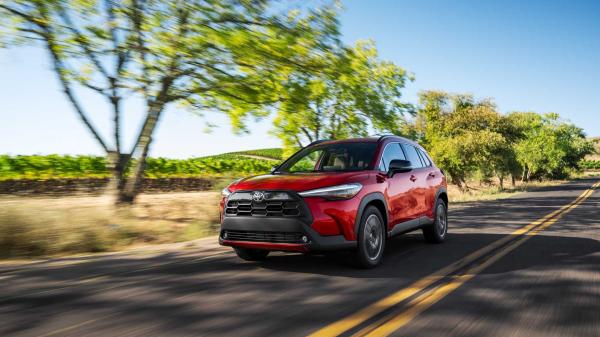
Front 3/4 shot of 2026 Toyota Corolla Cross Hybrid parkedToyota
The Toyota Corolla Cross’s unprecedented value retention creates a narrow margin between buying a new model and opting for a used alternative. CarGurus‘ used-car price index reports the average pre-owned transaction for a used Toyota Corolla Cross at $26,036. This figure sits roughly 6.59 percent below the broader used-car average. Contrasting this with a brand-new entry-level Toyota Corolla Cross Hybrid’s starting price of $28,495 questions whether a $2,500 gap between new and used options is a worthy discount to consider.
CarGurus’ index further highlights this stability through incremental, minor month-over-month fluctuations for the broader Toyota Corolla Cross range, with both ICE and HEV models ranging from subtle dips of 0.39 to 0.71 percent to minor increases between 0.8 and 0.89 percent. This result proves that Toyota’s compact crossover settles into a predictable value zone rather than fluctuating wildly with seasonal market volatility.
According to Edmunds, a Toyota Corolla Cross Hybrid ownership experience can cost you $30,414 over five years and 60,000 miles. This includes $3,381 on maintenance, $601 on repairs, and $8,401 on depreciation. CarEdge indicates that the average five-year ownership experience of the entire range comes in at $37,059, which includes spending $9,940 on depreciation, $7,220 on fuel, and $1,873 on maintenance.
When deployed as a competitive playbook against rivals like the Kia Niro, Hyundai Kona Hybrid, Honda HR-V Hybrid, or Mazda CX-50 Hybrid, the financial contrast of the Toyota Corolla Cross Hybrid sharpens dramatically. While a used Mazda CX-50 Hybrid commands a hefty average pre-owned price near $35,000, the Toyota Corolla Cross Hybrid undercuts it by thousands while offering a potent 196 horsepower and a stellar 42 MPG combined, rounded out by standard all-wheel drive. It fundamentally shifts the consumer strategy; instead of paying a massive upfront premium for rival badges on the used lot, choosing a Toyota Corolla Cross Hybrid allows buyers to extract maximum mechanical efficiency while protecting their principal investment far better than the competition.
The True Cost Of Long-Term Ownership
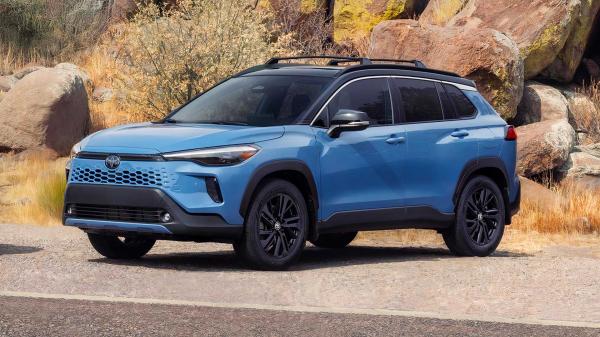
2025 Toyota Corolla Cross Hybrid Nightshade — Front Three-QuarterCraig Cole | TopSpeed
Beyond the initial purchase price, the Toyota Corolla Cross Hybrid’s long-term ownership costs reveal that even mainstream automotive experts routinely undersell just how affordable it is to operate over an extended ownership experience. Kelley Blue Book projects a five-year total cost to own of $52,133 for the Toyota Corolla Cross Hybrid, even if you calculate a $13,397 loss strictly to depreciation. It’s also a really great hybrid crossover if you are looking for long-term value retention. iSeeCars reveals that after five years of ownership, it will lose $8,810 or 30 percent of its value, which is a bit better than the current average for the segment. This result effectively proves that traditional formulas can fail to capture the compounding financial benefits of good fuel economy paired with proven mechanical reliability.
J.D. Power gives the Toyota Corolla Cross range an 80/100 consumer-verified overall score, which includes 79/100 for quality and reliability, 75/100 for the driving experience, 88/100 for resale, and 78/100 for the dealership experience. iSeeCars gives the same model with an 8.8/10 retained value rating, indicating that the model will lose $9,918 or 34.8 percent of its value in five years, which is somewhat lower than most of its key rivals. The Toyota Corolla Cross Hybrid’s value retention performance results in it developing a reputation for being a long-term commitment that yields good financial returns. This is a factor that works in its favor, as dependability becomes rarer across the broader automotive landscape.
How The Small Toyota Corolla Cross Is Quickly Becoming A Giant In America
The Toyota Corolla Cross quietly stands out as a balanced choice in a market chasing electrification and larger SUVs.
Pricing And Specification Remain Hugely Influential
2026 Toyota Corolla Cross Hybrid XSE dashAmee Reehal | TopSpeed
The 2026 Corolla Cross Hybrid range starts at $29,595 for the entry-level S trim. The SE follows this with a $30,915 price tag, followed by the flagship XSE at $33,630. This strategy makes the range a competitively priced model that should appeal to most new car buyers wanting a balanced hybrid vehicle. These prices exclude Toyota’s $1,450 delivery, processing, and handling fee. The Corolla Cross sits on the same TNGA-C platform used by the sedan and hatchback models. It’s also a locally built model, with production taking place at the brand’s Huntsville, Alabama, plant.
2026 Toyota Corolla Cross cargo holdToyota
The Corolla Cross Hybrid is the Japanese brand’s most affordable hybrid crossover option, aimed at first-time buyers who frequent urban and suburban driving environments. It’s an ideal counterpart to the Corolla sedan and hatch range, but benefits from the brand’s more advanced gasoline-electric hybrid technology without the burden of a heftier starting price.
Efficient And Dependable Engine Technology Forms The Foundation
Close-up shot of 2026 Toyota Corolla Cross Hybrid engine bayToyota
All four Corolla Cross trims feature Toyota’s naturally aspirated 2.0-liter four-cylinder Atkinson engine and triple electric motor configuration, which made its first appearance in the current-generation Prius. A direct-drive eCVT transfers a combined 196 horsepower and 152 pound-feet to all four wheels, resulting in a claimed 0-60 MPH time of 7.3 seconds. Independent tests confirm this claim is accurate in real-world conditions.
Base Trim Engine
2.0L Inline 4
Base Trim Transmission
CVT
Base Trim Drivetrain
Front-Wheel Drive
Base Trim Horsepower
169 HP @6600 RPM
Base Trim Torque
151 lb.-ft. @ 4400 RPM
Make
Toyota
Model
Corolla Cross
Segment
Subcompact SUV
The engine and two electric motors power the front wheels, while a third motor positioned at the rear completes the all-wheel-drive configuration. The 196-horsepower hybrid system delivers something more valuable than acceleration: 445 miles per tank means NYC to D.C. without stopping for fuel.
In isolation, the ICE generates 169 hp and 152 lb-ft. The front electric motors produce 110 hp, while the rear produces 40 hp and 62 lb-ft. Toyota does not disclose a combined torque figure, so the total torque is not available. Compared to ICE crossovers, it’s not the most capable hauler, but you can tow up to 1,500 pounds if you fit the optional Activity Mount.
The Toyota Corolla Cross Hybrid Is the Smart SUV Most Buyers Overlook
This overlooked hybrid SUV delivers 45 mpg, standard AWD, and more power than its gas-only sibling for under $31,000.
Fuel Efficiency Is Its Strongest Suit
2024 Toyota Corolla Cross Hybrid XSE Acidic BlastToyota
The Corolla Cross Hybrid also enjoys the benefit of being one of the most efficient hybrid crossovers currently available in the new car market, with its 46/39/42 MPG city/highway/combined EPA estimates. The 0.9-kWh battery pack means that the drivetrain possesses limited EV driving functionalities. It’s a typical hybrid system that acts as a supplementary drivetrain to reduce power losses and lower the internal-combustion engine’s load, resulting in good fuel economy returns. Despite this, it will cover a very impressive 445 miles from a single 10.6-gallon tank.
The Corolla Cross Hybrid’s low fuel cost is another appealing factor. The EPA indicates that you will get to enjoy up to $3,750 worth of fuel cost savings over five years compared to the average new vehicle currently being sold in the U.S. You can also expect to spend $1,400 on fuel every year and $2.38 to drive 25 miles. A full tank of gas will cost around $42.
Toyota’s SUV-Focused Strategy Is Paying Off
2026 Toyota Corolla Cross Hybrid XSE front shotAmee Reehal | TopSpeed
Toyota’s strategy in the U.S. for 2026 continues to center on a multi-pathway approach. The Japanese brand prioritizes a diverse lineup of crossovers and SUVs that cater to varying consumer needs rather than pivoting exclusively to battery-electric vehicles. This strategy has proven exceptionally successful. As of the first quarter of 2026, the brand’s hybrid vehicles accounted for over 50 percent of total sales volume. This is a milestone that reinforces their market dominance. Sales of their most popular compact and midsize utility models remain at historic highs.
Specific off-road-focused entries saw year-on-year surges as high as 84 percent for ICE variants and even more dramatic triple-digit growth for their hybridized counterparts as new generations reached dealerships. Toyota introduces hybridization as a core powertrain pillar, often making it the standard or exclusive offering for high-volume models to normalize the technology. By integrating planetary gear-based power split devices and high-capacity lithium-ion batteries across its catalog, the brand offers a seamless driving experience that requires no change in consumer behavior. Toyota’s choice to standardize hybridization effectively captures 37 percent of buyers who prioritize long-term resale value and low maintenance costs over the early adoption of fully electric platforms.
Sources: Toyota, iSeeCars, CarEdge, J.D. Power, Kelley Blue Book, and the EPA.















No Comments