
The Forgotten Fiberglass Sports Car That Beat The Corvette To Market
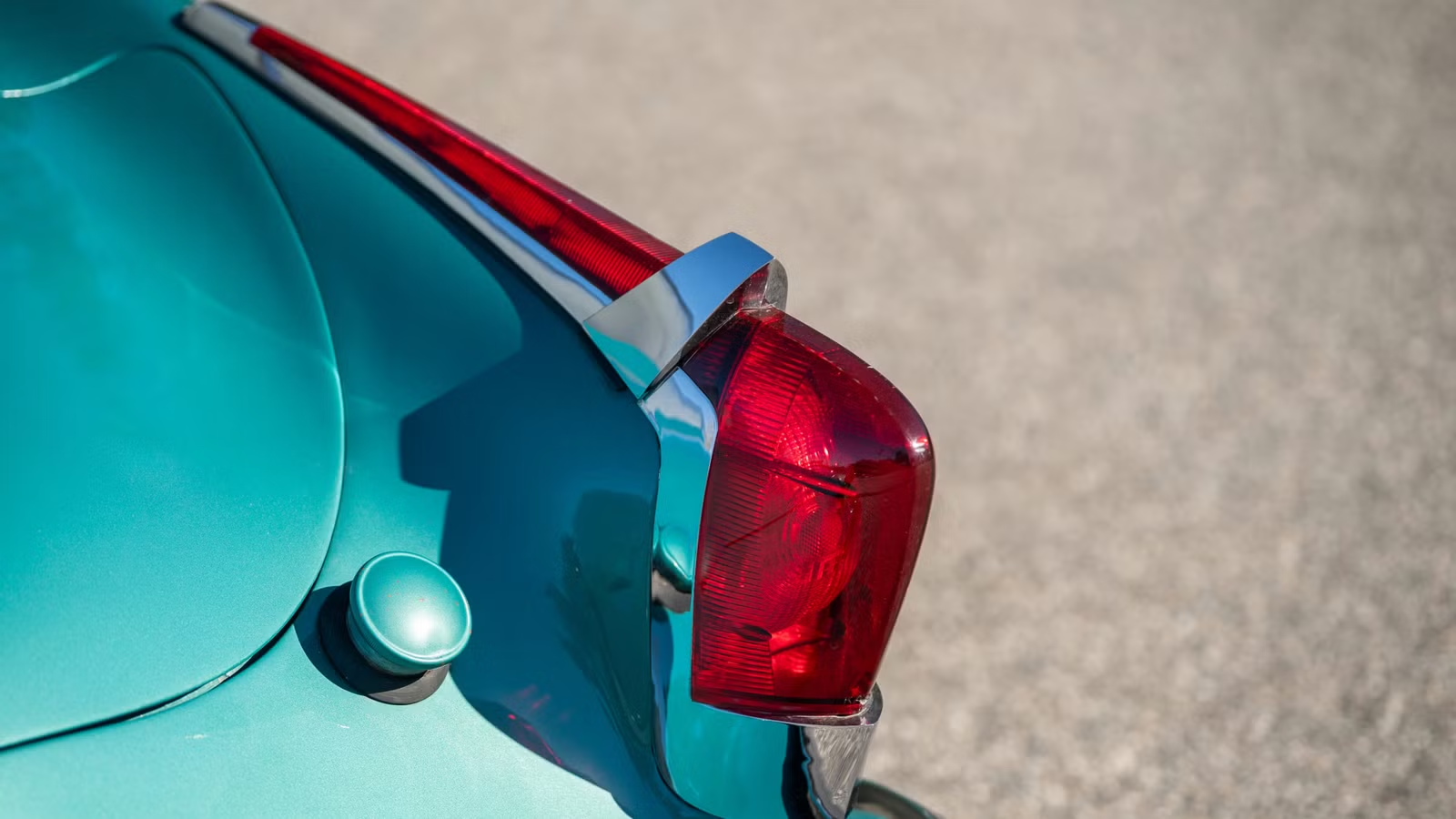
Before the Chevrolet Corvette became America’s sports car icon, another roadster actually reached the public first. Like the ‘Vette, it wore a fiberglass body, it had a design feature nobody else dared try yet, and it showed up to the party months before Chevy did. Then history quietly handed the credit to someone else.

The irony is that this obscure roadster did almost everything right and still lost. It arrived earlier, looked sharper, and took a real engineering risk. None of that mattered once the rival that came later turned into a legend. Here’s the story of a sports car that got there first and still finished last.
The Forgotten Race To Build America’s First Sports Car
After World War II, American servicemen came home with a new taste in cars. They had seen MGs, Jaguars, and Alfa Romeos overseas, and suddenly the family sedan felt a little boring. Detroit noticed, and a race quietly began to build America’s answer to the European roadster.

Chevrolet’s answer became the Corvette. Ford countered with a two-seat version of the Thunderbird. Both cars are remembered today as pioneers of the American sports car, and both earned that reputation fair and square.
What most people don’t remember is that a much smaller, independent automaker was running the exact same race. It had no marketing budget, no brand recognition, and barely any backing from its own leadership. Like the Corvette, it also had a fiberglass body and a design trick the Big Three hadn’t touched. And for one brief moment, it was actually winning.
The Fastest Quarter Mile Time For A Production Car In The ’60s
The 1960s were about the glory of quarter-mile domination, and by the end of the decade, one production car out-muscled all the others.
1954 Kaiser-Darrin — The Roadster That Almost Never Existed

|
Engine |
Transmission |
Power |
Torque |
|
2.6-liter Willys “Hurricane” F-head inline-six |
3-speed manual with overdrive |
90 hp |
127 lb-ft |
This story almost never happened, because the car wasn’t supposed to exist at all. Designer Howard “Dutch” Darrin built the prototype in secret, using his own money, after Kaiser Motors flatly rejected the idea of building a sports car. When company founder Henry J. Kaiser found out what Darrin had been doing behind his back, he was furious.
However, when his wife, Alyce, saw the car. She reportedly called it “the most beautiful thing I’ve ever seen,” and that single reaction is the reason the project got greenlit at all. Without her, the Kaiser-Darrin likely never leaves Darrin’s garage.

The car that resulted was the 1954 Kaiser-Darrin, built on a 100-inch Henry J chassis and styled entirely by Darrin himself. It’s a strange origin story for a sports car: rejected by the company that built it, saved by a single opinion at a dinner table.
The Kaiser-Darrin prototype was shown to the public in September 1952, about two months before the Corvette made its own debut. While the public saw the car, the production Darrin didn’t actually reach dealers until January 1954, and by then Corvettes had already been selling for some time.

So the Kaiser-Darrin beat the Corvette to the public stage, just not to the driveway. Under that fiberglass body sat a 161-cubic-inch Willys “Hurricane” inline-six producing 90 hp, paired with a 3-speed manual and a curb weight of about 2,175 lbs. The C1 Corvette offered at least 150 hp, meaning it was more powerful than the Kaiser-Darrin. But it was light and good-looking — it just wasn’t fast, and it wasn’t first to actually go on sale.
The Lost American Sports Car That Beat The Corvette By Four Years
This race-bred roadster set a Bonneville record in 1949, then vanished into obscurity despite beating the Corvette to market by four years.
The Doors That Disappeared Into The Fenders

Forget the engine for a second, because the Kaiser-Darrin’s real party trick was its doors. Instead of swinging outward like every other car on the road, they slid forward on tracks and disappeared into the front fenders. No door dings, no scraped paint in a tight parking spot — just a panel that quietly vanished.
Darrin had been fixated on the idea since the 1920s, and he finally patented the concept in 1946. By the time the Kaiser-Darrin arrived, he’d been chasing this exact feature for nearly thirty years.

To keep the mechanism simple, the doors skipped side windows entirely. That kept costs down, but it also meant the system stayed delicate. Narrow openings made climbing in and out awkward, and early doors had a habit of jamming until Kaiser retrofitted nylon roller bushings to smooth things out.
For obvious reasons, almost no other automaker dared touch the idea again for decades. The closest anyone came was BMW with its quirky Z1 roadster in the late 1980s, whose doors dropped vertically into the sills instead of sliding forward. It’s a different mechanism, but the same basic instinct: ditch the hinge entirely and make the door disappear.

The sliding-door idea eventually found its true calling on minivans. A feature once meant to make a sports car feel exotic ended up best known for hauling soccer gear and groceries. Dutch Darrin probably never saw that one coming.
The Price Tag That Killed A Genuine First-Mover

Being early didn’t save the Kaiser-Darrin, and the first problem was the price. At an original MSRP of $3,668, it cost about as much as a base Cadillac Series 62, while the Corvette landed somewhere between $2,774 and $3,513 depending on the year and source. That’s a tough sell for a car wearing a brand most buyers had never heard of.

Performance didn’t help the case either. The 90 hp Willys six was no match for the Corvette’s six-cylinder, and once Chevrolet added a V8, the gap only widened. A 0-60 mph run took around 15 seconds, which felt slow even by the modest standards of 1954.

Behind the scenes, Kaiser-Frazer was already falling apart. Dealers were dropping the brand, and Kaiser-Willys would exit the U.S. passenger car market entirely by 1955. A freak winter storm in Toledo then damaged roughly 50 unsold Darrins sitting in a storage yard, which only sped up the program’s collapse.
By the time production wrapped, only 435 units had been built, all in that single 1954 model year. The Kaiser-Darrin didn’t lose because it was a bad idea. It lost because almost everything around the idea was working against it.
No. 001 1953 Corvette Surfaces As The Birth Certificate Of American Performance
The original 1953 Corvette – Chassis No. 1 – just showed up, and the automotive world is still picking its jaw off the pavement.
How A Failed Sports Car Became A Secret Hot Rod

When Kaiser decided the storm-damaged, unsold Darrins should simply be destroyed, Dutch Darrin had other plans. He fought to buy somewhere between 50 and 100 of these cars at a token price, then shipped them out to his own showroom in Hollywood. The man who designed the car wasn’t about to let it disappear quietly.
He turned a modest roadster into something closer to a sleeper hot rod. Darrin retrofitted many of these cars with superchargers and multiple carburetors, and a handful reportedly received Cadillac Eldorado V8 engines. That’s a serious upgrade from the original 90 hp Willys six, though some historians remain skeptical about exactly how many true V8 cars exist today.

These reworked Darrins didn’t just sit pretty in a showroom window, either. One V8-powered car ran at Torrey Pines in 1954, and a young Lance Reventlow was among the drivers who later campaigned modified Darrins in SCCA racing. For a car written off as underpowered, that’s a surprisingly credible racing résumé.
That same rarity and backstory still command serious money today. Hagerty’s price guide places rough examples around $54,000, with concours-quality cars reaching roughly $148,000. Classic.com’s broader market average sits near $56,645, and a 2024 Barrett-Jackson sale brought $97,900 for one of the originals.
So the next time someone calls the Kaiser-Darrin a footnote, remember the rest of the story. A car dismissed as slow and overpriced got bought back by its own designer, stuffed with Cadillac muscle, and sent racing. That’s a hot-rod story three decades before the term even existed.
Sources: Sports Car Market Magazine, Hagerty, Classic, Barrett-Jackson, Mecum

Related posts



Latest Post


No Comments