
The First Mid-Engine Supercar That Costs Hot-Hatch Money To Buy And Service

Somewhere in an Audi dealership, a family wagon and a mid-engine supercar are sharing the same waiting line, the same technician, and most of the same engine. It’s the entire reason one of these two cars can be serviced like an appliance instead of a museum piece.

Its engine is a close cousin of the one humming under this supercar’s rear deck, dry sump and all. Stranger still, this exotic can be bought for the price of a well-loaded hot hatch. Here’s the car that makes that math actually work.
Every Cheap Supercar Has A Catch, Except One
Buying your first real supercar usually comes with a quiet trade-off nobody puts in the brochure. The car looks every bit as exotic as the posters on your childhood bedroom wall, but the ownership experience behind it can be brutal. A lot of these cars get cheap to buy precisely because they’re expensive to keep, and the savings up front just get clawed back later.

That’s the story behind plenty of budget supercar darlings. A Lamborghini Gallardo, an early Porsche 911 Turbo, or a Ferrari 360 can all be had for surprisingly reasonable money these days, right up until the first major bill arrives. Specialist labor, scarce parts, and dealer networks built for low volume all add up fast.
But what if one of these cars didn’t play by those rules? What if a mid-engine, all-wheel-drive exotic with a gated manual gearbox could be bought and maintained without that financial gut punch? One car actually pulls this off, and it’s been sitting in plain sight the whole time.

The Luxury Sedan That Secretly Used A Supercar Engine
This executive sedan used a legendary supercar engine and is now a used car bargain that can be had for Corolla money.
The Audi R8 4.2 V8 Is The Exception To The Rule

|
Engine |
Transmission |
Power |
Torque |
|
4.2-liter V8 |
6-speed gated manual |
420 hp |
317 lb-ft |
That car is the first-generation Audi R8 (Type 42), specifically the 4.2-liter V8 paired with the gated 6-speed manual. It’s the version enthusiasts point to first, the one that started Audi’s supercar story back in 2006, and it still looks the part parked next to anything twice its price. Mid-engine layout, quattro all-wheel drive, and a shifter you work with your whole arm rather than a paddle behind the wheel.

According to Classic.com, the average used market value for a manual V8-powered Gen-1 Audi R8 currently sits around $61,940. That number puts a genuine mid-engine supercar within reach of a heavily optioned hot hatch, which is not a sentence that applies to many other cars wearing a four-ring badge or anything more exotic. Entry-level examples in the UK have been spotted starting closer to $34,000 to $42,000, depending on mileage and condition.

Power numbers vary slightly depending on the source and measurement standard, landing somewhere between 414 and 420 hp, with torque around 317 lb-ft. The manual version sprints to 60 mph in roughly 4.2 seconds, which is plenty quick for a car this approachable to live with. For anyone moving up from a hot hatch or a sport sedan, this is about as gentle a first step into supercar ownership as the segment offers.
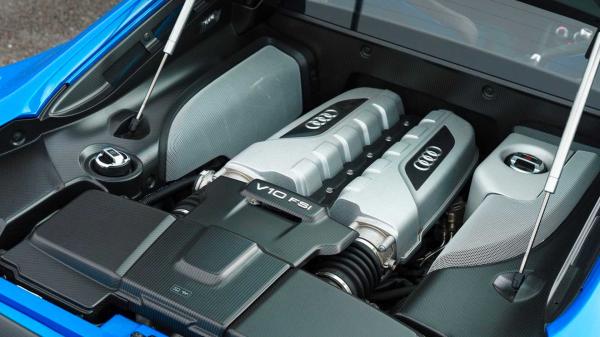
10 Cheapest V10 Cars On The Used Market In 2025
The new V10 market is in a sad state of affairs, but thanks to depreciation, some gems of yesteryear sell for seriously cheap.
The RS4 Secret Behind The R8’s Cheap Service Bills

The R8’s 4.2-liter V8 wasn’t designed in isolation just for a halo supercar. It’s essentially the same engine found in the B7-generation RS4, the same all-aluminum block and the same 32-valve layout, just fitted with a dry-sump oiling system so it can sit lower in the R8’s chassis and survive harder cornering. Audi basically borrowed a wagon engine, gave it a track-ready oil system, and dropped it behind the seats.
That shared history matters more than it sounds like it should. Because the block is fundamentally the same one sitting in thousands of RS4s on the road, any Audi franchise technician already knows this engine inside and out. There’s no need to hunt down a specialist shop or wait weeks for an appointment slot, since the local dealer has likely worked on this exact architecture all week.

A full service at an Audi franchise dealer runs around $1,180, and an independent specialist can knock that down closer to $830.
One important line needs drawing here, though. That pricing covers scheduled, routine servicing: oil changes, filters, fluids, and inspections. It does not cover wear items, and buyers should know that going in. Magnetic ride dampers, clutch wear from hard driving, and brake components are priced like genuine supercar parts on this car; no RS4 discount applies.
Same Bones As A Lamborghini, Half The Invoice

The R8’s other family connection is even more famous than its Audi roots. This car shares its chassis architecture, much of its drivetrain, and a long list of part numbers with the Lamborghini Gallardo, since both were developed under the same Volkswagen Group umbrella around the same time. They’re closer to siblings than rivals, mechanically speaking.
That kinship makes the service cost gap genuinely surprising. Average annual maintenance on a Gallardo runs around $1,400, and a major service can land anywhere from $1,260 to $3,810 depending on what’s due. Compare that to the R8’s roughly $1,180 full franchise service, and you’re looking at two cars built on remarkably similar hardware with very different invoices.
Some of that gap comes down to a quirk forum owners have noted for years: parts that share the same underlying design can carry different part numbers and wildly different sticker prices once the Lamborghini badge gets attached. Dealer network economics play a role too, since Lamborghini’s smaller, lower-volume service network simply charges more to stay profitable on fewer cars.
The same caveat from the last section applies here without exception. This comparison is about routine, scheduled service, not wear-and-tear repairs. A clutch failure or a magnetic damper issue will produce a supercar-sized bill on either car, and no amount of shared Audi parentage changes that math.

10 Affordable Supercars That Won’t Bankrupt You With Maintenance Costs
Supercar ownership doesn’t always need to break the bank! Here are 10 supercars that deliver exotic performance without sky-high maintenance costs.
The Last Great Gated Manual In A Mid-Engine Supercar

The gated shifter in this R8 isn’t just a nostalgic detail, it’s becoming one of the last examples of its kind in a mid-engine exotic. Most of the segment has already moved on to single-clutch automated manuals or dual-clutch paddles, and that open metal gate with its distinct mechanical click is quietly turning into its own collector category. This isn’t a maybe or a niche opinion among a few enthusiasts; it’s already happening in real time as values on manual examples start to separate from the rest of the market.
The 4.2-liter V8 version is arguably the purest way to experience that shifter today. It skips the extra weight that comes with the later V10 cars, and it skips the Lamborghini dealer network entirely while still delivering essentially the same driving sensation. Reviewers at the time praised this exact combination for being genuinely comfortable and easy to drive every day, not some stiff, temperamental exotic that only makes sense on a track day.
That’s really the whole story wrapped into one car. It can be bought for hot-hatch money, serviced down the street at a regular Audi dealer, and still deliver a shifting experience that nothing else on sale today can match.
Sources: Audi, PistonHeads, ClickMechanic, Scuderia Car Parts

Related posts





Latest Post



No Comments