
This Lamborghini V10-Swapped 1976 Volvo 240 Has The Opposite Problem Of Most Drag Cars
The Volvo 240 earned its reputation on crash safety, practicality, and durability, which made it the default choice for families who valued sensible over sporty. Lamborghini’s V10 sits at the other end of the spectrum, as a high-revving 10-cylinder built to give Italian supercars their howl.

One Swedish builder decided these two belonged together, and the result is now making passes at the drag strip. This Volvo’s biggest headache isn’t the problem most drag racers spend their time and money fighting, but the exact opposite.
The Volvo 240 And Lamborghini’s V10 Come From Opposite Worlds
Volvo showed the 240 to the world in August 1974, as a development of the 140 series. It arrived with a new overhead-cam four-cylinder engine family and boxy styling that put function well ahead of flair.

In 1976, the US National Highway Traffic Safety Administration chose the 240 as its standard car for continued safety work, which cemented Volvo’s image as a builder of safe family cars. That reputation kept the 240 in production for nearly two decades, and Volvo built 2,862,573 of them by the time it ended in 1993.

Lamborghini’s V10 debuted in the Gallardo in 2003, as the first engine the brand developed under Audi ownership. It later grew to 5.2-liters, and in the Huracán it made 602 hp without a turbocharger in sight.
The Huracán has since made way for the hybrid V8 Temerario, which retires Lamborghini’s V10 and makes every remaining example a little more special. Bolting one into a 1970s Swedish family sedan is about as far from its intended home as that engine could get.
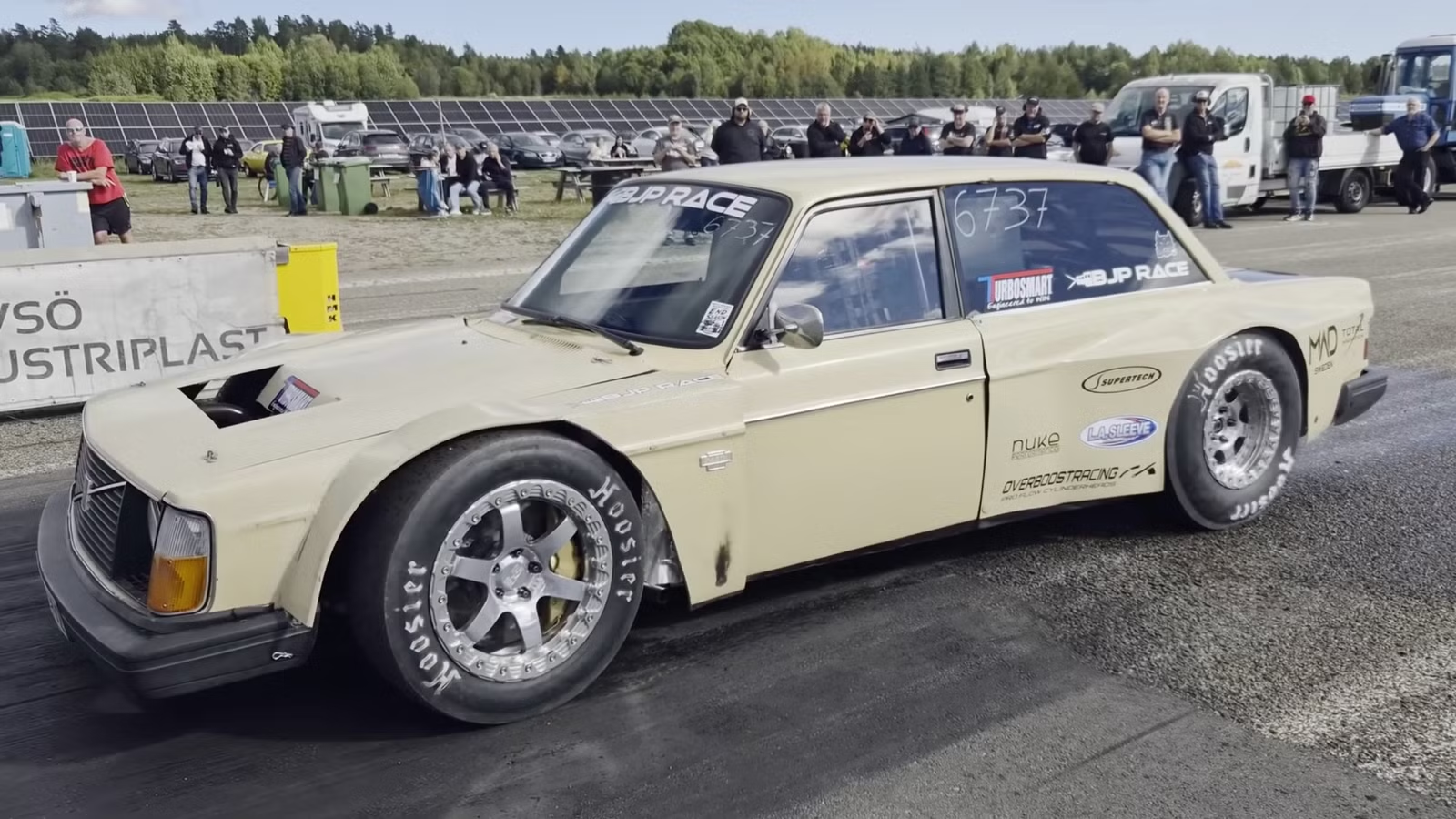
Meet Waffles, The Wheelie-Pulling AWD Volvo 240 With A Lamborghini Heart
Swedish builder and YouTuber Peter Björck started with a tan 1976 Volvo 240 that hadn’t been driven since 1993. He picked the 240 because its wheelbase is within 1 mm of the Audi R8’s, a close relative of the Huracán that donated the V10, the dual-clutch transaxle, and the front differential.
Björck cut out the 240’s floor pan and built a tube-frame chassis in its place, so very little of the original Volvo remains under the skin. The V10 now sits behind the cabin with forged rods and pistons, a billet intake manifold with 20 injector ports, and a pair of turbochargers sending power to all four wheels.

Björck named the car Waffles, and its first proper drag strip outing came at Hudiksvall Raceway in Sweden, a converted airfield. Its best eighth-mile pass took 5.34 seconds at 137 mph, with a 1.29-second 60-foot time.
Traction, the thing most drag racers chase with sticky tires and careful tuning, was never an issue. Running 15 psi in the tires all weekend, the AWD Volvo never spun its wheels, and instead it kept trying to lift its front end off the ground.

Those wheelies triggered the MoTeC engine management’s pitch control, which cut power so aggressively on one pass that Björck had to abort the run. On another, the data logs showed the front wheel speeds dropping as the nose climbed, yet he still refuses to bolt on wheelie bars.
137 MPH On Low Boost Is Only The Beginning For This Lambo-Powered Volvo
Björck’s plan for the wheelies leans on suspension rather than bars, with an anti-squat four-link setup on his list. He’s also weighing a switch from bias-ply slicks to radials, and he still needs to master MoTeC’s torque-based model, which kept cutting torque in third gear on the second day.
That 137-mph pass came on just 1.1 bar, or roughly 16 psi of boost, and even that oscillated as he worked out the Turbosmart wastegates. Björck estimates the turbos can handle 2 to 3 bar, though he isn’t yet sure how much boost the higher-compression V10 will take.

The Volvo now carries a parachute mounted where its trailer hitch used to sit, with the release handle in the headliner. He needs it above 149 mph, a speed he expects to pass once he runs the full quarter mile.
Gearbox software problems made the road here rough enough to cost him a spot at Street Week, Sweden’s 201-meter drag-and-drive event spread across five tracks. Even so, the car finished eight passes over its first weekend without needing a single repair, which is a promising start for something this wild.
Source: PeterBjorck via YouTube

Related posts



Latest Post


No Comments