
The Most Affordable Superbike You Can Buy Today
Liter-class sports bikes sell on performance, racing heritage, and the rush of a 1,000cc inline-four engine. Riders buy into this class for big power, sharp chassis dynamics, and track-ready ergonomics. But modern superbikes have become increasingly expensive to buy and live with. The push for peak horsepower numbers and track telemetry has brought steep price tags, complex electronics, and fragile components that are costly to maintain. Despite this trend, one Japanese manufacturer has kept the liter-bike formula straightforward by offering a dependable, fully updated superbike that undercuts every direct rival.
Much Of The Liter Superbike Segment Has Steep Showroom Markups Today

The modern superbike dilemma comes down to a single truth: buying into genuine 1,000 cc performance now requires deep pockets. For years, Japanese sports bikes were the accessible path to racetrack performance. Today, that is no longer the case. Flagship motorcycles from European and Japanese brands start at $18,000, and true racetrack-ready exotica will cost you at least $30,000. Buyers are expected to pay extra for complex electronic packages, dealer-locked features, and carbon-fiber bodywork that does very little on the street. Riders who simply want a fast, reliable liter-class machine with predictable handling are increasingly being priced out of contention.
But Sensible Engineering Has Brought Some Exceptions

The solution for keeping a sport bike affordable without stripping away its capability comes down to practical engineering. The goal is simple: preserve the immediate midrange punch and sharp handling of an authentic liter supersport, but avoid driving up the sticker price with unnecessary gimmicks or complex electronic suspension. Honda’s CBR1000RR and Kawasaki’s Ninja ZX-10R are both proof of this very approach, and they continue to attract buyers worldwide.

But if you want an even lower MSRP, Suzuki is where you need to look. The brand has tackled this by sticking to a proven platform backed by years of endurance racing and superbike championships. Instead of starting from scratch with an expensive clean-sheet redesign, the factory refined the engine internals, smoothed out the powerband, and fitted the essential modern rider aids to a dependable chassis to keep the price low.

The GSX-R1000 Proves Fast Doesn’t Have To Mean Expensive

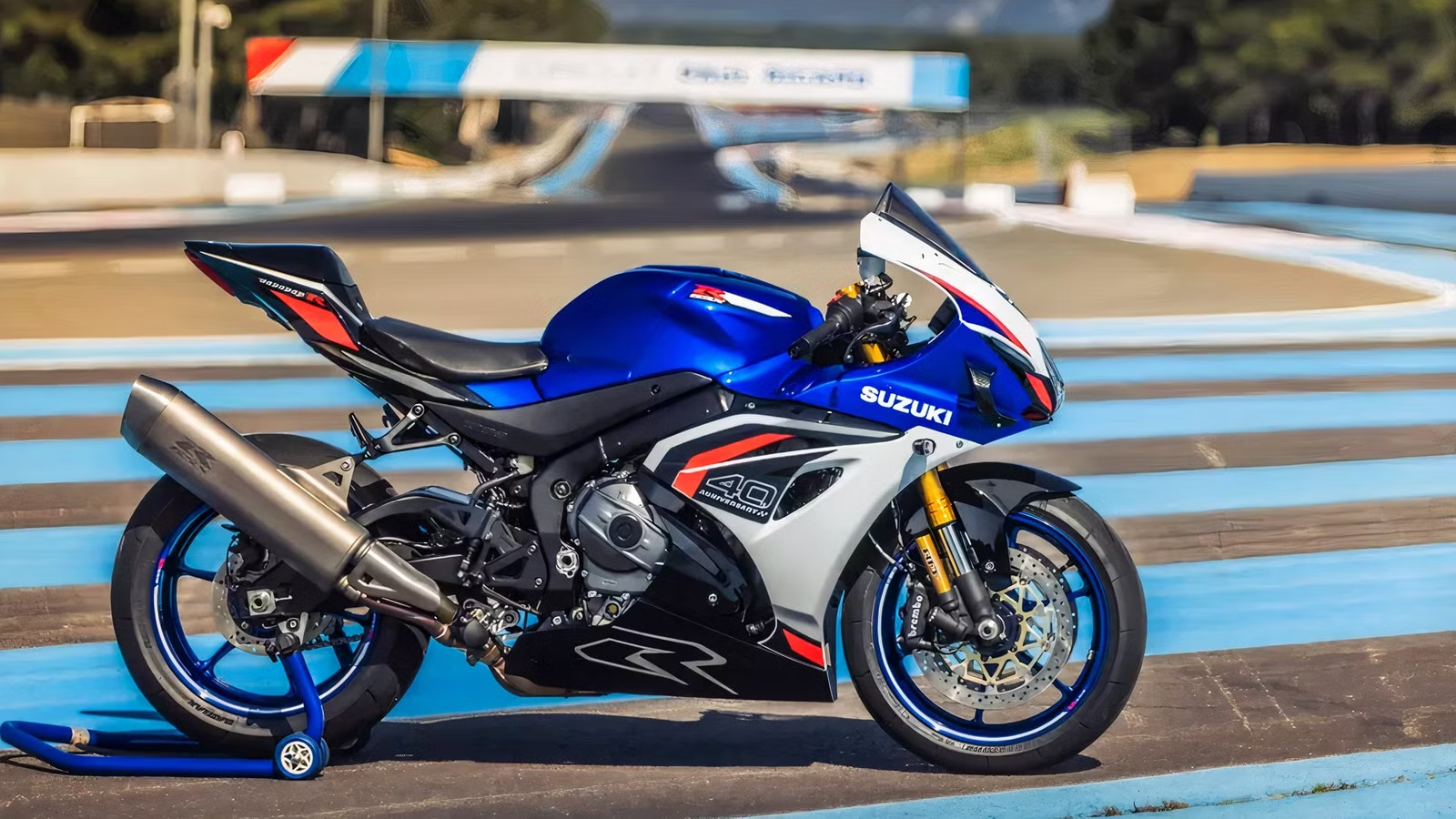
The result is the 2027 Suzuki GSX-R1000, one of the fastest motorcycles in the world. It offers authentic liter-bike performance at a price no other brand matches right now. Powered by an updated 999.8 cc inline-four, it pairs retro commemorative styling with Showa Big Piston forks, radial Brembo Monobloc brakes, and a six-axis IMU. It gives riders real-world midrange drive, front-end feel, and aggressive ergos without forcing them to pay exotic-bike money.
Just $16,399 For Proper Liter-Bike Performance

The GSX-R1000 costs $16,399, which makes this the cheapest way into real superbike performance. That’s $100 down from the previous-gen Gixxer. In doing that, Suzuki doesn’t cut any obvious corners, either. It has everything that you would expect from a liter-class superbike, short of electronic suspension or turn-by-turn electronic aids. This preference for affordable componentry also makes the GSX-R1000 one of the most affordable to maintain and one of the easiest to upgrade.

Suzuki has chosen not to reinvent the wheel, or the GSX-R’s engine, for its return in 2027. This is an engine that has been around since 2017, and has gone through a lot of incremental updates that helped make it a better unit overall while complying with tighter Euro 5+ emission norms. It still displaces 999.8 cc, has an inline-four-cylinder configuration, and a unique mechanical variable valve timing system. The latter originates from Suzuki’s MotoGP technology.

The output figures are 193 horsepower at 13,200 RPM and 81 pound-feet of torque at 11,000 RPM. This is a slight dip from the previous gen’s figure, but this is something that all high-performance engines undergo while meeting the latest emission norms. This engine is mated to a six-speed gearbox with an assist-and-slipper clutch and a standard two-way quickshifter. The GSX-R1000 engine is widely admired because of the way it develops torque in the low and midrange and how reliable it is.
Showa Big Piston Forks And Brembo Monoblocs Make Up The Underpinnings

There are barely any changes to the chassis compared to the previous generation GSX-R1000, which makes reliability feel exciting. This has an aluminum perimeter frame with 43 mm Showa Big Piston inverted forks at the front and a Showa monoshock at the rear; the suspension is fully adjustable. The brakes are twin 320 mm discs at the front with Brembo radial four-piston monobloc calipers, while there is a 220 mm brake disc at the rear with a Nissin single-piston caliper. 17-inch lightweight alloy wheels and high-performance tubeless radial tires are a given.
Compact Liter Dimensions Make The 32.5-Inch Saddle Feel Steeper In The Saddle
All three of the returning GSX-R1000’s variants share a length of 81.7 inches, a width of 27.8 inches, and a wheelbase of 55.9 inches. This is accompanied by a ground clearance of 5.1 inches, a seat height of 32.5 inches, and a curb weight of 448 pounds. The fuel tank can hold 4.2 gallons, meanwhile. These are all par-for-the-course dimensions for a liter-class superbike: a short length and extremely short wheelbase coupled with a slightly wide body thanks to the transverse inline-four engine.
Full Six-Axis IMU Safety Under $17,000 Is A Big Plus

Looking at the price and the electronics that the base GSX-R1000 offers makes it look like a modern-day miracle because of the sheer value it delivers in its segment. There is a six-axis IMU paired with the by-wire throttle, and it offers 10 levels of traction control, wheelie control, cornering ABS, and roll torque control. The last item is like predictive traction control, which helps you avoid getting into a slide rather than helping pull you out of one. Suzuki’s staples, like the Easy Start System and Low RPM Assist, are also present.

But when you look at the features, that’s where you see how Suzuki has managed to shave off those dollars. The base Gixxer has a reverse LCD; while it displays all the information you could possibly want at a glance, it is not a TFT screen, and there’s no Bluetooth or navigation even as an option.
The GSX-R1000 Rivals The CBR1000RR And ZX-10R

There are a surprising number of liter-class superbikes available in the market, right from the Suzuki GSX-R1000 all the way to track exotica that are not street legal. We are going to focus on two other Japanese liter-class base models because they are the only ones that are similar to the Suzuki in price. The nearest to the Suzuki is the Kawasaki Ninja ZX-10R at $16,999, which is a smart buy in its class. It has a 5-inch TFT instrument binnacle with Bluetooth connectivity and an Öhlins steering damper, but ABS costs $1,000 more.

It is the exact same playbook that Honda follows with the $17,099 Honda CBR1000RR: you need an extra $300 for ABS. Also, while the GSX-R has had incremental updates over the years, including one for 2027, the US-market Fireblade is the older SC77 platform that was first launched in 2017, so it has a five-axis IMU. The flip side is that it is probably the most reliable one among them all and, what’s more, makes it feel exciting!
Sources: Suzuki Cycles USA

Related posts



Latest Post


No Comments