
10 Beginner-Friendly Japanese Bikes That Quietly Master Everyday Riding
Buying your first motorcycle is easy if the only requirement is finding something small. But that’s a narrow use case that’ll leave you with another substantial expenditure the moment you outgrow it. Thus, finding one that remains genuinely useful on a daily basis even after the first six months into riding is a bit of a harder task at hand.

Japan’s major manufacturers currently offer a much broader spectrum of choices for this very purpose. Everything from scramblers to cruisers and even a supermoto is represented, so there’s something for everyone and every taste. The common thread is predictable power, manageable ergonomics, and enough everyday usefulness to survive well beyond the early learning stages.
10
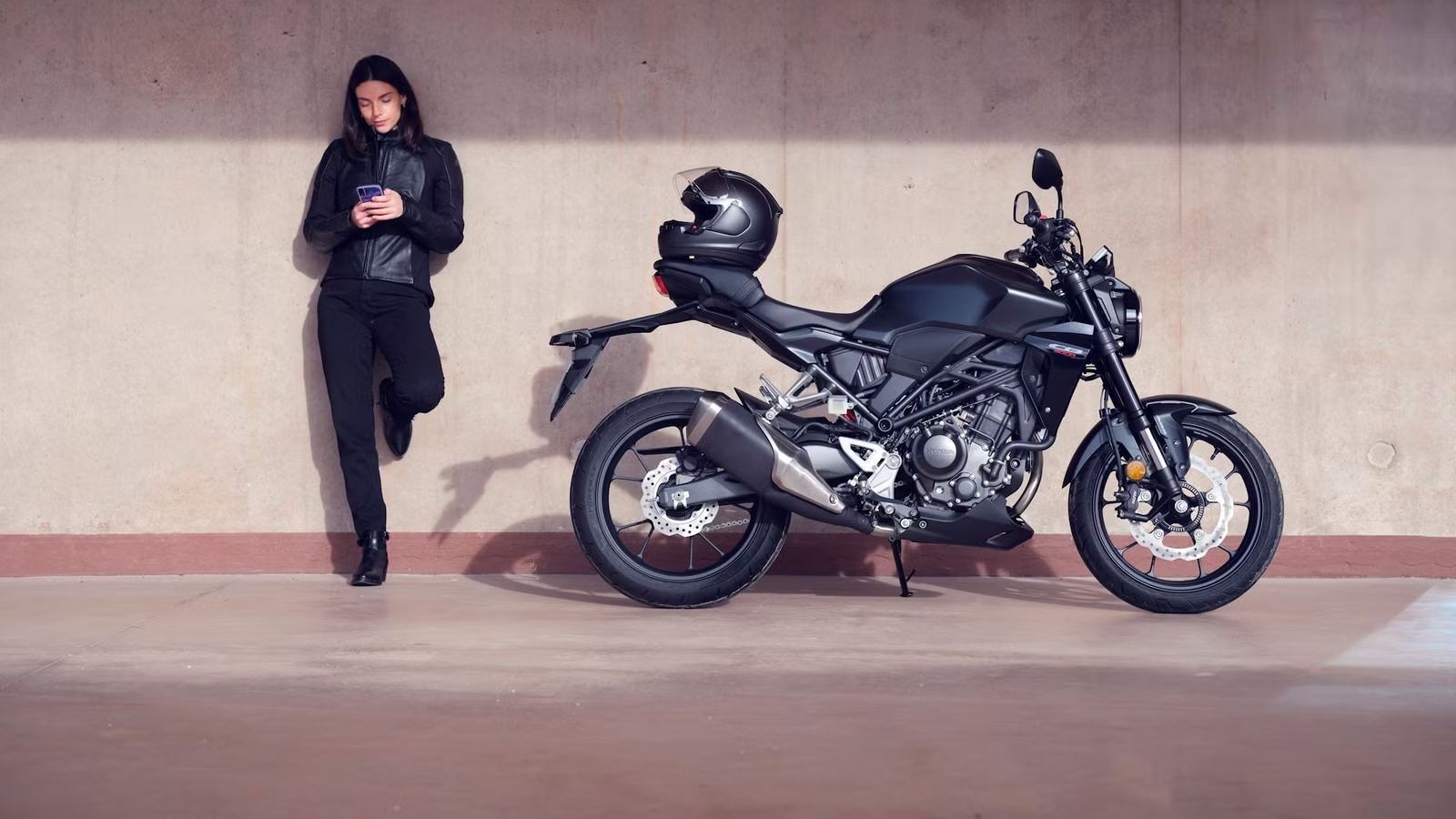
Honda CB300R
Price: $4,499
Honda’s smallest CB makes simplicity work in its favor. The 286cc liquid-cooled single is counterbalanced and fuel-injected, while the complete motorcycle weighs just 316 pounds ready to ride. This is a combination that makes low-speed corrections, parking-lot drills, and city maneuvering considerably less intimidating than its rivals. Standard ABS also removes one unnecessary variable while a new rider develops good braking technique.


Yet, the CB300R avoids feeling like a stripped-down training tool. Its 41mm fork, 17-inch wheels, and compact 53.2-inch wheelbase give it genuinely useful road manners, while the upright riding position works just as well for commuting as it does for learning proper cornering techniques. The 31.6-inch seat is taller than cruiser alternatives here, but the exceptionally low weight compensates.
9
Yamaha MT-03
Price: $4,999

The MT-03 adds a second cylinder without dramatically increasing the intimidation factor. Yamaha’s 321cc parallel-twin rewards revs but remains approachable at ordinary road speeds, giving beginners room to understand throttle control before they start exploring the upper half of the tachometer. Its narrow chassis and roughly 31-inch seat also make the motorcycle physically approachable despite its more aggressive MT-family styling.

More importantly, the Yamaha MT-03 can handle duties that frequently expose the limitations of smaller singles. The twin-cylinder engine is happier maintaining highway speeds, and its conventional upright ergonomics make repeated weekday trips considerably easier than a committed sport bike riding position would. Recent updates also brought an assist-and-slipper clutch and smartphone connectivity into the package.
8
Honda Rebel 300 E-Clutch
Price: $5,349

Few current motorcycles remove as many early learning hurdles as the Rebel 300 E-Clutch. Honda pairs its familiar 286cc single with the E-Clutch system, which automatically handles clutch engagement while leaving the rider responsible for shifting through the six-speed gearbox. You can pull away, stop, and change gears without touching the clutch lever at all, although conventional manual clutch operation remains possible whenever you’ve become comfortable.

That considerably reduces the chances of an embarrassing stall at an intersection, but the rest of the motorcycle is equally accommodating for new riders. Its seat sits only 27.2 inches from the ground, letting shorter riders put both feet down much more easily, while the engine delivers its performance without nasty surprises. At 379 pounds, the Rebel isn’t exceptionally light for its displacement, but its low center of gravity makes that figure less troublesome in practice.
7
Kawasaki Z500 ABS
Price: $5,699

Kawasaki’s Z500 ABS occupies a solid middle-ground in the beginner market. Its 451cc parallel-twin provides substantially more flexibility than most 300cc engines without jumping into genuinely serious middleweight performance. There is enough torque to avoid constantly chasing revs in traffic, while an assist-and-slipper clutch takes some strain out of repeated shifting and helps calm mistimed downshifts.

A 30.9-inch seat combines with a 368-pound curb weight, so the Z500 remains relatively easy to manage while stationary. ABS is standard on this version, and Kawasaki also includes smartphone connectivity through its Rideology app. Most importantly, there is enough motorcycle here for beginners to concentrate on developing technique, while improving riders are unlikely to outgrow the Z500’s limits immediately afterward.
6
Honda CB500 Hornet
Price: $5,899

The CB500 Hornet is where beginner-friendly starts overlapping with genuinely grown-up middleweight hardware. Honda’s 471cc parallel-twin has long been valued for its tractable delivery, and the 2026 Hornet combines it with a slipper clutch that reduces clutch-lever effort by 45 percent. Smooth low-speed response matters far more to a new rider than a dramatic peaky delivery, and this engine has enough flexibility to tolerate an imperfect gear choice without complaint.

Honda hasn’t cheapened the chassis to hit its surprisingly low price either. The Hornet gets a 41mm Showa Separate Function Fork-Big Piston (SFF-BP), twin 296mm front brake discs with four-piston calipers, and standard ABS. Its 414-pound curb weight requires slightly more respect than the 300-class choices, but the 31.1-inch seat remains reasonable. Add a generous 4.5-gallon tank, and this is arguably closer to an everyday motorcycle that happens to suit beginners than a beginner motorcycle awaiting replacement.
5
Honda CRF300L Rally
Price: $6,499

Adventure bikes tend to become large remarkably quickly. The CRF300L Rally offers the same general freedom of an ADV without requiring a new rider to wrestle with 500-plus pounds of motorcycle. Honda’s familiar 286cc single sits inside a machine weighing 333 pounds ready to ride, backed by 10.2 inches of suspension travel at both ends and proper 21-inch front and 18-inch rear wheels.

Its 35.2-inch seat is the obvious caveat. Shorter beginners should try one out before getting carried away by the Dakar-inspired bodywork. For riders who fit it, however, the Rally has unusually broad everyday usefulness. A 3.4-gallon tank, tall windscreen, extra bodywork, standard ABS, and comfortable upright ergonomics make commuting and longer road rides feasible, while the light chassis and long suspension open up unpaved routes.
4
Honda SCL500
Price: $6,999

The SCL500 uses much of the same sensible mechanical foundation as Honda’s other 471cc twins but packages it around scrambler styling and relaxed roadster ergonomics. Its liquid-cooled parallel-twin delivers predictable power through a six-speed transmission and slipper clutch, while standard ABS adds braking reassurance. Nothing about the powertrain asks a beginner to stay constantly on guard, as its real appeal is versatility.

Suspension travel reaches 5.9 inches at the front and 5.7 inches at the rear, and the 19-inch front wheel gives the SCL a little more tolerance for imperfect pavement as well as trail ventures than a conventional naked bike. The 31.1-inch seat is accessible for a middleweight, but the 425-pound curb weight is noticeable, particularly during parking maneuvers. The good part is that this usually forgotten motorcycle is actually substantial enough for passengers, highway use, and longer days in the saddle.
3
Kawasaki Vulcan S ABS
Price: $8,149

The Vulcan S ABS proves engine capacity alone is a poor way to judge whether a motorcycle suits a newcomer. Its 649cc parallel-twin produces a claimed 60 horsepower, but Kawasaki tunes the package around accessible road performance rather than cruiser theatrics. A 27.8-inch seat puts the rider reassuringly close to the pavement, and the long wheelbase gives the Vulcan S a settled ride on the move.

Its cleverest beginner feature is ergonomic rather than electronic. Kawasaki’s Ergo-Fit system allows the seat, foot controls, and handlebar arrangement to be tailored for different rider sizes, addressing a massive bike fit problem that rivals don’t offer a solution to. The ABS version does weigh just under 500 pounds, so it demands more care at slower speeds. Once underway, though, it offers enough performance and comfort to make a second purchase unnecessary for quite some time.
2
Kawasaki Ninja 650 ABS
Price: $8,199

The Ninja 650 ABS looks considerably more serious than a conventional beginner bike, yet its specifications remain surprisingly approachable. Kawasaki’s 649cc parallel-twin delivers useful low- and midrange performance rather than demanding superbike-like revs, and the motorcycle’s 31.1-inch seat is no higher than several other bikes on this list. The ABS-equipped model weighs about 426 pounds ready to ride.

Its everyday advantage is its riding position. Despite the Ninja’s bodywork, the handlebars sit high enough and the footpegs low enough to avoid the committed ergonomics associated with supersports. A 4.0-gallon tank and fairing also make highway commuting and longer rides considerably easier. This is better suited to a disciplined beginner than someone who wants the least powerful motorcycle possible, but it offers perhaps the clearest path from first bike to long-term sport bike.
1
Suzuki DR-Z4SM
Price: $8,999

The DR-Z4SM is the oddball here, and possibly the reason for its attraction. Suzuki rebuilt its famous supermoto formula around a modern 398cc fuel-injected single, ride-by-wire throttle, three selectable power-delivery modes, traction control, and ABS with a rear-wheel-off setting. The result still prioritizes simplicity and directness, but electronics now give less experienced riders more ways to tailor its responses.

At just 340 pounds ready to ride, the Suzuki is exceptionally easy to throw around once moving. Fully adjustable KYB suspension, 17-inch wheels wearing Dunlop Sportmax Q5A tires, and a 310mm front brake mean the chassis also has considerably more ability than most motorcycles sold as beginner-friendly. The catch is its towering 35-inch seat, which can make stops awkward for shorter newcomers. But if you fit that ergonomic requirement, then commuting, rough pavement, tight back roads, and the occasional track session are turned into thrilling experiences by the DR-Z4SM rather than giving you separate reasons to own another motorcycle.
Source: Various Manufacturers

Related posts


Latest Post


No Comments