
The Sports Bike With Honda Reliability And Harley-Level Presence
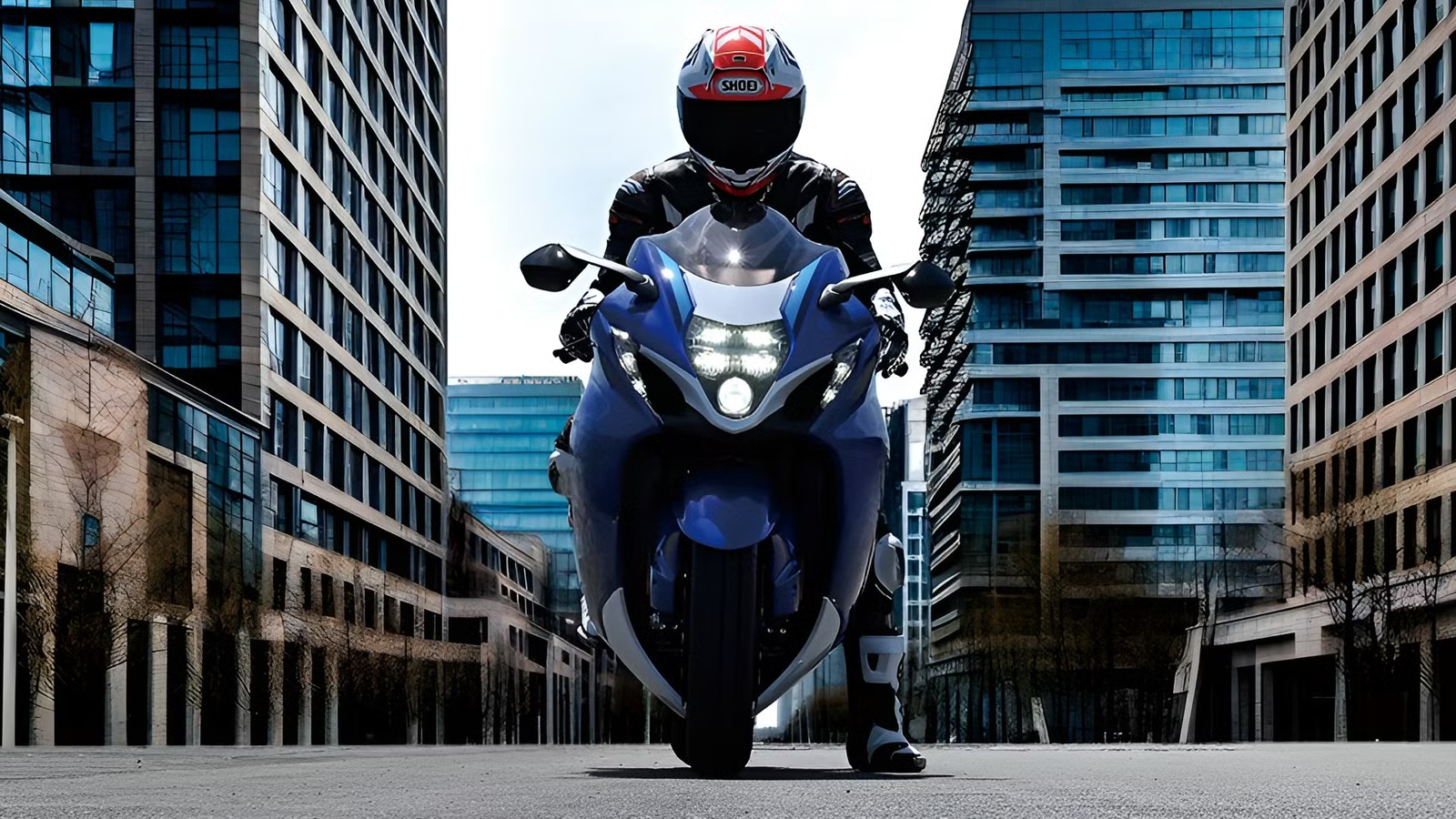
Sports bikes are built to thrill — aggressive, loud, and unapologetically focused on performance over comfort. But every so often, a machine comes along that breaks the mold without abandoning what makes the breed great. The Suzuki Hayabusa is exactly that bike: a fully-faired sports machine that delivers blistering performance alongside genuine, long-haul reliability — and does it all wrapped in one of the most iconic silhouettes in motorcycling history. After 27 years, this nameplate still turns heads like a Harley and runs like a Honda. Here’s why it remains one of the most compelling daily-rideable sports bikes on the market.
Why Honda Sets The Standard For Reliability
Understressed Mechanical Components And Rock-Solid After-Sales Support Are Key Attributes

In the motorcycle world, Honda dominates reliability rankings thanks to exceptional engineering, longevity, and high-quality builds. A primary reason for Honda’s fame is its understressed suite of motorcycle engines. These are built with robust, durable components that experience far less strain even after extended runs, which directly extends their service life.
From the humble yet funky urban-going Monkey to the wicked-fast CBR sports bike, the reliability quotient remains consistent. Honda sustains that elevated standard across its entire lineup through relatively low-maintenance components and one of the most extensive parts and service networks in the industry. Together, these factors cement Honda as the benchmark for motorcycle reliability.
Whereas, Harley-Davidson Always Turns Heads
Beautifully Fuses 120+ Years Of Legacy And Modern Technology


Harley-Davidson is a heritage-rich American motorcycle maker. Its legacy is built on classically styled design, shiny rumbling V-twins, and a cultural identity that has earned it one of the most loyal fan bases in motorcycling. Prime examples include the Fat Boy and the modern-day Hydra-Glide Revival. Abundant chrome, burbling V-twin engines, vibrant color choices, and commanding dimensions ensure that a Harley-Davidson is never mistaken for anything else on the road. Its deep-rooted cultural legacy has made the brand a recognized phenomenon in virtually every corner of the world.
The 2026 Suzuki Hayabusa Offers Honda Reliability And Harley-Level Presence
Priced From $19,499

Suzuki is famed for consistently refining their motorcycles. While exotic European makers are praised for pushing the envelope with bleeding-edge, futuristic technology, Japanese manufacturers — and Suzuki in particular — take a more measured approach, focusing on perfecting what they already have. This philosophy is a primary reason why the Suzuki Hayabusa delivers Honda-grade reliability despite being a fierce sports bike. The engine and chassis are calculated evolutions of the mighty first-generation 1999 Suzuki Hayabusa, which was once the fastest production motorcycle on the road.
At the same time, the Suzuki Hayabusa’s design is one of the most iconic and recognizable in the world. The current-generation model’s styling traces its DNA directly to the first-gen Busa, launched 27 years ago. Even then, Suzuki prioritized aerodynamic efficiency to achieve extreme, stable high-speed performance. Much like a Harley is instantly identified by its distinctive old-school visual cues and V-twin soundtrack, the Hayabusa stands out with its muscular, timeless shape and a long, low form factor. The iconic Kanji symbol — representing the peregrine falcon — on the fairings is among the most recognizable Japanese motifs in the world.
What’s New On The 2026 Hayabusa

Suzuki adds a new Special Edition that dials up the visual drama. The new Hayabusa Special Edition features a Pearl Vigor Blue finish accented by contrasting trim and details. The Kanji symbols are rendered in bright white, making the characters pop against the bodywork. This model also receives a special-edition badge on the fuel tank, which features raised Suzuki lettering for added texture. Rounding out the look are black tail covers on the dual stainless steel mufflers, color-matched 17-inch wheels, white-trimmed side cowls, and a color-matching rear seat cowl.

While the base 2026 Hayabusa starts from $19,499, the Special Edition is priced higher at $20,129. Beyond the visual updates, there are no mechanical or electronic changes for 2026 — a reflection of just how thoroughly sorted the Hayabusa already is. Suzuki had already meaningfully upgraded the bike in 2025 with more versatile cruise control and a revised launch control system.
How Can This High-Performance Motorcycle Be So Reliable

The famed “bulletproof” reliability of the Suzuki Hayabusa has everything to do with how carefully its mechanical package has been developed. At the core sits an overengineered four-cylinder engine whose crankshafts, pistons, and connecting rods are designed for both high performance and long-term durability. It’s not an exaggeration to call it the 2JZ of motorcycle engines — the sheer number of heavily modified Busas out there speaks for itself. Even turbocharged builds are far from rare in the Hayabusa community.
While Suzuki has evolved its 1,340 cc mill over the years, the core architecture still traces back to the original Hayabusa’s 1,299 cc inline-four. Decades of consistent refinement have transformed that foundation into one of the most reliable sports bike engines ever produced. The motor is well known for surpassing 100,000 miles without requiring a major overhaul.
The Hayabusa’s Iconic Four-Cylinder Engine Packs Immense Torque

The 1,340 cc four-cylinder engine on the Hayabusa is one of the largest units fitted to a production sports bike today. This legendary motor features a ride-by-wire electronic throttle body with dual fuel injectors per cylinder and a compression ratio of 12.5:1. A neatly integrated ram air intake system in the nose of the aerodynamic front fairing ensures a steady supply of pressurized air at speed. All of these elements combine to produce 187.4 horsepower and 110.6 pound-feet of torque, with a characteristically strong mid-range. Thanks to years of mechanical and electronic refinement, the Busa — despite its intimidating performance credentials — is a remarkably approachable machine.
This Fast Motorcycle Is A Comfortable Mile-Muncher Too

Working in concert with the tractable four-cylinder engine is an equally well-developed chassis, paired with versatile suspension and braking hardware that help make the Hayabusa a surprisingly capable touring motorcycle. It uses a twin-spar aluminum frame suspended by fully adjustable KYB-tuned suspension at both ends. Braking duties are handled by Brembo Stylema calipers clamping twin 320 mm rotors up front, delivering strong and progressive stopping power.
Massive Dimensions Bring Massive Stability

Despite its substantial footprint — a wheelbase of 58.3 inches and an overall length of 85.8 inches — the Suzuki Hayabusa still manages to be a comfortable highway companion. A low seat height of 31.5 inches, combined with a ground clearance of just 4.9 inches, keeps the center of gravity low and the bike accessible even for shorter riders. That low center of gravity also contributes to the Busa’s rock-solid highway stability at all speeds. To make the Hayabusa genuinely touring-ready, Suzuki offers a range of accessories including a taller touring screen, tank bags, luggage hooks, and more.
Commendable Electronics To Tame The Peregrine Falcon

Suzuki has equipped the Hayabusa with a comprehensive suite of electronics that both elevate the riding experience and keep the rider protected. The cockpit blends analog and digital instrumentation — a deliberate nod to tradition in an era dominated by full-TFT displays. Underpinning it all is the S.I.R.S. (Suzuki Intelligent Ride System), driven by a six-axis Bosch IMU that enables versatile, customizable electronic intervention.
Key features include 10-mode traction control, a 3-mode power selector, a bi-directional quickshifter, anti-lift control, motion-tracking ABS, and an active speed limiter. Adaptive cruise control — refined further in 2025 — makes long-distance riding more relaxed. Other notable electronic features include:
- Motion Track Brake System and Traction Control
- Suzuki Drive Mode Selector Alpha (SDMS-a)
- Suzuki Easy Start and Low RPM Assist
- Slope Dependent Control System
- Launch Control System
- Engine Brake Control
- Hill Hold System
Sources: Suzuki

Related posts
Latest Post


No Comments