How Ford’s 2.7 EcoBoost Became The F-150 Engine Buyers Prefer
11 minutes reading
Monday, 5 Oct 2026 13:30 0 6 autotech
Truck buyers are conditioned to think bigger is better. When a Ford F-150 offers a 3.5-liter EcoBoost with the highest conventional towing capacity and a 5.0-liter Coyote V8 with the sound and reputation buyers expect from a pickup, the smaller 2.7-liter EcoBoost can look like the engine you settle for to save money.
That assumption misses what made the 2.7 EcoBoost so successful. It delivered enough power for daily driving, enough towing capacity for most recreational trailers, and better fuel economy than the larger engines without feeling like a budget powertrain. Ford will replace it with a 3.0-liter EcoBoost for 2027, but that change looks more like an evolution of the 2.7’s formula than an admission that it failed.
A Bigger Engine Is Not Always The Better Truck Engine
Horsepower And Displacement Can Distract From Everyday Usability
Low angle 3/4 shot of 2023 Ford F-150 in blue Posing on top of rocky terrainFord
Ford gives an F-150 shopper several compelling ways to justify spending more. The 3.5-liter EcoBoost produces 400 horsepower and 500 pound-feet of torque, while the 5.0-liter Coyote delivers 400 horsepower and 410 pound-feet. Both engines appear more appropriate for a full-size truck than a 2.7-liter V6, especially when you judge them only by displacement or maximum capability.
Most owners, however, spend considerably more time commuting, carrying passengers, and running errands than towing at the truck’s limit. In those situations, throttle response, low-speed torque, fuel consumption, and purchase price matter more than the highest number in Ford’s towing guide. The 2.7 EcoBoost was engineered around those everyday priorities.
Its 325 horsepower is modest next to Ford’s larger engines, but its 400 pound-feet arrives low enough in the rev range to make the F-150 feel responsive. You do not have to rev it like a naturally aspirated economy engine to merge into traffic or climb a grade. But if the 2.7 EcoBoost was so capable, why did buyers overlook it for years — and what finally changed?
Most F-150 Owners Do Not Need The Maximum Tow Rating
Front 3/4 view of 2018 black Ford F-150 towing.Ford
A properly configured recent F-150 with the 2.7 EcoBoost can tow approximately 10,000 pounds, depending on model year, cab, bed, drivetrain, axle ratio, and equipment. That is less than the 13,500-pound maximum available with the 3.5 EcoBoost, but it still covers many travel trailers, boats, utility trailers, and recreational loads.
Maximum tow ratings also require very specific configurations. Passengers, accessories, cargo in the bed, and trailer tongue weight consume payload capacity, which can become the limiting factor before an owner reaches the advertised towing maximum. Buying the 3.5 EcoBoost makes sense when you regularly pull a heavy trailer, but its extra capability provides little benefit if your trailer weighs 6,000 pounds.
The 5.0 V8 occupies a different position. It appeals to owners who want a naturally aspirated response, familiar V8 character, and a broad aftermarket, but it does not automatically become the best towing choice simply because it has more cylinders. That value argument looks stronger once you see what Ford actually built into the engine — and why it took buyers a few years to notice.
The 2.7 EcoBoost Became The F-150’s Unexpected Sweet Spot
Ford’s Smaller V6 Produces 325 Horsepower And 400 Lb-Ft Of Torque
2019 Ford F-150 Towing A Travel TrailerFord
Ford introduced the 2.7 EcoBoost to the F-150 for 2015, and the engine improved substantially for 2018. The second-generation version retained direct injection but added port injection, increased torque, reduced internal friction, and received more precise electronic wastegate controls. Ford paired it with the 10-speed automatic, which helps keep the engine within its broad working range.
The result is a combination that rarely feels undersized in normal driving. The transmission can select a lower ratio when the truck is loaded, while the turbochargers provide useful torque without requiring high engine speeds. An unloaded 2.7-liter F-150 can also feel lighter and more eager than buyers expect from an entry-level powertrain.
That distinction matters because Ford did not tune the 2.7 strictly for fuel economy. Its acceleration is strong enough that owners are not constantly reminded that they chose the smaller option. You receive a legitimate truck engine that happens to have a smaller displacement, not an economy engine attempting to move a full-size pickup.
Its Appeal Came From Balance Rather Than One Class-Leading Number
Front 3/4 shot of 2025 Ford F-150 in red parked off-roadFord
Ford has not released reliable public engine-level sales figures proving that the 2.7-liter engine outsold every other F-150 powertrain. Claims that it was definitely the truck’s top-selling engine should therefore be treated cautiously unless registration data can verify them. Ford’s decision to make it the standard engine across much of the recent lineup nevertheless demonstrates how central it became to the F-150.
Owner discussions tell a similar story but do not provide a scientific sales ranking. Long-term owners frequently praise the engine’s acceleration, highway range, and ability to tow moderate loads, while shoppers repeatedly describe it as the sensible alternative to the 3.5 EcoBoost. That consensus is not the same as verified take-rate data, but it helps explain why the 2.7 developed such a loyal following.
The engine succeeded because it rarely forced a buyer to accept an obvious daily compromise. You could save money and fuel without ending up with a truck that felt slow, while still retaining considerably more towing ability than many owners needed.
The Numbers Explain Why The Smaller EcoBoost Worked
Real-World MPG Matters More Than The EPA Label Alone
Shot of a Ford F-150 cruising on the highway while towingFord
In comparable recent F-150 configurations, the 2.7 EcoBoost generally carries the strongest EPA rating of the three conventional gasoline engines. A 2024 RWD version was rated at 20 city/ 26 highway mpg, and 22 mpg combined. Comparable 3.5 EcoBoost and 5.0 V8 trucks were generally rated lower, although drivetrain, tires, axle ratio, and equipment can change the result.
The difference is not always dramatic in real-world driving. Turbocharged engines consume significantly more fuel when repeatedly asked to produce boost, and towing can shrink the 2.7’s advantage over the larger engines. Third-party testing has repeatedly shown that trailer weight, speed, wind, and terrain influence fuel consumption more than a small difference in an EPA estimate.
The 2.7 still holds an advantage for owners who spend most of their time driving an empty or lightly loaded truck. Saving two or three mpg can become meaningful over 15,000 annual miles, particularly when the smaller engine also costs less to purchase. That benefit becomes less important for an owner who tows near the engine’s limit every week.
The 3.5 EcoBoost And 5.0 V8 Still Win For The Right Buyers
Blue 2021 Ford F-150 Raptor PosedFord
The 3.5 EcoBoost remains the better tool for frequent heavy towing. Its additional 100 pound-feet provides more reserve on grades and during highway merging, while the right configuration unlocks the F-150’s highest conventional tow rating. An owner pulling a large travel trailer should prioritize that reserve over a modest unloaded fuel-economy advantage.
The 5.0 V8 makes its case through simplicity of operation rather than absolute mechanical simplicity. It lacks turbochargers, and its linear power delivery and familiar exhaust note remain valuable to traditional truck buyers. However, modern cylinder deactivation and variable valve timing systems mean the Coyote is no longer an old-fashioned, low-complexity V8.
You should therefore choose according to workload. But choosing the right engine at the dealership is only half the decision — what separates a smart 2.7 purchase from an expensive one happens over the next 100,000 miles.
Long-Term Ownership Determines Whether The Smaller Engine Was Smarter
The Nano V6 Was Designed For Strength, Not Merely Efficiency
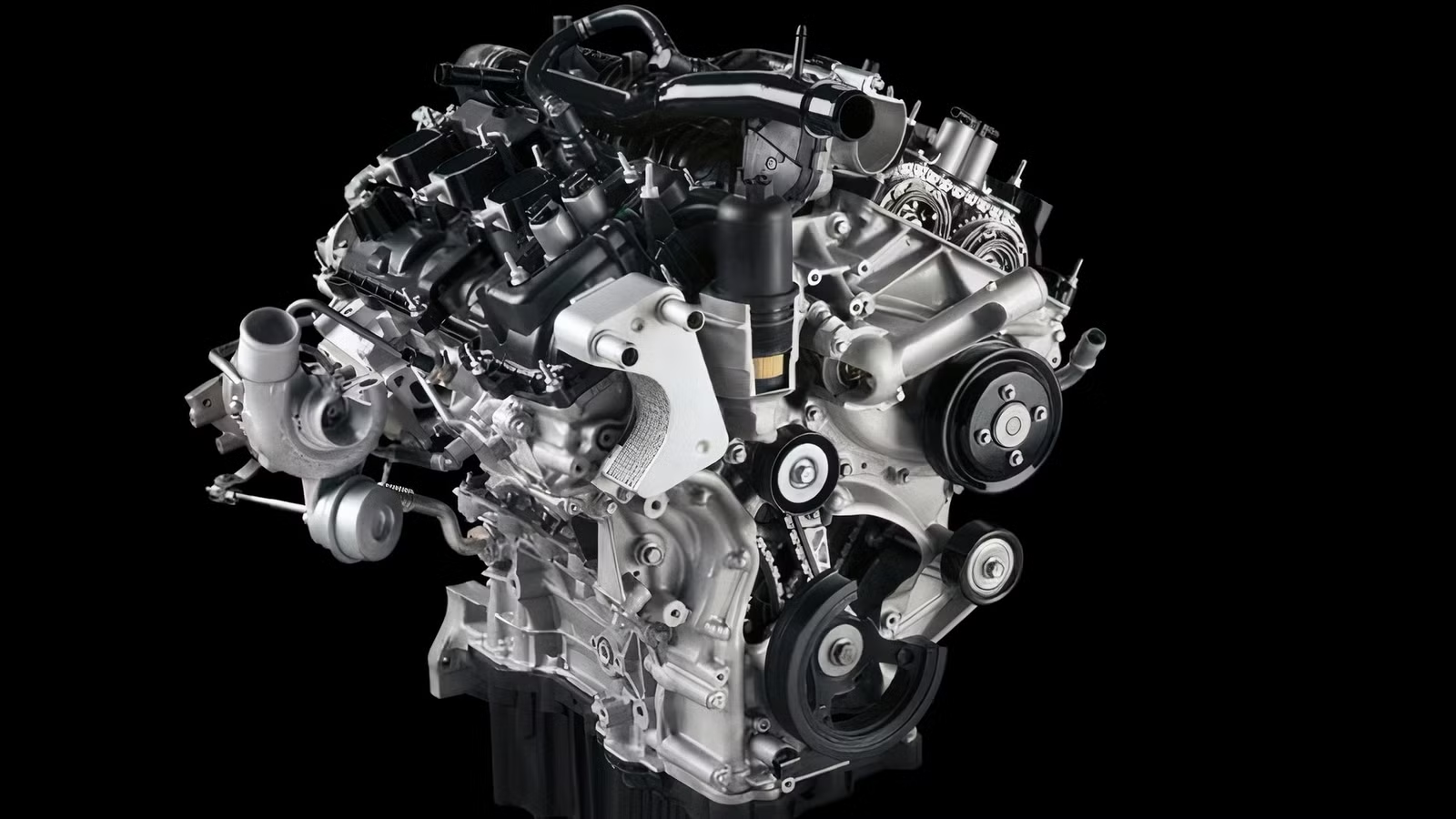
Close up studio shot of 2.7-Liter Ford EcoBoost V-6Ford
The 2.7 belongs to Ford’s Nano V6 family and uses a compacted graphite iron block rather than a conventional aluminum block. Compacted graphite iron provides substantial strength for its weight and is also used in demanding diesel applications. Ford combined that block with aluminum cylinder heads, integrated exhaust manifolds, and two compact turbochargers to create an engine capable of handling high cylinder pressures.
The engine is sometimes inaccurately described as having “twin-scroll turbos.” The important distinction is that the 2.7 uses twin turbochargers, one per cylinder bank, rather than a single twin-scroll turbocharger. Their small size helps them respond quickly, contributing to the engine’s strong low-speed performance.
The second-generation engine’s combination of port and direct injection also provides an ownership advantage over direct-injection-only systems. Port injectors can help wash the backs of the intake valves, reducing the potential for carbon accumulation. That does not make the engine maintenance-free, but it addresses one concern associated with earlier direct-injected engines.
Maintenance History Matters More Than Internet Engine Rivalries
Front three-quarter view of a gray Ford F-150 Platinum towing an airstream trailerFord
Ford’s normal schedule uses its Intelligent Oil-Life Monitor rather than a fixed oil-change interval. Trucks subjected to towing, extensive idling, dusty conditions, short trips, or extreme temperatures may require service sooner, and frequent towing can bring oil changes into the roughly 3,000- to 5,000-mile range. A used 2.7 with documented, timely oil changes is a safer purchase than one stretched to the maximum interval.
Ford calls for spark plug replacement at 100,000 miles under normal use, followed by automatic transmission fluid and filter service at 150,000 miles. Buyers planning to keep an F-150 past 100,000 miles should also budget for belts, hoses, ignition coils, fluid services, and inspection of the turbocharger oil and coolant lines. Severe-use trucks may need transmission, axle, and transfer-case fluids sooner than the normal schedule suggests.
Earlier 2.7-liter trucks can develop composite oil-pan leaks, while neglected examples may experience ignition misfires, boost-control problems, or coolant and oil leaks. Turbocharger replacement is not routine maintenance, but one failed assembly can cost roughly $1,600 to $2,000 before regional labor differences and related repairs. Comparable F-150 oil pan sealing work can cost $700 to $950, making a thorough pre-purchase inspection worthwhile.
Rear three quarter shot of a gray Ford F-150 drivingFord
The 3.5 EcoBoost carries similar turbocharged-engine risks and has a more visible history of cam-phaser complaints in certain generations. The 5.0 avoids turbo replacement but introduces its own potential expenses, including oil consumption concerns in some years and the complexity of modern valvetrain components. No engine offers a guaranteed inexpensive trip beyond 100,000 miles, which makes the condition of the individual truck more important than online brand loyalty.
Ford also recalled certain 2021 and 2022 vehicles equipped with 2.7 and 3.0-liter Nano-family engines because defective intake valves could fracture. Affected engines generally failed relatively early, and Ford extended coverage after recalling and testing the identified vehicles. A VIN check and complete service history should be mandatory when considering one of those model years.
The 2.7 EcoBoost Proved That Enough Engine Can Be The Best Engine
Ford’s 2027 F-150 Replaces 2.7 Liters With 3.0 Liters
The 2027 F-150 retires the 2.7 EcoBoost and replaces it with a 3.0-liter twin-turbo V6 derived from the same broader engine family. Ford rates the new engine at 325 horsepower and 400 pound-feet, matching the outgoing 2.7’s headline output rather than chasing the 400-horsepower engines above it.
The meaningful change is where the engine delivers its torque. Ford says the 3.0 reaches peak torque at approximately 2,250 rpm, substantially earlier than the outgoing engine’s published peak. That should make the new base engine feel stronger during ordinary acceleration and while moving a trailer, even though its maximum output barely changes.
Ford’s decision does not suggest buyers rejected the smaller EcoBoost concept. The company enlarged and returned to the same basic idea: quick turbo response, abundant low-speed torque, and enough capability for the majority of F-150 owners. The replacement validates the formula even as it closes the 2.7-liter chapter.
The Right F-150 Engine Depends On The Work You Actually Do
Driving shot of a blue 2024 Ford F-150 XLT towing a trailer on a forest highway shown in front 3/4 viewFord
A used F-150 shopper should not dismiss the 2.7 simply because Ford has moved to a 3.0-liter engine. A well-maintained 2018-or-newer truck offers an improved dual-injection engine, strong everyday performance, useful towing capacity, and potentially lower fuel costs than the larger gasoline options. Service records, transmission behavior, cold-start operation, oil leaks, and recall completion matter more than choosing the biggest displacement.
The 3.5 EcoBoost remains worth the additional cost when you frequently tow a heavy trailer, while the 5.0 V8 suits buyers who specifically want its character and naturally aspirated response. If your truck spends most of its life commuting, carrying home-improvement supplies, and occasionally pulling a moderate trailer, the 2.7 may be all the engine you need.
That was the smaller EcoBoost’s real achievement. It convinced buyers that choosing an engine with enough power could be smarter than paying for the most powerful engine available.
Base Trim Engine
2.7L EcoBoost V6 ICE
Base Trim Transmission
10-speed automatic
Base Trim Drivetrain
Rear-Wheel Drive
Base Trim Horsepower
325 HP @5000 RPM
Base Trim Torque
400 lb.-ft. @ 3500 RPM
Base Trim Fuel Economy (city/highway/combined)
17/25/20 MPG
Make
Ford
Model
F-150
Segment
Full-Size Pickup Truck
Sources: Ford, Car and Driver, Fueleconomy.gov, Kelley Blue Book, Edmunds, NHTSA, RepairPal, J.D. Power












No Comments