
The Best Duramax Ever Built Is A Two-Year Truck That Outlasts Every Diesel
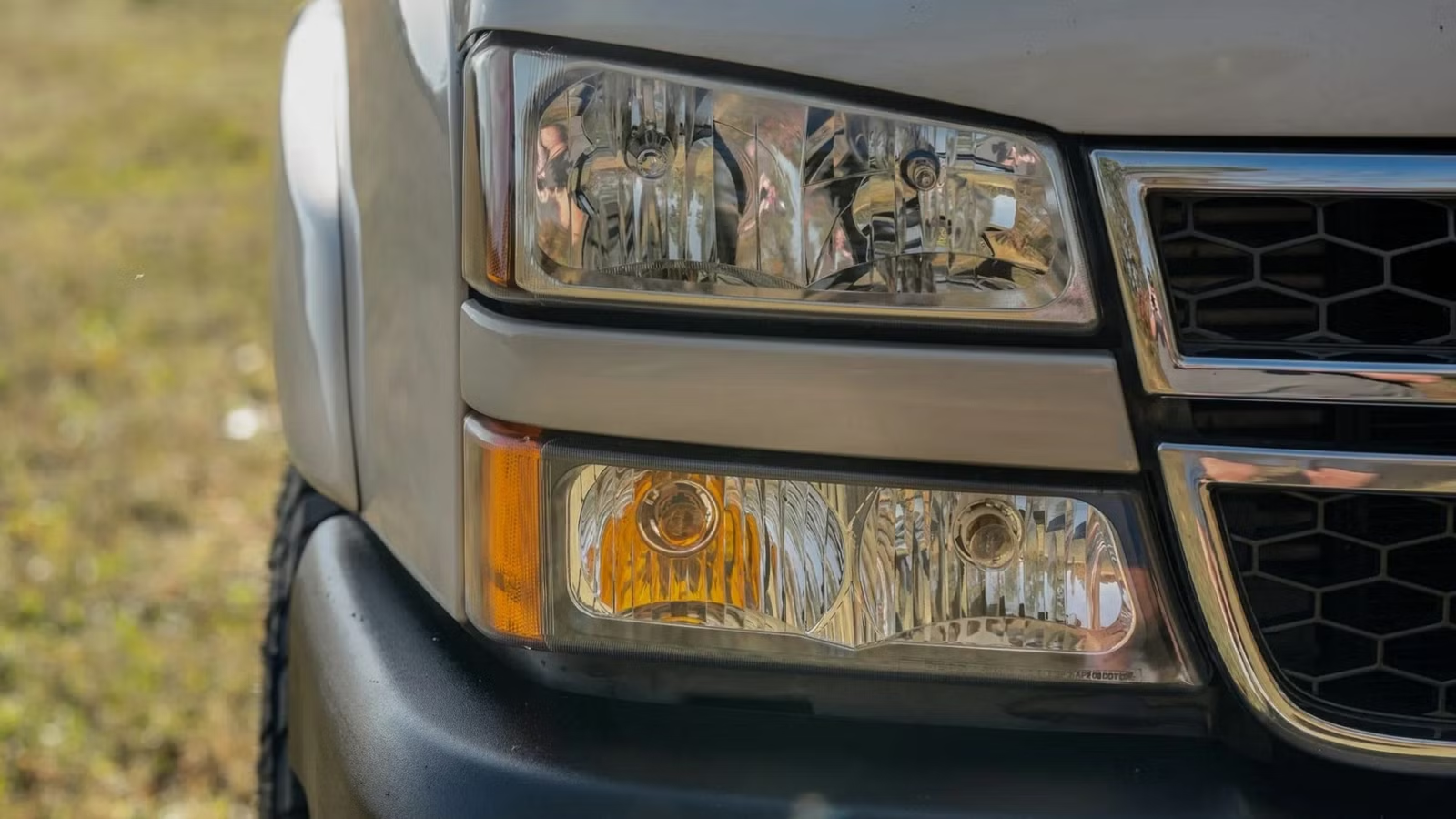
Diesel truck progress usually moves in one direction: new engines make more power, tow more weight, run cleaner, and sit inside quieter, smarter trucks. However, no matter the evolution, one brief stretch of GM heavy-duty production keeps pulling buyers backward through time. These pickups are nearly old enough to have their own mortgages, but clean examples remain desirable because they landed in a narrow gap between early diesel growing pains and the more complex hardware that followed.
Diesel Trucks Got Better On Paper — And More Complicated Underneath

A new Chevrolet Silverado HD shows how far diesel pickups have come. The current 6.6-liter Duramax makes 470 horsepower and 975 lb-ft of torque, paired with a 10-speed Allison automatic. Newer trucks also bring stronger chassis hardware, better brakes, improved cooling, quieter cabins, smarter trailer tech, and safety features older HD pickups never had. Anyone towing a large fifth-wheel through mountain country would notice the difference quickly.
The trade-off sits underneath all that progress. Starting with the LMM generation, Duramax pickups gained a diesel particulate filter, or DPF, that catches soot and burns it during regeneration. The later LML added selective catalytic reduction and diesel exhaust fluid, better known as SCR and DEF. Those systems serve a real purpose: EPA rules beginning with the 2007 model year cut the particulate-matter limit for heavy-duty diesels by roughly 90 percent, and verified DPF systems can slash particulate emissions by 85 to 90 percent or more.
The used-truck question here is not old versus new – it is whether a buyer values simpler hardware or newer capability and cleaner emissions control.

GM Hit A Tiny Sweet Spot Just Before The Rules Changed

By 2006, GM had already spent several years improving its 6.6-liter diesel. Engineers strengthened the block around the cylinder bores and main-bearing areas, revised the rods and pistons, raised common-rail fuel pressure, opened up the turbo inlet, and added a newer engine controller. Output jumped too – the earlier LLY made 310 horsepower and, in its later form, 605 lb-ft of torque. The 2006 engine stepped up to roughly 360 horsepower and 650 lb-ft.
Then the timing window closed. That engine survived through 2006 and into the 2007 Classic trucks before GM switched to the LMM, which brought a DPF. The short-lived version kept Bosch’s CP3 high-pressure fuel pump and, on automatic trucks, gained the six-speed Allison 1000. It also arrived years before Duramax pickups adopted SCR and DEF. Buyers briefly got strong, then-modern diesel performance without the exhaust-treatment systems that defined later generations. Apparently, one extra transmission gear and fewer things hanging off the exhaust were enough to create a cult following.
The 2006–2007 LBZ Duramax Is The Two-Year Truck Buyers Still Chase

That engine was the 6.6-liter LBZ Duramax, sold in 2006 and early-2007 Chevrolet Silverado HD and GMC Sierra HD pickups. Those 2007 models belong to the older “Classic” body generation; the redesigned trucks moved to the LMM. The easiest way to identify a real LBZ is the VIN – an LBZ-equipped truck carries “D” as the eighth VIN digit. Keep that in mind for crossover years, when seller descriptions were not always as precise as buyers might hope.
The LBZ’s appeal comes from the package, not one miracle part. Its 360 horsepower and 650 lb-ft of torque still make it a useful tow engine. GM strengthened the block and rods, raised common-rail pressure beyond 26,000 psi, enlarged the turbo inlet, and used a new 32-bit engine controller. Bosch’s CP3 remained at the heart of the fuel system, while automatic trucks received the six-speed Allison 1000. The LBZ also avoided the DPF and DEF systems used on later Duramax generations. Still, calling it an engine with “no emissions equipment” is wrong – it used EGR and a diesel oxidation catalyst.

Over the years, mileage heroes built the legend. One 2006 Chevrolet 2500HD LBZ owner reported approaching 430,000 miles while describing the truck as still largely original. The repairs at that point sounded more like normal aging than catastrophic engine trouble: hydroboost seepage, worn bearings, old belts, cooling-stack cleaning, transmission cooler lines, and tired interior parts. Of course, that does not prove every LBZ will reach 400,000 or 500,000 miles, but it does show why the engine earned a durability reputation.
The LBZ also benefited from lessons learned on earlier Duramax engines. Its stronger block webbing and connecting rods gave it more margin than its predecessors, while the larger turbo inlet helped address airflow and heat concerns linked to the LLY. It still has failure points, though – modified engines can crack pistons, and variable turbo vanes can stick. Also, water pumps fail, transmission cooler lines seep, and front-end parts wear. Nothing can save a truck from road salt, poor maintenance, or a previous owner with a hot tune and more enthusiasm than judgment.
The LBZ, LML, And L5P Solve Three Different Work-Truck Problems

The LBZ fits buyers who put simplicity near the top of the list. Its 360 horsepower and 650 lb-ft remain useful, the CP3 has a long history, and there is no DPF regeneration or DEF tank to consider. Its biggest drawback is age – every LBZ is now roughly two decades old. Rust, cooling-system condition, wiring, front-end wear, steering play, transmission history, and previous modifications can matter as much as the engine itself. An excellent diesel inside a rotten truck still leaves the buyer with a rotten truck.
The LML, sold from 2011 through 2016, gives the buyer more factory output and a newer chassis. It made 397 horsepower and 765 lb-ft, added SCR and DEF alongside the DPF, and used Bosch’s CP4.2 high-pressure pump instead of the CP3. That pump is not without risk: failures can spread metal debris through the high-pressure fuel system and turn one bad part into a much larger repair. Not every LML will suffer that failure, but fuel-system history deserves careful attention. For buyers who want more power without moving into the newest trucks, the LML represents a middle ground.

The L5P puts modern capability first. It arrived for 2017 with substantially more power than the LBZ and replaced the LML’s Bosch pump with a Denso high-pressure system. Current versions make 470 horsepower and 975 lb-ft, paired with a 10-speed Allison automatic, while properly configured Silverado HD models can tow up to 36,000 pounds. The L5P also brings current emissions hardware, stronger chassis development, better cabin refinement, cameras, trailer aids, and newer safety tech. For frequent heavy towing, those advantages can matter far more than mechanical simplicity.
The Best LBZ Isn’t The Lowest-Mileage One — It’s The Least-Abused One

That creates an odd used-truck market. Buyers may pay extra for an older LBZ partly because it lacks hardware newer trucks gained, but mileage alone does not tell the whole story. A 120,000-mile truck with rust, poor tuning, neglected fluids, or a hard towing life can be a worse buy than a stock 250,000-mile example with detailed maintenance records.
A serious buyer should start with the VIN and confirm that eighth digit D. From there, service history is more important than shiny paint – an unmodified powertrain, or one modified carefully, deserves priority over a mystery tune and missing factory parts. Inspect the frame and body for rust, check the cooling system, watch injector and fuel-system behavior, pay attention to cold starts, examine transmission cooler lines, test the Allison through its shifts, and look for front-end wear or signs of aggressive tuning.

The LBZ’s reputation never came from being the most powerful Duramax GM built. It came from timing – by 2006, the 6.6-liter diesel had matured, GM had strengthened key hardware, power had risen sharply, and automatic trucks gained the newer transmission. Soon after, Duramax pickups entered the DPF era, followed by SCR, DEF, more sensors, and increasingly complex controls. The LBZ landed in the narrow gap after the Duramax grew up but before diesel technology entered its next phase. GM built that combination for barely two years, which is exactly why buyers still search for it.
Source: GM, Chevrolet

Related posts


Latest Post


No Comments