
10 Japanese Motorcycles That Deserve To Stay In Your Garage Forever
Japanese motorcycles set the benchmark for reliable, refined bikes that can last virtually forever with timely maintenance. This isn’t limited to safe, daily-ridable bets; it also includes track-ready sportbikes and naked bikes, style-first cruisers, and even go-anywhere dual-sports. But despite this edge, not all Japanese bikes deserve to stay in your garage forever. Only a special few are worthy, ranging from luxurious full-dressers to surprisingly comfortable sportbikes, and even a discontinued yet still-undisputed 200-horsepower muscle cruiser. Honda, Yamaha, Suzuki, and Kawasaki clearly offer some very engaging forever companions.

This list is organized in descending order of pricing.
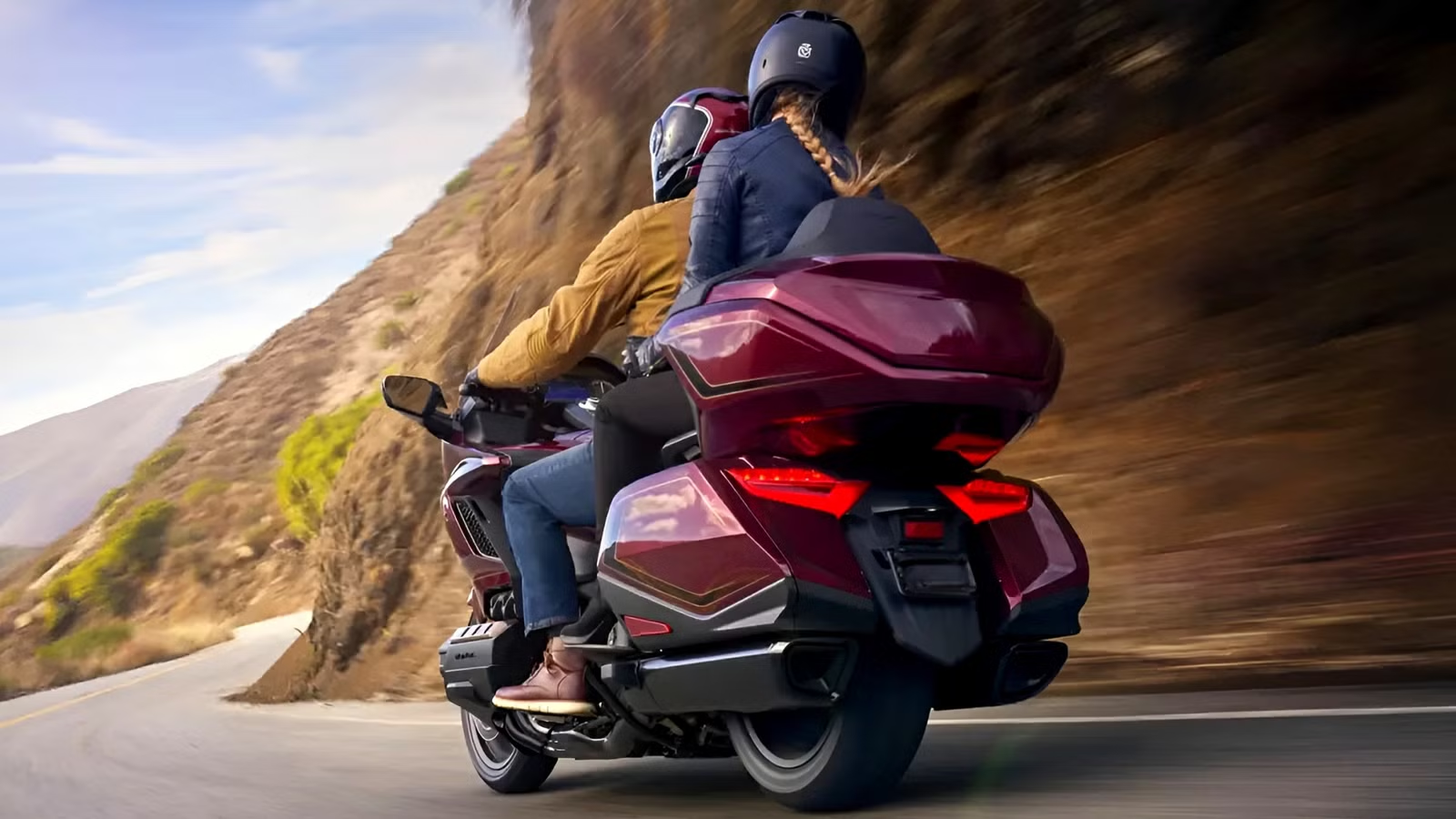
Honda Gold Wing Tour
Price: $29,500
This is Honda’s flagship touring bike that takes the fight to the big guns from Harley and Indian and wins big time. For under $30,000, the Gold Wing Tour offers a lot more in technology, features, and unique appeal than its big-twin counterparts. Powering this luxury tourer is a unique flat-six engine, the only one of its kind. It produces 124.7 horsepower and 125.3 pound-feet of torque. Standard, power goes to the rear wheel via a shaft-driven six-speed manual gearbox.

Honda also offers the only motorcycle-spec seven-speed DCT. This is also the only motorcycle in the world that can be equipped with an airbag from the factory. The underpinnings are equally unique, with a die-cast aluminum twin-beam frame, a double-wishbone suspension up front, and a Pro-Link monoshock on a single-sided swingarm at the rear. Technology features are top-spec too. Notable ones include multiple ride modes, traction control, cruise control, and hill-hold assist.

Suzuki Hayabusa
Price: $19,499

The Suzuki Hayabusa is a motorcycle that has become so popular that even people who aren’t into motorcycles know the nameplate and its iconic design. This surprisingly comfortable sportbike makes reliability feel exciting. Since its inception, the Hayabusa has stayed true to its iconic and bulbous design. Its versatile inline-four engine has also proved its mettle over the years. Its balance of performance, looks, refinement, and reliability is why, despite an incremental update in 2026, the Busa still stays desirable.

The Busa’s effortless 1,340 cc inline-four produces 187 horsepower and 110 pound-feet of torque. Power is sent to the rear wheel via a stress-enduring six-speed manual gearbox with clutch assist. Its sophisticated chassis is designed for high-speed stability and is backed by a slew of top-spec electronic aids that are the best in the class. Notable ride-enhancing ones include wheelie control, cornering ABS, engine brake control, launch control, ride modes, and power modes.
Suzuki Boulevard M109R
Price: $15,799

This underrated muscle cruiser bike brings the best of both worlds together—the visual intimidation of a big-twin American cruiser and the refinement and value-packed appeal of a Japanese motorcycle. The Suzuki Boulevard M109R is currently the most powerful Japanese cruiser bike on sale. A beastly 1,783 cc V-twin engine powers it. This liquid-cooled mill produces 128 horsepower and 118 pound-feet of torque. Despite being 20 years old, the M109R remains highly capable and even dwarfs the mighty Triumph Rocket 3 Storm in engine piston size.

Power is sent to the rear wheel via a five-speed manual gearbox. Its heavy-duty underpinnings also add to its muscular appeal. A surprising feature here is the braking system, which Suzuki has derived from the 2000s GSX-R sportbike. Its huge size and timeless, muscular design help the M109R stay relevant for years to come. Proven refinement, reliability levels, and an aggressive price make this Suzuki an underdog power cruiser to buy today.
Second-Gen Yamaha V-Max
Used Prices Start From $15,000

This discontinued Japanese motorcycle deserves a second chance. The second-gen Yamaha V-Max is essentially still the segment leader in power cruisers. Even after six years off the market, no other wild cruiser has outclassed this desirable Yamaha. The rival list includes the 182-horsepower Ducati Diavel V4 RS and the 180-horsepower Triumph Rocket 3 Storm R. Powering Japan’s flagship power cruiser is a robust 1,679 cc, 65-degree V4 engine with forged pistons, fuel injection, and an impressive performance curve.

It produces 197 horsepower and 123.7 pound-feet of torque. The chassis comprises a gravity-cast aluminum mainframe that uses the engine as a stressed member. Suspension duties are taken care of by top-spec fully adjustable hardware. This is an iconic power cruiser which will most likely never be replicated. Getting one is tough, as owners know its value. But if you do, even for around $18,000 to $20,000, it is still worth it.
Honda CBR600RR
Price: $11,499 (Non-ABS) / $12,499 (ABS)

This is a rare specimen of an aggressive sportbike that will outlive its owner. The Honda CBR600RR is the last of its kind with a high-revving four-cylinder engine, underseat exhaust, and raw riding dynamics devoid of sophisticated electronics. It is as analog as a sportbike can be in 2026. It also brings refined, proven engineering to the mix. It is a proper middleweight supersport in an era of ‘soft’ parallel-twin sportbikes. The Honda CBR600RR is powered by a 599 cc liquid-cooled inline-four engine that refuses to quit.

It produces 119 horsepower and 46.5 pound-feet of torque and revs to 15,000 RPM with ease. Power is sent to the rear wheel via a six-speed manual gearbox with an assist and slipper clutch. For hardcore riders, Honda also offers a non-ABS version. The underpinnings are lightweight and designed for precision handling. The chassis is a twin-spar aluminum frame suspended on fully adjustable Showa suspension. Years of refinement have arguably also made this the most reliable sportbike today.
Suzuki V-Strom 650XT
Price: $9,799

Despite being virtually unchanged since 2019, the third-gen Suzuki V-Strom 650 still holds its ground in 2026 against more modern rivals. Its undisputed reliability and refinement steal the spotlight from top-spec technology and performance ratings. Furthermore, the XT version adds durability and go-anywhere appeal with laced wheels and added protection all around. An unkillable V-twin powers the V-Strom 650XT.

Its legendary 645 cc, 90-degree, liquid-cooled mill has been around since 1999. It has been going strong ever since, with subtle yet impactful updates that have refined it over the years. It produces 70 horsepower and 45.7 pound-feet of torque. Power is sent to the rear wheel via a six-speed manual gearbox. The underpinnings are designed for stability and durability, and the V-Strom’s comfortable, cocooned ergonomics make it an easy 500-mile motorcycle that will never break.
Honda Shadow Phantom
Price: $9,299

The Honda Shadow Phantom’s desirability and timeless appeal come from its mix of proven engineering and custom-inspired styling. This is also why it is one of those cruiser bikes that riders keep longer than any other motorcycle. It offers the perfect balance of comfort, style, and value among cruiser bikes under $10,000. Powering this timeless mile-muncher is a proven classic-vibing V-twin. The 745 cc liquid-cooled mill produces approximately 45 horsepower and 48 pound-feet of torque.

Reliability is its strong suit, as Honda has been refining the current Shadow’s core formula since 1997. The underpinnings are traditional and sturdy, comprising a double-cradle steel frame. It is suspended on 41 mm telescopic forks up front and preload-adjustable twin shocks at the rear. Technological features are minimal, and it only gets dual-channel ABS. But this also makes it easy to repair and keeps spare parts affordable. Furthermore, for those prepared to look beyond brand allegiance, this is the most value-packed and equally desirable Harley-Davidson alternative today.
Suzuki DR-Z4S
Price: $8,999

This is the long-overdue successor to the extremely durable but outdated Suzuki DR-Z400S dual-sport. The DR-Z4S is a properly modern offering that scores high on design, features, and performance. Powering this go-anywhere Suzuki bike is a massively updated 398 cc single-cylinder engine. This liquid-cooled mill produces 37 horsepower and 27 pound-feet of torque. While these numbers may seem modest, its low curb weight of just 333 pounds changes the perspective, yielding a commendable power-to-weight ratio.

Power is sent to the rear wheel via a five-speed manual gearbox. The underpinnings are durable and lightweight, with a focus on off-road finesse. The DR-Z4S sits on a twin-spar chassis with long-travel KYB suspension. It is loaded with technology too. Notable features include ride-by-wire, three power modes, two-level traction control, and a dedicated ‘Gravel’ mode for added capability on trails. A switchable ABS also adds to the fun.
Suzuki SV650
Price: $8,149

This underappreciated streetfighter fuses Ducati-grade drama with Japanese-grade refinement, reliability, and value. The exposed trellis frame, compact form factor, and circular headlamp enclosure strongly remind us of the OG Ducati Monster. This gives the SV650 a surprisingly elevated exotic appeal. Beneath the appealing design sits a 27-year-old platform that refuses to quit. Its V-twin engine is equally impressive and refuses to bow down to technological advancements. This 645 cc V-twin has been around since 1999 and is today the only V-twin in its class.

This engine is so timeless that Suzuki has adapted it for the all-new SV-7GX crossover. On the SV650, it produces 75 horsepower and 47 pound-feet of torque with a focus on meaty low- and mid-range torque. Power is sent to the rear wheel via a six-speed manual gearbox. The underpinnings are designed to deliver fun yet stable riding dynamics. Ergonomics are comfortable, with a seat height of 30.9 inches and a fairly relaxed rider triangle. The Suzuki SV650 is in a league of its own.
Kawasaki KLR650
Price: $6,999

This motorcycle is outdated but still overbuilt to outlast the competition. The KLR650 is the longest-surviving motorcycle in Kawasaki’s lineup, with the first model launched in 1987. Surprisingly, this dual-sport has changed little over its forty-year run, and that’s its strength. The KLR has been on the road for so long that Kawasaki has virtually refined it into an indestructible machine. The engine and chassis reflect simple, rugged engineering. It is also a capable dual-sport that can easily be transformed into a globe-trotter with Kawasaki’s official accessories alone.

The aftermarket support for this icon is limitless and widespread thanks to its popularity. A workhorse liquid-cooled, single-cylinder engine powers the KLR650. The 652 cc mill produces 40 horsepower and 39.1 pound-feet of torque. Its robust underpinnings include a semi-double-cradle frame and long-travel suspension with up to 8 inches of travel. The ergonomics are comfortable for urban runs, off-road trails, and long highway rides. This is one of those few motorcycles that will never leave you stranded.
Sources: Suzuki Cycles, Honda Powersports, Yamaha Motorsports, and Kawasaki.

Related posts
Latest Post


No Comments