
The Retro Twin That Undercuts A Triumph Bonneville By Thousands
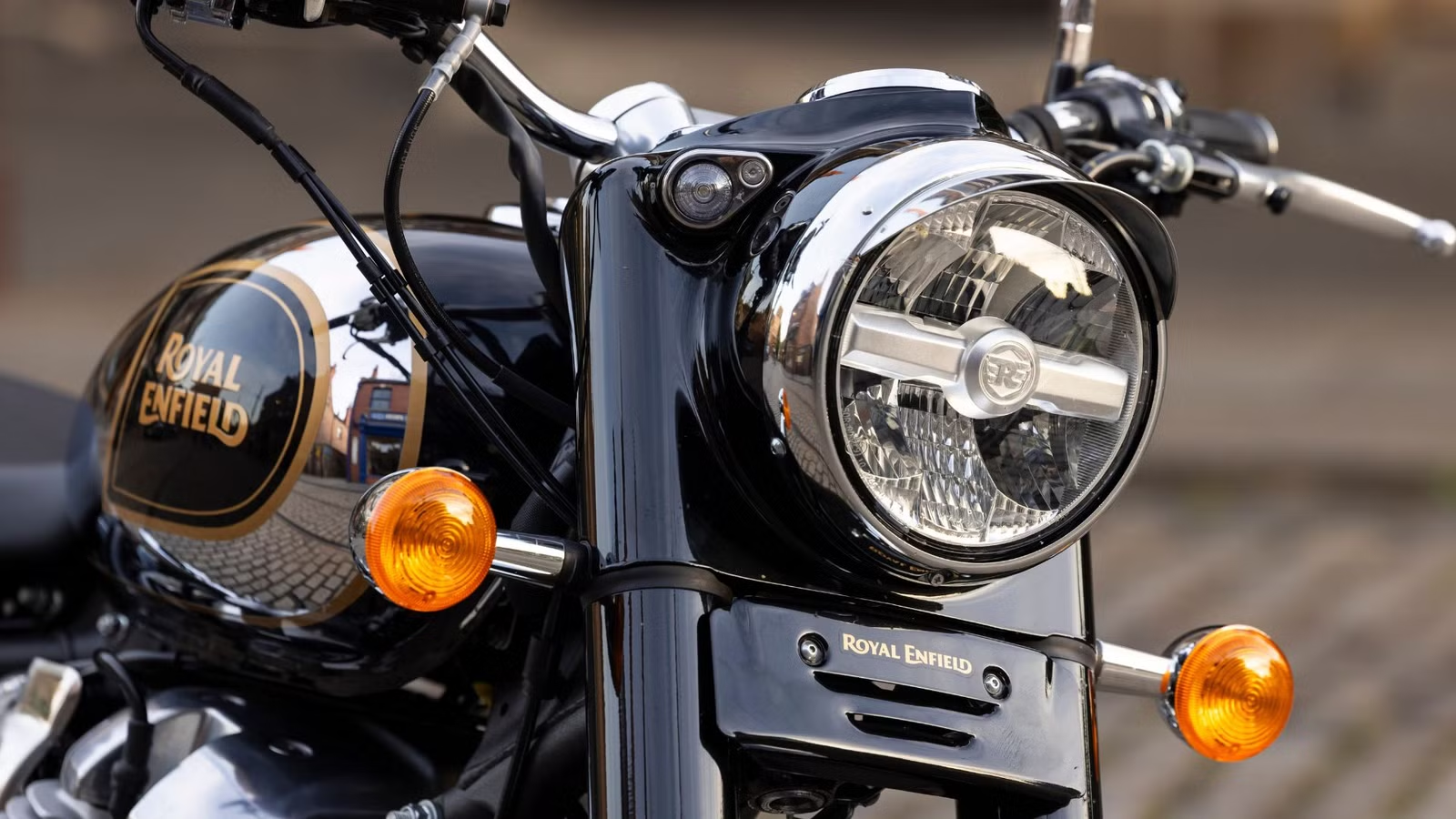
There’s something undeniably appealing about a motorcycle that looks like it could’ve rolled straight out of the 1960s. A teardrop fuel tank, plenty of chrome, wire-spoke wheels, a relaxed riding position — it’s a formula that’s survived decades because it simply works. Modern classics aren’t about chasing lap times or boasting cutting-edge electronics. They’re about slowing things down, enjoying the ride, and connecting with motorcycling’s roots. Ironically, that simplicity has become surprisingly expensive.

Over the past decade, the “modern classic” category has evolved from a niche corner of the market into one of motorcycling’s hottest segments. As demand has grown, so have prices. Heritage branding, premium finishes, and increasingly sophisticated technology have pushed many retro-styled motorcycles well into premium territory. For riders who simply want the timeless Bonneville experience — a charismatic parallel twin wrapped in classic British-inspired styling — the cost of entry is now higher than ever.
The Rising Cost Of Riding A “Modern Classic”
The Multi-Cylinder Price Barrier
Retro motorcycling has always had a two-tier structure, whether shoppers think about it in those terms. On one side sit the single-cylinder machines — bikes like Royal Enfield’s own Classic 350 or Honda’s Rebel 300 — that get new riders into the look and feel of a heritage bike without draining a savings account. They’re light, approachable, and cheap to insure. What they’re not, generally, is capable of comfortable interstate work. A single-cylinder retro can feel strained at 75 mph for hours at a stretch, and it rarely has the visual heft that seasoned riders associate with a “real” roadster.

Step up to a proper twin, though, and the price jumps dramatically. For years, crossing from a budget single into a genuine heritage twin meant crossing into five-figure territory almost automatically. That gap between the cheap bikes and the “grown-up” bikes has been one of the odder pricing quirks in motorcycling — there was very little in between.
The Triumph Bonneville Benchmark

No bike defines that upper tier better than the Triumph Bonneville. For 2026, theBonneville T120carries a base MSRP of $13,995, a jump of $1,100 over the previous model year, and that price doesn’t include freight, setup, tax, or anything else a dealer tacks on afterward. Triumph does offer a slightly gentler entry point in the T100, priced at $11,495, but even that “budget” Bonneville still costs more than plenty of riders expect to spend on something styled after a 1959 original.
There’s a reason the T120 gets used as the reference point rather than the T100, though. The name Bonneville is basically shorthand for the whole retro-twin category — it’s the bike people picture when they say “modern classic.” For 2026, Triumph backed that reputation up with real hardware: cornering-aware ABS and traction control, courtesy of a new IMU, plus cruise control that’s no longer an option but standard equipment across the T120 lineup. That’s meaningful engineering. It’s also expensive engineering, and the buyer foots that bill.
The Royal Enfield Classic 650 Undercuts The Bonneville By Thousands
Base Price: $7,499

Enter the Royal Enfield Classic 650, which arrived at US dealers earlier this year carrying a base MSRP of $7,499. Do the math against the Bonneville T120 and the gap comes out to roughly $6,500 — the Classic 650 costs about 46 percent less than Triumph’s flagship modern classic. It even beats the “affordable” T100 by close to $4,000, which is a strange sentence to write about a bike that isn’t the cheapest thing in its own showroom.
The Classic 650 isn’t a stripped-down afterthought, either. It’s part of Royal Enfield’s 125th-anniversary lineup, and it’s the first twin cylinder bike to don the Classic nameplate. Royal Enfield built this bike specifically to answer a question American riders had been asking for years: what if the Classic 350’s looks came wrapped around something with actual highway legs?
A 648cc Parallel-Twin With Old-School Character
The Proven Powertrain

Under that teardrop tank sits a648cc air/oil-cooled parallel twin, SOHC, eight valves total — the same basic architecture that put Royal Enfield back on the map in the US when it launched in the Interceptor 650 and Continental GT in 2018. Royal Enfield claims 47 horsepower at 7,150 rpm and 38 pound-feet of torque at 5,250 rpm for the US-spec Classic 650, numbers that were never going to win a drag race but were never meant to. This is an engine tuned for the kind of riding most people actually do: rolling on the throttle out of a stop sign, cruising a two-lane road, not chasing a redline.
Character Via A 270-Degree Crank

The reason this engine feels more alive than its spec sheet suggests comes down to the crankshaft. Royal Enfield uses a 270-degree firing order, which staggers the pistons’ movement instead of firing them in perfect unison. The result is an offbeat, slightly lopsided exhaust note and a torque delivery that feels punchier low in the rev range than the horsepower figure implies.
It’s the same trick that’s made 270-degree twins fashionable across the industry for exactly this reason — they sound and feel more like a V-twin than a traditional parallel twin, without the extra width or complexity. Next to the Bonneville’s larger, liquid-cooled 1,197cc unit, the Classic 650 gives up real horsepower. What it doesn’t give up is the sense that you’re riding something mechanical and honest, which is precisely the appeal retro shoppers are chasing in the first place.
Heritage Styling Built On A Cruiser-Like Chassis
Scaling Up An Iconic Silhouette

Royal Enfield’s designers essentially took the Classic 350’s shape and blew it up a size, and it works. The teardrop fuel tank returns, as does the casquette-style headlamp nacelle, now with an LED bulb tucked inside for modern output without breaking the retro silhouette. Twin peashooter exhaust pipes run down each side, chrome-finished and unmistakably British in inspiration despite the bike being built in India. Look closely at the cylinder head, and you’ll notice the fins angle forward slightly, a deliberate design cue borrowed from Royal Enfield’s own twin-cylinder machines of the 1950s and ’60s — a detail that has nothing to do with cooling performance and everything to do with looking the part.
Low Seat And Long Wheelbase

The numbers underneath that styling lean heavily toward cruiser territory: a 31.5-inch seat height, a 58.1-inch wheelbase, and a claimed wet weight of 535 pounds with the tank nearly full. Royal Enfield built in a removable passenger pillion and subframe, so the bike ships two-up capable but can be converted to a solo-seat look with factory hardware. Reviewers who’ve spent real time on the Classic 650 have noted that it rides more like a cruiser than its “Classic” name suggests, with a low center of gravity, relaxed ergonomics, and a seating position that puts the feet forward enough to be comfortable but not so far that standing on the pegs becomes awkward.
What You Get And What You Don’t
Premium Running Gear

Up front, the Classic 650 gets a43mm Showa conventional fork with roughly 4.7 inches of travel, paired with twin rear shocks adjustable for preload and offering about 3.5 inches of travel. Braking comes from Royal Enfield-branded ByBre calipers, with a 320mm front disc and a 300mm rear disc, backed by standard dual-channel ABS. It’s not the most powerful setup in the class — some reviewers have wished for a second front rotor given the bike’s weight — but it’s dependable, proven, and does the job without complaint.
No Traction Control, No Ride Modes And No Adjustable Suspension

What’s missing is just as telling as what’s there. There’s no traction control, no selectable ride modes, and no cornering-aware ABS like the system Triumph just rolled out across the 2026 Bonneville range. The front fork isn’t adjustable at all, and cruise control isn’t offered. None of that is an oversight — it’s a deliberate decision. Royal Enfield built this bike to be mechanically simple on purpose, and that simplicity is exactly where the savings come from. Triumph spent real money engineering an IMU-based electronics suite into the Bonneville, and that cost gets passed straight to the buyer. Royal Enfield skipped it, and the price reflects that trade-off honestly rather than hiding it behind marketing.
Add in a three-year, unlimited-mile warranty with roadside assistance included at no extra charge — a policy that leaves Triumph’s standard coverage looking thin by comparison — and the Classic 650’s value case gets even harder to argue with. It isn’t trying to be a cut-rate Bonneville. It’s a different set of priorities entirely, built for riders who’d rather spend their money on gas and gear than on electronics they may never switch on.
Source: Royal Enfield

Related posts




Latest Post


No Comments