
The Japanese Motorcycle That Quietly Changed Touring Forever
Today, the idea of setting off on a cross-country motorcycle tour feels almost like second nature. But rewind to the early 1900s, and munching thousands of miles on a two-wheeler sounded more like a fantasy than reality. Going beyond the daily commute wasn’t what early motorcycles were built for. They were still finding their identity, evolving, with the changing infrastructure and needs.

No one could have predicted that these modest machines would eventually evolve into tourers, cruisers, adventure bikes, and countless other segments. But evolution rarely happens overnight.
How Motorcycle Touring Evolved Into Its Own Category
Interestingly, this evolution can’t be credited to a single inventor or one groundbreaking motorcycle. It was the result of a changing era, infrastructure, and the need to commute faster and farther. Even riders in those times wanted their machine to be more practical, more comfortable, and capable of going beyond the daily commute. The earliest steps were surprisingly simple. Riders began with the fitment of aftermarket luggage racks, larger fuel tanks, and spring-mounted seats to make long rides a little easier.

But turning a motorcycle into a long-distance companion took more than luggage racks and larger fuel tanks. The real breakthrough came from engineering, as comfort, stability, and confidence at speed couldn’t be bolted on, they had to be built into the motorcycle itself. Then came a revolution from a German brand that changed motorcycle suspension forever. In 1935, BMW launched the R 12 Tourer, the world’s first production motorcycle to come with hydraulic telescopic front forks. It not only improved ride comfort, handling, and stability, but also dramatically changed the way motorcycles felt on the road. Later, Harley-Davidson introduced the Hydra-Glide in 1949, the brand’s first motorcycle with telescopic front forks.

Even then, a motorcycle couldn’t be called a “tourer.” It needed to have the right balance of comfort, practicality, and performance; an aerodynamic design to manage the wind blast at high speed; enough luggage-carrying capacity; and an engine powerful enough to cruise all day with two riders aboard without breaking a sweat. While most manufacturers chased that formula, Honda decided to rewrite it entirely, creating a motorcycle that didn’t just dominate touring—it changed what riders expected from a motorcycle in the first place.
Long Road To The Honda Gold Wing

Before the world saw the first-ever Gold Wing, the motorcycle that laid the foundation for Honda’s success was the CB750 Four. Launched in 1969 primarily for the U.S. market, it also became a hit in other parts of the world, including Europe and Japan. But that success didn’t last unchallenged, as more powerful offerings like the Kawasaki Z1 and the Harley-Davidson Sportster 1000 forced Honda to rethink its strategy. The company knew it needed something entirely different to stay ahead. In chasing that goal, Honda ended up creating far more than just another motorcycle.
The First-gen Gold Wing

Also known as GL1000, the first-generation Gold Wing wasn’t exactly the luxury tourer we know today. Honda conceived it as a super sport model to counter rising competition in America. It debuted in 1974 at the U.S. dealer show in Las Vegas before reaching American showrooms in 1975. Propulsion duties were handled by a 4-stroke horizontally opposed 4-cylinder (flat-4) 1,000 cc engine, which for that time was very refined. The engineering was just as unconventional. Honda placed the fuel tank beneath the seat to lower the center of gravity, while the traditional fuel tank area was used to house the electrical components.
The Engineering That Made It Different

Honda wasn’t done rewriting the rulebook when it launched the second-generation Gold Wing (GL1100) in 1980. Interestingly, the GL1100 was locally manufactured in Ohio, U.S.A., while the first-gen GL1000 was a Japan import. The engine grew to 1,085 cc, the wheelbase stretched, and the pillion seat became a priority. The Gold Wing was no longer just built to go fast, it was built to go far. Honda then introduced the Interstate version of the same bike with a fairing, saddlebags, and a trunk, giving riders a ready-made touring machine straight out of the showroom. In 1982, Honda introduced yet another variant of the GL1100, the Aspencade, featuring amenities like LCD meters, FM/AM radio, and an improved backrest.

The Gold Wing kept getting bigger and better with time. In 1984, Honda introduced the GL1200, increasing displacement from 1,085 cc to 1,182 cc. Four years later, a real game-changer was introduced. It was the fourth-gen Gold Wing, the GL1500. Yes, you guessed it. Gone was the flat-four, and in its place sat a smooth, 1,500 cc, liquid-cooled flat-six engine. The styling also took a dramatic leap forward, with sleeker bodywork that finally gave the Gold Wing the presence of a true luxury tourer. Honda also added one feature that owners genuinely appreciated: reverse gear. It may have sounded unusual for a motorcycle, but for a machine weighing well over 750 pounds, it was nothing short of indispensable.

Although the GL1500 remained fundamentally unchanged until 2001, Honda pushed the boundaries even further with the introduction of the GL1800. Engine capacity grew from 1,500 cc to 1,832 cc, offering tractable performance even at high speeds. The aluminum twin-spar frame significantly improved the handling of this heavyweight motorcycle. Passenger comfort was enhanced as well, with the rear seat becoming 2 inches onger and 2.7 inches wider than that of the outgoing GL1500.
GL1800: World’s First Motorcycle With An Airbag

While the Gold Wing was already redefining long-distance touring, Honda’s engineers were looking beyond it. They were working on an idea few thought could ever work on a motorcycle: an airbag. The research began in 1990, and after 16 years of testing and refinement, Honda turned that ambitious concept into reality. In 2006, the GL1800 made history as the world’s first production motorcycle to be equipped with an airbag.
The Latest Gold Wing

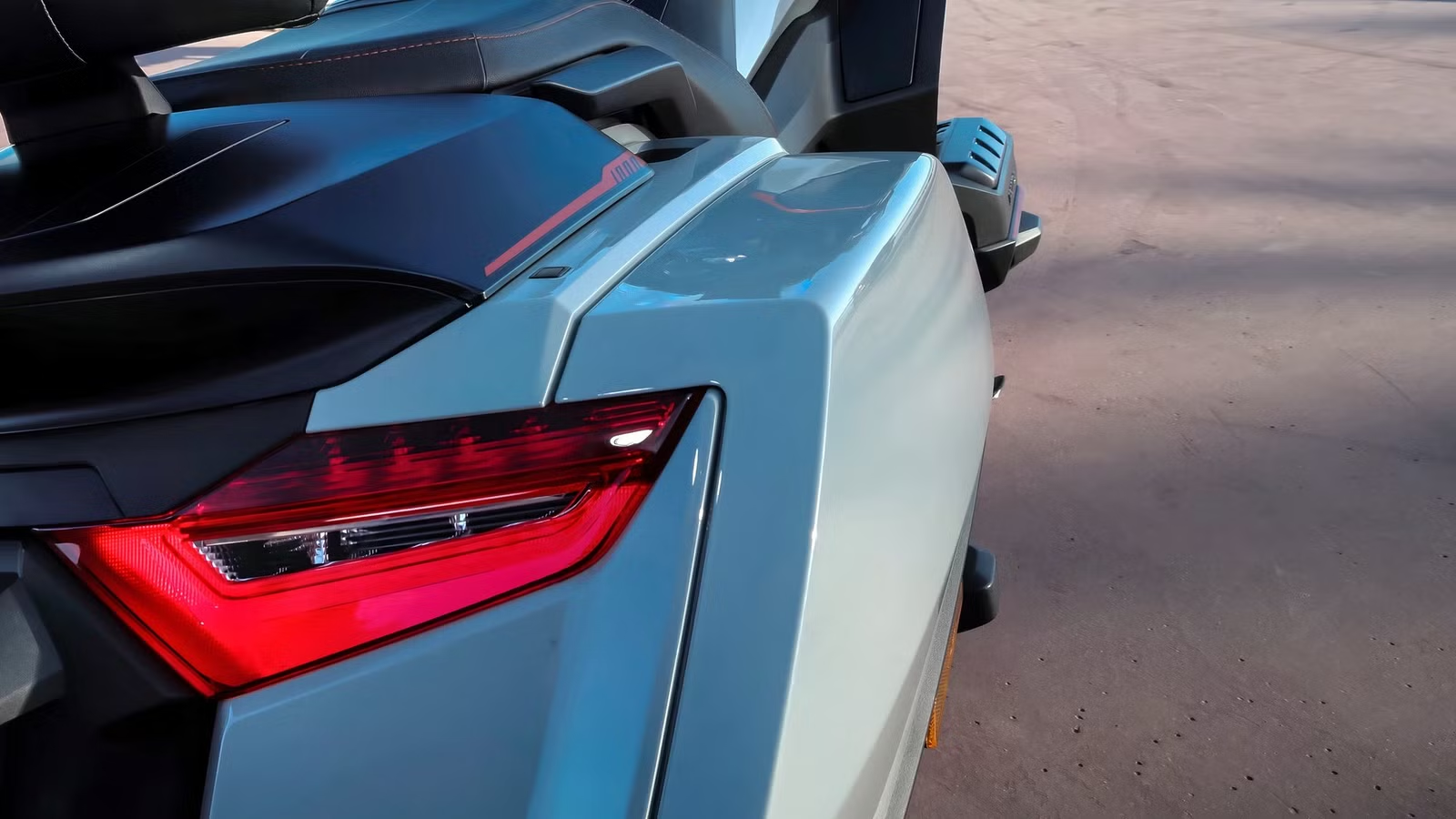
The Gold Wing finally got its most recent major update in 2018, and it was not merely an update but a complete revamp of this Japanese luxury tourer. Built on an all-new aluminum twin-spar frame, it also comes with a double-wishbone front suspension that significantly improves stability and handling. Honda further adopted a Unicam valve train, making the engine 6.3 kg lighter than before. Compared to its predecessor, the latest Gold Wing shed more than 80 pounds, thanks to its newly engineered chassis. It comes with the choice of either a 6-speed manual transmission or a 7-speed dual-clutch transmission (DCT), paired with a 1,833 cc flat-six engine that makes 124.6 hp and 170 Nm of torque. It looks sharper, more aerodynamic, and more premium than ever.
Features That Changed Touring Forever

The Gold Wing’s appeal goes far beyond its engineering and luxury. It’s loaded with tech that continues to raise the bar for touring motorcycles. Sure, it gets throttle-by-wire and four riding modes (Tour, Sport, Econ, and Rain), but that’s just scratching the surface. Ride it, and it just feels like a car on two wheels. The feature list also includes a 7-inch TFT display, wireless Apple CarPlay and Android Auto, cruise control, an electrically adjustable windscreen, a smart key system, heated seats and grips, and hill-start assist.
How Competitors Followed

Just like Honda, the competition never stopped evolving, yet the Gold Wing had already become the benchmark everyone wanted to beat. BMW came up with the K 1600 GTL powered by a 1,649 cc inline-six engine producing 160 hp. Harley-Davidson countered with the 1,923 cc V-twin-powered Road Glide, while Indian offers the Roadmaster with either a 1,890 cc air-cooled or 1,834 cc liquid-cooled V-twin engine. They all pushed the segment forward, but they were all measured against the motorcycle that had redefined it.
Honda changed the way the world looked at touring motorcycles. What began as a groundbreaking super-sport machine evolved into the benchmark that reshaped the entire segment and inspired manufacturers across the globe. Starting at $25,500, the Gold Wing remains one of the most balanced, feature-packed, and refined luxury touring motorcycles money can buy.
Sources: Honda

Related posts

Latest Post


No Comments