
This Lightweight Honda Humiliated Bigger Superbikes And Changed The Class Forever
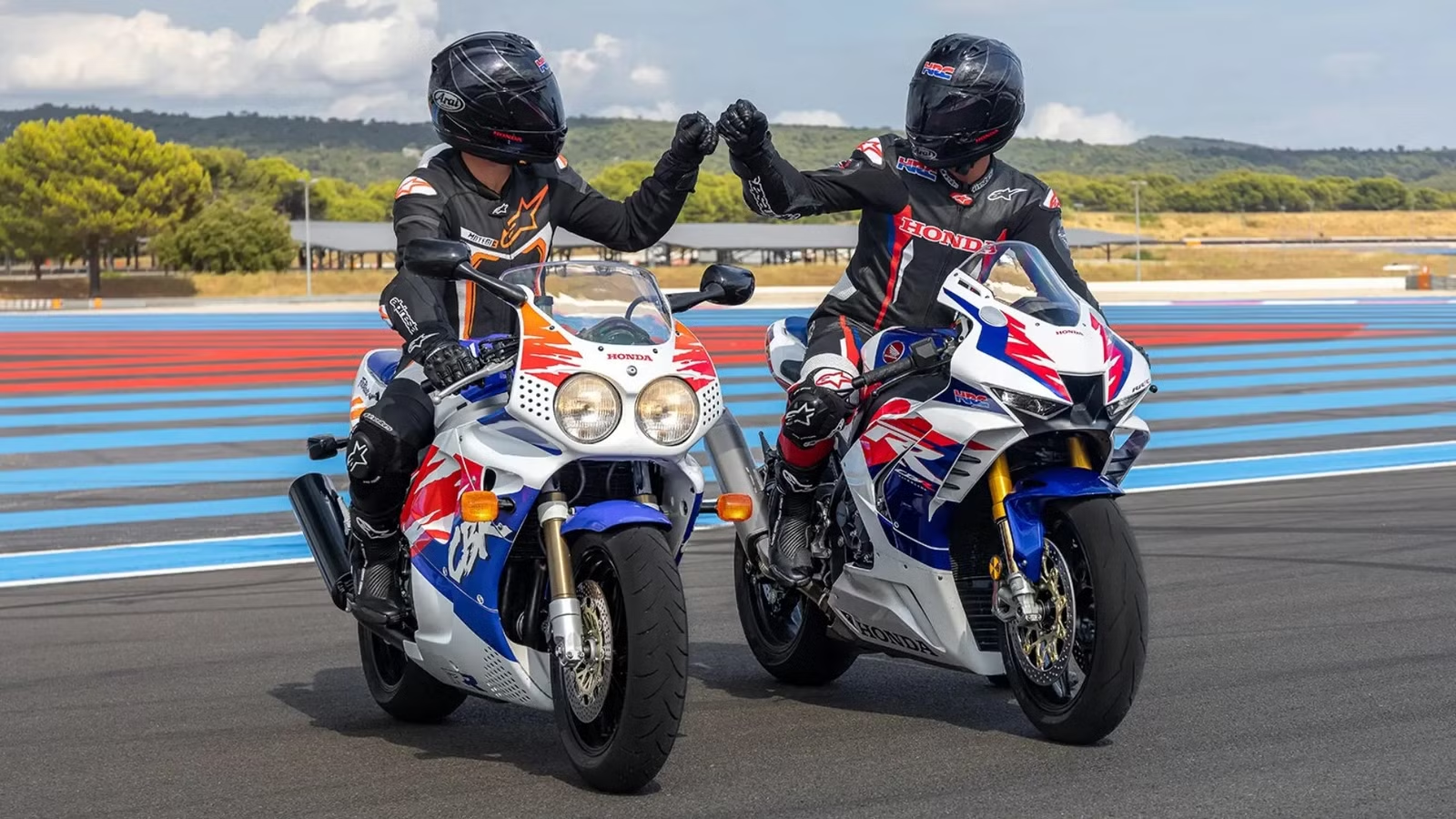
The 90s open-class motorcycle scene was dictated by a focus on engine capacity and top speed. Flagship superbikes at that time were monsters, with engine capacities pushing past 1,100 cc. Motorcycles like the Suzuki GSX-R1100 and Yamaha FZR1000 were missiles on the drag strip, but heavy and a handful on corners. Honda realized that pushing for heady engine output wasn’t the solution. Instead of building another heavy straight line rocket, its engineering team tore up the rulebook and focused instead on light weight, agility, and usable performance. That decision proved to be an absolute game changer in the superbike world.
The 90s Japanese Open-Class Sportsbike: How A Visionary Engineer Rewrote The Rules

Open-class motorcycles in the 90s had engine capacities surpassing 1,000cc and pushing past 180 mph with ease, but they were portly, tipping the scales at well over 500 pounds. It changed when Honda’s engineering legend Tadao Baba envisioned a lightweight game changer, a motorcycle that would disrupt the motorcycle market and rewrite the rules of the open-class motorcycle segment. Rather than pushing for absolute peak horsepower, Tadao Baba’s engineering team trained their sights on weight reduction, dedicating themselves to the core philosophy that real-world pace was heavily influenced by chassis agility and total control.
Initially, Honda planned to build a 750 cc inline-four motorcycle that would replace an aging prototype. During development, however, the engineering team discovered that stroking out the 750 cc engine block to 893 cc was possible without significantly altering engine dimensions or mass. This allowed Honda to achieve open-class levels of performance within a middleweight chassis.
The result was a motorcycle that weighed just 454 pounds — barely four pounds heavier than Honda’s own 600 cc middleweight motorcycle. More importantly, it was 66 pounds lighter than the Yamaha FZR1000 and around 100 pounds lighter than the Suzuki GSX-R1100. This significant weight advantage was possible thanks to the engineering team trimming the weight off every conceivable component to its absolute minimum.

Big Performance In Small Displacement: 1992 Honda CBR900RR FireBlade

This groundbreaking motorcycle was the 1992 Honda CBR900RR FireBlade. Underneath its minimalist bodywork, the FireBlade had a 893 cc liquid-cooled, DOHC, 16-valve inline-four engine with four 38 mm Keihin carburetors. It produced 122 horsepower at 10,500 rpm and 65 pound feet of torque at 8,500 rpm which, on paper, was lower than the 140-plus horsepower numbers of other 1,000 cc and 1,100 cc rivals. However, thanks to its incredible power-to-weight ratio, the Honda CBR900RR FireBlade dominated its competition in real world street and track performance. The compact motor revved freely to its redline and delivered smooth and usable power through a slick 6-speed gearbox. Period tests of the time had the CBR900RR post sub 3.0 second 0-60 mph times and mid-10-second quarter-mile times.
Thanks to the ultra-compact crankcase and use of magnesium for critical components, Honda project leader Tadao Baba ensured that the engine was exceptionally rigid, so much so that it served as a stressed member of the twin-spar aluminum frame, which besides helping save weight, also helped lower the motorcycle’s overall center of gravity.
Honda CBR900RR FireBlade Chassis Dynamics: Why The 16-inch Front Wheel Worked

The secret behind the Honda CBR900RR’s game-changing performance was its handling dynamics. To achieve maximum agility and flickability, Honda went the controversial route by opting for an unconventional 16-inch front wheel wrapped in a 130/70-ZR16 tire in place of the standard 17-inch setup. The rear, though, had a conventional 17-inch tire.
The benefits of the smaller 16-inch front wheel included a drastic reduction in gyroscopic forces, allowing the motorcycle’s front end to tip into corners with minimal steering effort. Combined with a short 55.3-inch wheelbase and aggressive steering geometry, the Honda FireBlade changed directions faster than any of its rivals. It even had distinctive aerodynamic holes in the fairing to cut through drag and reduce turn-in resistance at high speed.
On twisty roads and tight racetracks, the Honda CBR900RR FireBlade effortlessly outgunned its heavier rivals. While the 1,100 cc superbike riders had to brake early and wrestle the motorcycle through mid-corner transitions, FireBlade owners could brake late, carry massive speed into corners, and power out long before the competition. The FireBlade delivered raw, precise and razor-sharp handling that demanded respect, but highly rewarded rider skill.
The FireBlade Legacy: How The CBR900RR Created The Modern Liter-Class Segment

When motorcycling journalists first rode the Honda CBR900RR FireBlade in 1992, they hailed it as a game changer capable of revolutionizing the sportsbike segment. The Honda FireBlade flipped the script, rendering the old-school philosophy of powerful but heavy superbikes obsolete. It forced rival bikemakers to go back to the drawing board to build lighter and more compact superbikes.
Without the Honda CBR900RR, we probably would not have witnessed motorcycling icons such as the Yamaha YZF-R1 and the Suzuki GSX-R1000. Tadao Baba’s insistence on light weight over raw horsepower laid the foundation for the modern “liter-class” superbike segment, setting a design tone that’s seen even in the current crop of superbikes.
The original SC28 Honda FireBlade spawned a long line of iconic Hondas, like the CBR919RR, CBR929RR, CBR945RR, and eventually the CBR1000RR. The first-gen 1992 CBR900RR FireBlade remains a revolutionary motorcycle — a lightweight Japanese missile that dominated established heavyweights and redefined superbike performance.

Related posts

Latest Post


No Comments