
The Plug-in Hybrid SUV With The Highest Driving Range From 2024
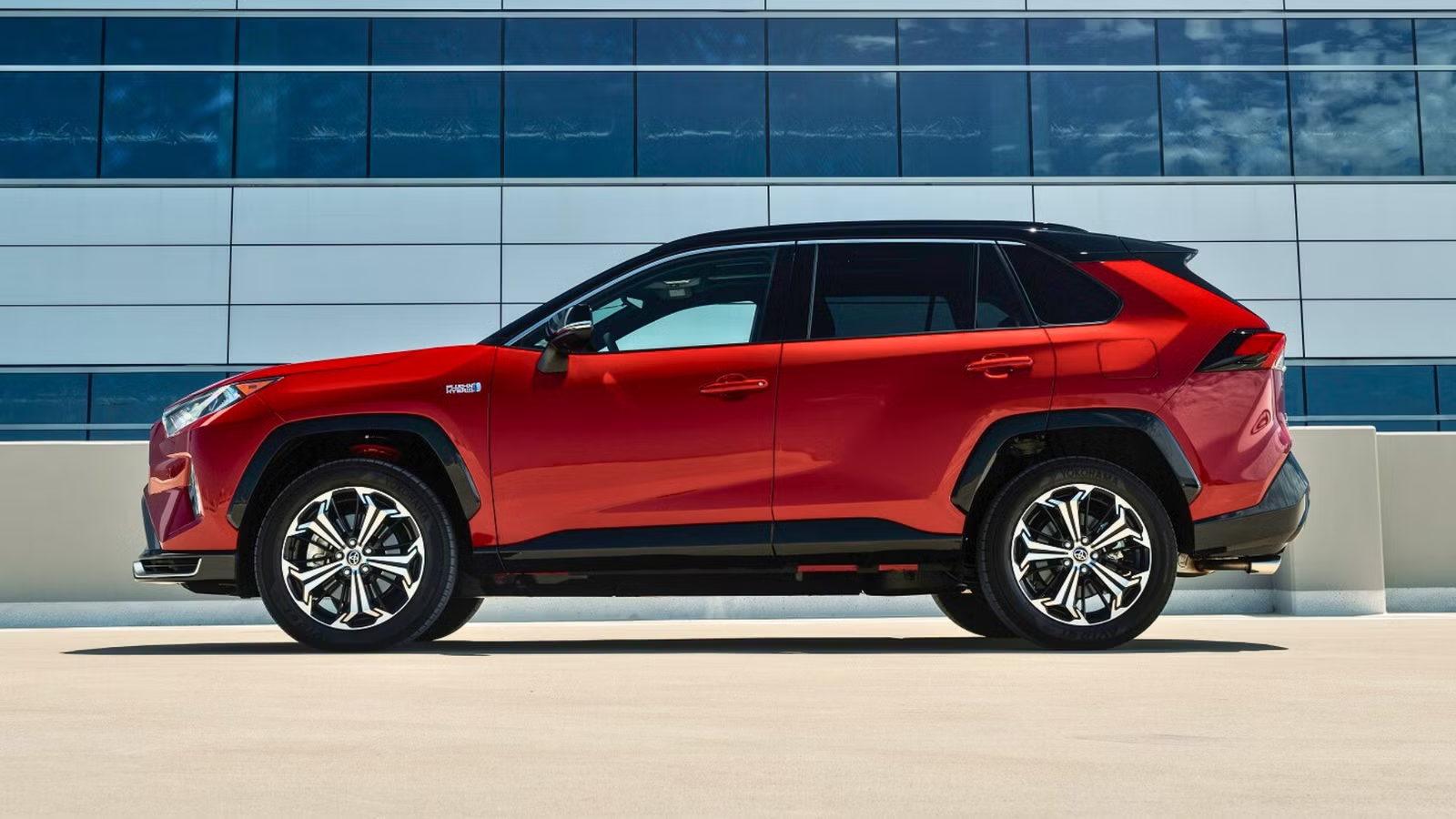
Plug-in hybrid SUVs have never been more capable — or more plentiful — yet one model continues to stand apart when it comes to sheer driving range. Among the growing field of used PHEV crossovers available in the U.S. market, the Toyota RAV4 Prime wears the long-range crown by a convincing margin. The EPA estimates its 14.5-gallon tank and 14.9 kWh battery work together to cover an impressive 600 miles on a full tank, with 42 of those miles available on electricity alone — figures that are genuinely difficult to beat at any price point.

The RAV4 Prime bests models like the XC60 Recharge, which returns a 560-mile estimate. The Lexus NX PHEV, which features near-identical mechanical components, covers a claimed 550 miles on a single tank. The RAV4 Prime returns the best gasoline range, but if you’re looking for the best EV-only range from a PHEV SUV, you’ll have to substantially increase your budget to buy the Range Rover Sport P550e, which features a larger battery pack good for 53 miles on a charge.
The Toyota RAV4 Prime Covers 600 Miles On A Single Tank
This 600-mile range estimate is largely thanks to the Toyota RAV4 Prime’s clever gasoline-electric drivetrain. The PHEV crossover pairs a naturally aspirated 2.5-liter four-cylinder Atkinson-cycle engine — rated at 177 horsepower and 165 pound-feet on its own — with two electric motors. A front electric drive unit generates 179 horsepower and 199 pound-feet, while a smaller rear motor contributes 53 horsepower and 89 pound-feet.
Performance Specifications
| Powertrain | 2.5-liter four-cylinder and two electric motors |
| Horsepower | 302 HP @ 6,000 RPM |
| Torque | 288 LB-FT @ 3,600 RPM |
| Transmission | Single-speed e-CTV |
| Battery | 14.9 kWh Net |
| Range | 600 Miles |
| Fuel Economy | 94 MPGe |
| 0-60 MPH | 5.8 Seconds |
| Top Speed | 124 MPH |

Collectively, Toyota limits the RAV4 Prime’s output to 302 horsepower and 288 pound-feet, delivered to all wheels via its direct-drive single-speed eCVT. The brand claims this drivetrain gets the Prime from 0–60 mph in 5.8 seconds, though independent tests show it can be as low as 5.6 seconds in ideal conditions, making it one of the brand’s fastest midsize crossovers. Toyota also limits the RAV4 Prime’s top speed to 124 mph. On the downside, the PHEV’s towing capacity is a modest 2,500 pounds, and the bulky electrical system does eat into available cargo space.
The Toyota RAV4 Prime Takes 12 Hours To Charge
If you want to recharge the battery via a Level One household outlet rated at 120 volts, you will spend around 12 hours waiting for a full charge. A Level Two system rated at 240 volts significantly cuts this time to just 2.5 hours, thanks to the RAV4 Prime’s 6.6 kW onboard charger. The RAV4 is also compatible with most public Level Two charging stations, making it easy to top up on longer trips.
Toyota RAV4 Prime Range And Charging Time
| Battery | 14.9 kWh |
| Range | 42 Miles |
| Level 1 AC 120V Charging time (0-100%) | 12 Hours |
| Level 2 DC 240V Charging time (0-100%) | 2.5 Hours |
| Level 3 DC 440V Charging time | N/A |
The Toyota RAV4 Prime features a compact battery and electrical system, so it doesn’t support Level Three DC fast charging. On the plus side, it delivers an impressive 42-mile EPA-estimated electric range on a single charge — a strong result given how small the battery is relative to the vehicle’s roughly 4,300-pound curb weight. Rounding out the efficiency picture is an efficient 94 MPGe energy consumption estimate on the EPA’s combined cycle.
The Toyota RAV4 Prime Offers A Lot Of Interior And Cargo Space

The Toyota RAV4 Prime’s interior stands out within Toyota’s lineup. In true crossover fashion, the cabin offers generous storage at the front, sides, and center console. While it isn’t an entry-level vehicle, it isn’t a premium one either — though Toyota’s decision to limit the Prime to higher-end trim levels means you do get plush soft-touch materials throughout the cabin.
Interior Dimensions
| Front Row | Rear Row | |
| Headroom | 37.7 inches | 39.5 inches |
| Legroom | 41.0 inches | 37.8 inches |
| Shoulder room | 57.8 inches | 56.4 inches |
| Hip room | 54.3 inches | 47.7 inches |
| Cargo Capacity | 69.8 cubic-feet | 37.6 cubic-feet |
The RAV4 Prime features practical interior packaging that matches the non-hybrid models despite the additional electrical components. The default cargo area measures 37.5 cubic feet — enough for a grocery run or light camping gear for a small family. Folding the rear seats flat extends capacity to 69.8 cubic feet. Toyota also offers a range of storage accessories for buyers who need to push the RAV4 Prime’s interior versatility even further.
The Toyota RAV4 Prime Comes Standard With Safety Sense 2.5+

The Toyota RAV4 Prime comes standard with the brand’s Safety Sense 2.5+. While it isn’t the newest suite available, it remains effective enough to earn the RAV4 an overall five-star rating from NHTSA crash testing. The package covers a broad range of key safety requirements, including a pre-collision system with pedestrian detection, lane-departure alert with steering assist, and lane tracing assist, as well as road sign detection and dynamic radar adaptive cruise control.
Toyota Safety Sense 2.5+
- Pre-collision system with pedestrian detection
- Dynamic radar cruise control
- Lane departure alert with steering assist
- Lane tracing assist
- Road sign assist
- Automatic high beams
Passive safety features include Toyota’s Star Safety System, which bundles enhanced vehicle stability and traction control, ABS with electronic brake-force distribution and brake assist, and smart stop technology. Toyota also includes a comprehensive eight-airbag suite to protect all occupants in a collision, making the RAV4 Prime one of the more thoroughly protected options in its segment.
When New, The 2024 Toyota RAV4 Prime Started At $43,690

The RAV4 Prime range started at $43,690 for the base SE trim and $47,560 for the more premium XSE trim. Toyota fitted all RAV4 Prime trims with the same wheels, so there is no difference in efficiency estimates between grades. If you are looking to buy this two-year-old RAV4 “Prime” over the now-called RAV4 “Plug-in Hybrid”, then you’re looking at fair purchase prices of $36,700 and $39,200 for SE and XSE trims, respectively, according to KBB.
Toyota shipped the RAV4 Prime with a 120-volt charging cable as standard, but did not include a Level Two charging cable — you’ll need to source one from a reputable third-party supplier, of which there are many.
Level Two chargers rated for 6.6 kW generally went for around $270 to $320. Most feature a NEMA 10-30 or SAE J1772 connector, compatible with a wide range of public charging stations. A Level Two charger is a must if you plan to regularly use the RAV4 Prime’s electric capability — particularly if most of your driving takes place in urban or suburban environments. Budget around $650 for a wallbox unit, plus an additional $800 to $2,000 for professional installation, depending on your location.
Toyota Covers The RAV4 Prime’s Battery For 12 Years

All RAV4 Prime units come standard with Toyota’s class-leading warranty, which covers the battery system for 120 months or 150,000 miles. Most competing manufacturers offer only 96-month or 100,000-mile coverage. Toyota’s more generous terms reflect its long track record in hybrid technology, which has produced some impressive reliability results. The brand rates its hybrid battery packs for around eight years of service, though real-world owners report they frequently last longer, even with regular use.
|
Type |
Length |
|---|---|
|
Full Warranty |
36 Months/36,000 Miles |
|
Powertrain Warranty |
60 Months/60,000 Miles |
|
Maintenance Warranty |
24 Months/25,000 Miles |
|
Roadside Warranty |
24 Months/Unlimited Miles |
|
Corrosion Warranty |
60 Months/Unlimited Miles |
|
Federal Emissions Performance |
24 Months/24,000 Miles |
|
Federal Emissions Defect |
36 Months/36,000 Miles |
|
Seat Belt And Airbags |
60 Months/60,000 Miles |
If you need to replace the RAV4 Prime’s battery pack outside of warranty, expect to pay between $10,000 and $12,000 including labor at an official Toyota workshop. Costs can be reduced by sourcing a quality used battery pack and having it fitted by a reputable independent workshop. The replacement procedure typically takes four to six hours.
Sources: the EPA, NHTSA, Car and Driver, KBB, and Edmunds.

Related posts




Latest Post


No Comments