
Suzuki’s Most Underrated Motorcycle Deserves Another Chance
Suzuki has never been short of motorcycles with the engineering credentials to stand alongside the best in the industry. The Japanese manufacturer has built everything from the legendary Hayabusa and GSX-R family to the versatile V-Strom lineup, earning a great reputation over the years. Yet some of its most accomplished motorcycles have struggled to receive the recognition they deserve, often because of perception rather than any shortcomings in their engineering.

Japanese motorcycles can appear conservative next to their more flamboyant European rivals, and their practical strengths are not always apparent on a specification sheet. This becomes even more evident when a motorcycle refuses to fit neatly into a single category, instead combining characteristics from two different segments. Suzuki has one such motorcycle in its lineup – one that remains surprisingly overlooked despite having plenty to offer.
Why Some Of Suzuki’s Best Motorcycles Get Overlooked In Today’s Market
Suzuki has produced several motorcycles that offered more than their reputations suggested. The Bandit 1250S is a good example, pairing a muscular four-cylinder engine with relaxed ergonomics and impressive real-world versatility. Its conservative styling and substantial weight made it easy to overlook, but those same characteristics helped turn it into a capable and comfortable everyday sport-tourer. The first-generation V-Strom 1000 faced a similar perception problem. Adventure riders often considered it too road-focused, while sport-tourers had plenty of other options that appeared more purpose-built or visually appealing.


Even the modern Katana struggled to achieve mainstream recognition after its return in 2019. Its distinctive styling, potent GSX-S1000-based engine, and Suzuki’s proven engineering gave it plenty of character, but some riders viewed it through the lens of the original Katana rather than judging it as a contemporary motorcycle. A short windscreen and relatively small fuel tank further limited its appeal for long-distance riding. Suzuki’s current lineup has similarly overlooked machines, but the challenge becomes even more complicated when a motorcycle enters the crossover segment.
Building A Great Crossover Motorcycle Is No Easy Task

The crossover category is notoriously difficult for manufacturers to execute successfully. These motorcycles attempt to combine two very different personalities in one package. They need to offer the cornering ability and acceleration of a sportbike while delivering the upright ergonomics, suspension travel, weather protection, and luggage capacity associated with a touring or adventure motorcycle. The challenge lies in finding the right balance. A sport bike-derived crossover can become expensive and demanding, while a touring-focused model may sacrifice excitement on a winding road. That is where Suzuki’s approach becomes interesting, as it occupies the space between these two extremes.
The Suzuki GSX-S1000GX+ Marries Superbike DNA With All-Day Versatility
Starting MSRP: $18,749

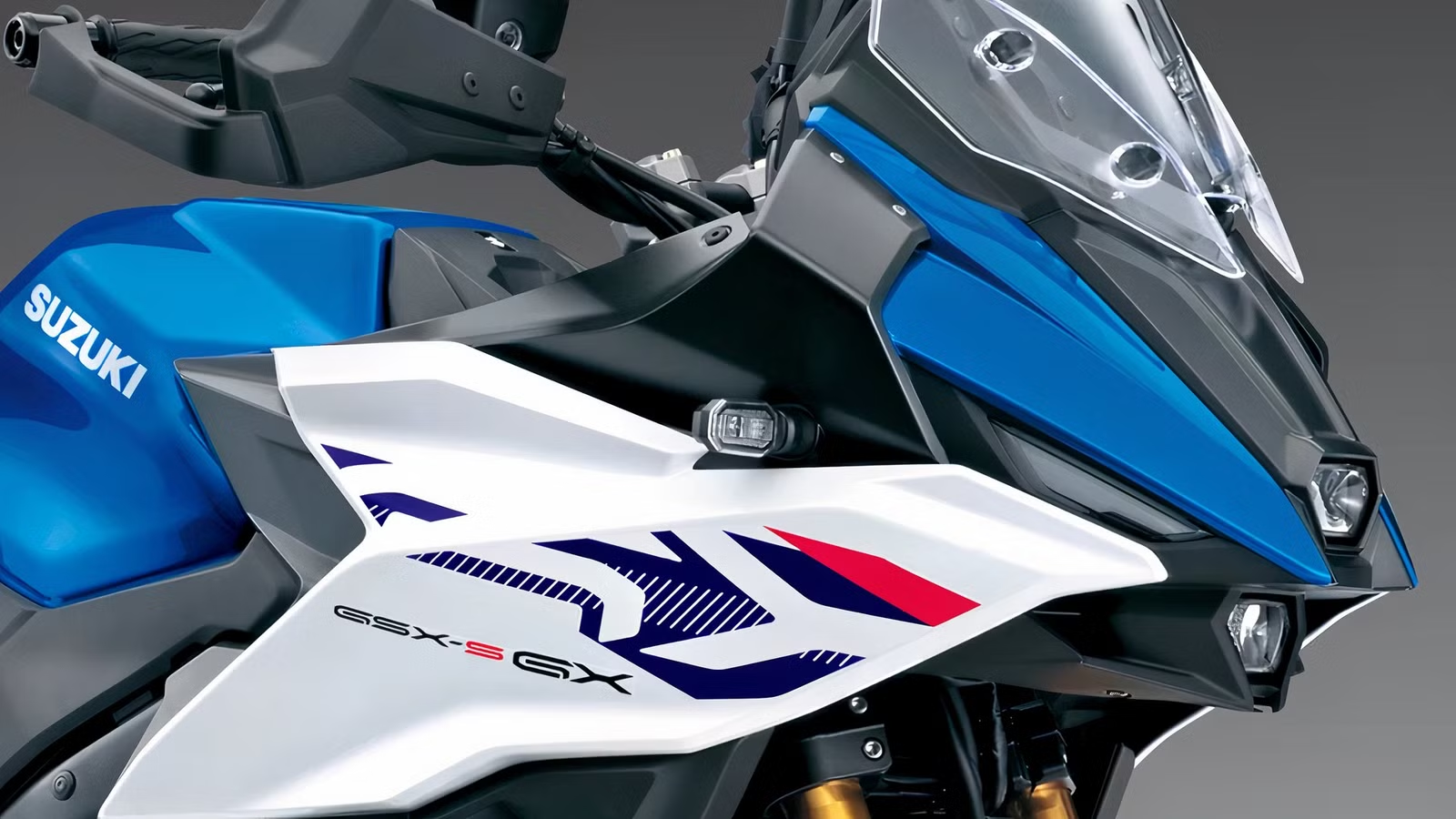
The motorcycle in context is Suzuki’s flagship liter-class sport crossover – the GSX-S1000GX+. Introduced in January 2024, it represents Suzuki’s attempt to create a premium sport crossover without sacrificing the character that makes a sports bike enjoyable. The GSX-S1000GX+ shares its core engine and aluminum twin-spar frame architecture with the Grand Touring GSX-S1000GT family, while adopting an upright riding position and rider-focused ergonomics more closely associated with the V-Strom 1050.

The result is a motorcycle built to handle far more than one type of ride. It can navigate daily traffic, attack a winding mountain road, and even cover serious miles. For 2026, the Suzuki GSX-S1000GX+ carries a base MSRP of $18,749 and is available in Pearl Brilliant White and Metallic Triton Blue colors. That price places it firmly in the premium territory, but the GX+ counters with a generous list of standard equipment, including features that some rivals charge extra for or reserve for higher trim levels.
A GSX-R-Derived Four-Cylinder Engine Gives It Serious Performance

At the heart of the Suzuki GSX-S1000GX+ is a 999cc liquid-cooled inline-four engine derived from the legendary GSX-R1000 (specifically the K5 architecture). This long-stroke motor uses a 73.4mm bore, 59mm stroke, and 12.2:1 compression ratio, along with ride-by-wire throttle bodies and revised camshaft profiles designed to meet emissions requirements while maintaining strong rideability.
Fine-tuned for street and touring duties, the GSX-S1000GX+ produces 150 horsepower at 11,000 RPM and 78.2 pound-feet of torque at 9,250 RPM, paired with a six-speed gearbox, Suzuki Clutch Assist System, and bi-directional quickshifter. Unlike an exotic, highly stressed superbike engine, this motor has been adapted for everyday usability. Suzuki has tuned it to deliver a broad spread of usable performance, with particular emphasis on the mid-to-high-RPM range where a sport-touring motorcycle spends much of its time.

Reliability is another important advantage. This powertrain comes from an engine family Suzuki has refined for years across its GSX-S and GSX-R series motorcycles, giving it a proven foundation. For riders seeking serious performance without unnecessary complexity, that established engineering should add considerable confidence, particularly in a motorcycle designed to handle everything from daily commutes to long-distance touring.
Long-Travel Electronic Suspension And An Upright Ergo Package Redefine Comfort

What truly elevates the GSX-S1000GX+ is the debut of Suzuki Advanced Electronic Suspension. By combining data from the six-axis IMU (Inertial Measurement Unit), wheel-speed sensors, and suspension-stroke sensors, the system continuously adjusts damping according to real-time riding conditions. With 5.9 inches of travel at both ends, the GX+ can glide over rough surfaces without losing composure even when pushed through a fast, sweeping curve. It also features Suzuki Road Adaptive Stabilization, which helps maintain stability when riding over uneven surfaces.

The GSX-S1000GX+ uses Suzuki’s proven twin-spar aluminum frame, which helps to deliver nimble handling and strong road-holding ability. Its ergonomics are equally well sorted, with a tall stance, approachable 33.3-inch seat height, and upright riding position that helps reduce fatigue on longer rides. Braking duties are performed by dual 310mm front discs with Brembo four-piston radial-mount monobloc calipers, while a 240mm rear disc uses a Nissin single-piston caliper. Suzuki’s electronic rider-aid package adds traction control, cornering ABS, lift control, cruise control, and multiple riding modes.
Standard Luggage And Connectivity Make It Ready For Any Ride Any Time

As a true ‘Plus’ model in Suzuki’s lineup, the GSX-S1000GX+ comes factory-equipped with touring accessories as standard. It gets color-matched 26-liter quick-release side cases that integrate neatly into the tail section. These hard saddlebags are spacious enough to swallow a full-face helmet, riding gear, or daily essentials, effectively turning the motorcycle into an instant weekend escape machine. An adjustable windscreen, hand guards, and relaxed riding triangle further strengthen its touring credentials. Suzuki also equips the GX+ with a 6.5-inch full-color TFT display featuring mySPIN smartphone connectivity.
The Suzuki GSX-S1000GX+ Deserves A Second Look Over Its Rivals
The Suzuki GSX-S1000GX+ does not dominate every category, but that is not its purpose. Its appeal lies in combining several desirable traits without becoming excessively specialized. The biggest argument in favor of the GSX-S1000GX+ is its distinct interpretation of the premium crossover formula. The BMW S 1000 XR pairs a potent 999cc inline-four with an unmistakably performance-focused character, while the Kawasaki Versys 1100 SE LT takes yet another approach, emphasizing its larger 1,099cc engine and long-distance versatility.

The Suzuki GSX-S1000GX+ sits comfortably between these approaches. Its GSX-R-derived four-cylinder engine gives it genuine sporting credentials, while its electronic suspension, upright ergonomics, and standard luggage make it considerably more practical than a conventional sportbike. It may never command the same instant recognition as a GSX-R, Hayabusa, or V-Strom, but its well-rounded package makes it one of the more intriguing motorcycles in Suzuki’s current lineup. For riders willing to look beyond the most obvious choices, this understated crossover deserves considerably more attention.
Source: Suzuki Cycles

Related posts




Latest Post


No Comments