
Mazda’s K V6: The Forgotten ’90s Pocket Rocket
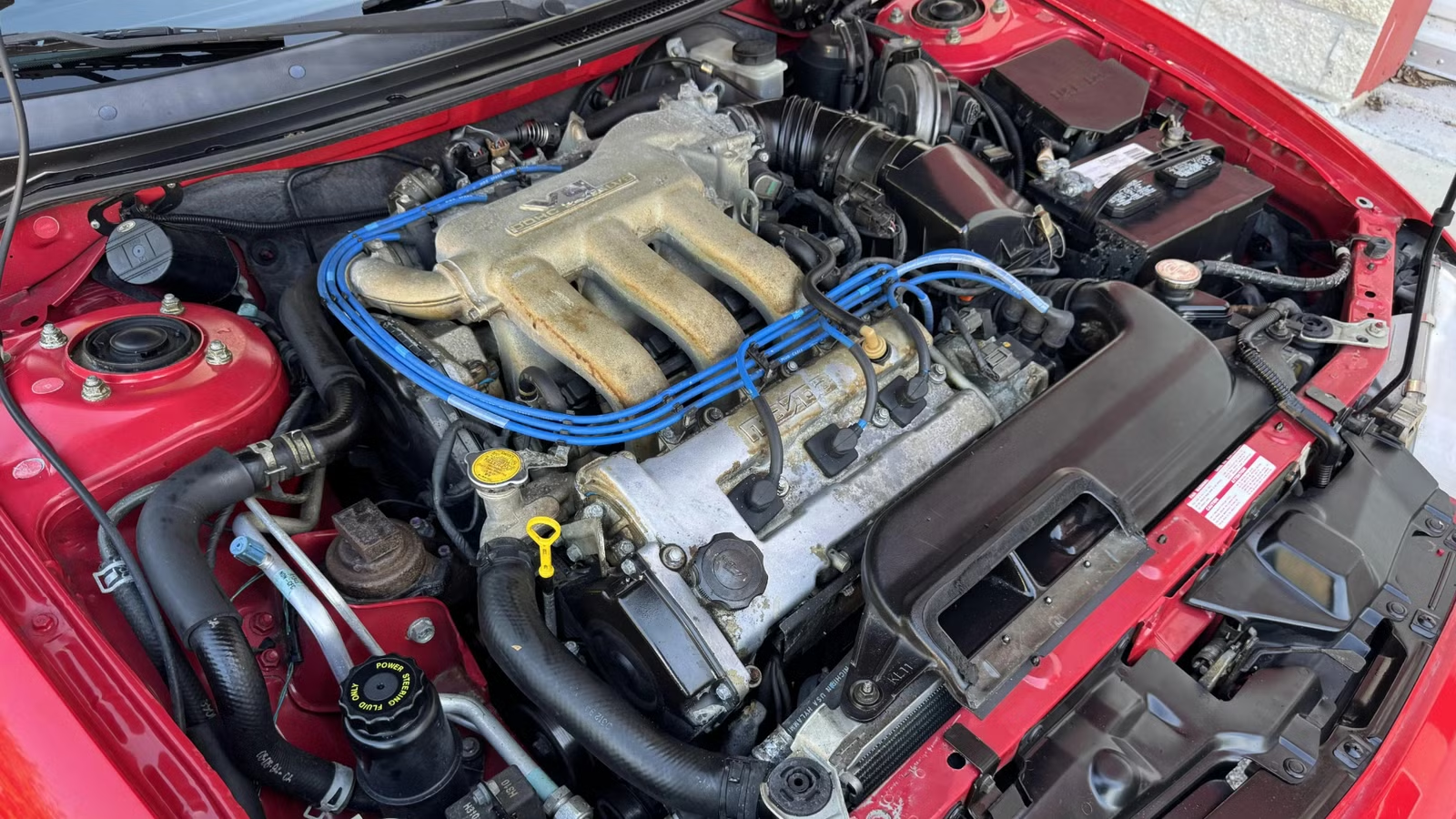
The V6 is an engine layout that often doesn’t get the love it deserves. Smaller and less characterful than a V8 but more complex than an inline-4 or an inline-6, it occupies a very unusual space in the automotive landscape. So, it becomes a neglected middle ground. That’s a shame, because some V6s that have turned up over the years have been nothing short of fantastic. This includes one that came from one of Japan’s most celebrated automakers.
Japanese Automakers Were Building Some Very Cool Engines Back In The ’90s

Back in the 1990s, it wasn’t uncommon to see japanese cars have some seriously incredible engines. All the big Japanese automakers were going full steam ahead into engine development, and it resulted in some of the best engines in the world. These engines weren’t just great for their time – they’re actually still fantastic today.
Back Then, Mazda Had Some Of The Coolest Engines Out Of All Of Them

Out of all the Japanese automakers, the one that had some of the coolest engines back then was Mazda. Of course, we all know about the rotary engines Mazda had at the time. There was also the 1.8-liter BP inline-4, which while being an ’80s design was produced all the way up to 1998. One of Mazda’s coolest engines ever, though, has to be one of its most forgotten. Its configuration and engineering is on the more conservative side compared to some of what Mazda was producing back then. But that didn’t stop it from being brilliant.

Mazda’s K V6 Is A Pocket Rocket Of A Powerplant From That 1990s Golden Era

|
Type |
Displacement |
Power |
Torque |
|
V6 |
1.8-2.5 liters |
130-217 hp |
115-210 lb-ft |
At first glance, Mazda’s K engine might seem like a relatively ordinary V6. A small V6, but a regular V6 nonetheless. But, this engine not only packs a surprising amount of punch for its size, it’s also fairly innovative for its time. It comes in four different variants, all of which are on the smaller end for V6s. They’re also mainly on the lower end of power compared to what you’d get from a V6. They also didn’t rev very high—the redline on many of these engines only went up to 7,000 rpm.
So far, these engines seem fairly conservative in terms of their engineering and characteristics. But, take a look at the intake manifold, and you’ll see something that was a little ahead of the curve for its time. All variants of the K engine got what’s known as the Variable Resonance Induction System (VRIS). This used a clever engineering principle based on the Helmholtz resonance effect (also known as wind throb). The intake manifold has three chambers, each tuned to a specific resonant frequency. The engine’s ECU dynamically switches between chambers, monitoring engine rpm and choosing the one whose resonant frequency best aligns with the rpm at any given time. This oddly musical method of engineering an intake manifold results in better volumetric efficiency. That in turn means these engines get better torque over the entire rpm range.
Induction systems like this are commonplace now. But, back in the ’90s, they really weren’t. The technology did already exist – Mercedes-Benz filed a patent for a similar system all the way back in the 1950s, and Audi had already made a production engine with a similar system in the 1980s. But Mazda’s K engines were one of the first engine families to have this kind of engineering in cars that any ordinary customer could buy.
The K8 Variant Is One Of The Smallest Production V6s Ever Made

If we’re talking about pint-sized powerplants, the K8 variant has to take the crown. At just 1.8 liters in size, it’s one of the smallest production V6s ever made. If you want to find anything smaller, one of the only ones you could find is the F1-derived turbo V6 that makes up the ICE component of the Mercedes-AMG One’s hybrid powertrain. This engine really does fit the definition of pocket rocket. It produced 130 hp in America and 135 hp in its native Japan when it first appeared in 1991. At its height, it produced as much as 144 hp and 115 lb-ft of torque. That’s seriously impressive for such a tiny engine from the ’90s!
Why did Mazda create such a tiny V6 in the first place? Well, it has a lot to do with how road tax was charged in Japan back then. Engines that were 2 liters or larger in size got taxed more. This wasn’t something exclusive to Japan – quite a few countries in Europe had similar higher taxes on bigger engines, too. But, the Japanese regulations did have a huge influence on the development of new Japanese engines. The K8 is far from the only engine (or engine variant) developed to fit within those rules, but it’s certainly one of the quirkiest and most interesting.
Mazda Created A Supercharged K Variant, And It Was Seriously Powerful
That tiny K8 isn’t the only unconventional variant Mazda managed to derive from the K engine architecture. There was also the KJ-ZEM, a 2.3-liter version with a supercharger. This is the most powerful of all the K variants, producing 217 horsepower and 210 lb-ft of torque.
This variant of the K engine is interesting in not just the fact that it has a supercharger, but why the supercharger was even there in the first place. It was a key component of what’s known as the Miller cycle of combustion. In the Miller cycle, the valves stay open for longer than what would happen in a conventional Otto cycle engine. This creates what amounts to an extra fifth stroke during the compression cycle. This is also what happens in the Atkinson cycle engines you see on a lot of hybrid cars today.
While this makes the engine more efficient, it does mean that there’s a loss of power due to the loss of charge air during the combustion cycle. That’s where the supercharger comes in. The extra induction from the supercharger makes those compression losses lower, and boosts the power as a result.
It Powered Some Of Mazda’s Coolest And Most Underappreciated Cars

While the K engines were a mechanical marvel in many ways, they often ended up powering fairly boring everyday Mazdas. You’re most likely to find a K V6 in cars like the Mazda 323 and 626, as well as the Xedos 6 (known as the Eunos 500 in Japan and the Mazda Eunos 500 in Australia) and the Mazda Millenia (known as the Xedos 9 in Europe, the Eunos 800 in Japan and the Mazda Eunos 800 in Australia and Hong Kong). There were a few special and under-appreciated models that got K engines, though. The two that people may know about the most are the MX-3 and the MX-6. The MX-3 is one of only two models that got the tiny K8 variant. Meanwhile, the MX-6 got both the 2-liter KF and the 2.5-liter KL variants.
In Australia, if you were fortunate enough at the time, you could get one of Mazda’s most special and underappreciated cars. That was the Eunos 800 SP, a sports sedan limited to just 30 examples. This was one of the only cars that got the awesome KJ-ZEM variant (along with the 800 M variant it was based on), and it got some motorsport-style tuning along with that too. That was thanks to Mazda’s Motorsports division, which developed those modifications locally in Sydney. The biggest difference between the 800 SP and the 800 M was that it sat on Eibach springs. This improved the handling, as well as making the car sit 25 mm lower than the 800 M.
It Wasn’t Just Mazdas That Got K Engines
As you’d expect from a Mazda-developed engine, the K V6 primarily appeared in Mazda cars. But, there were a couple of non-Mazda models that got variants of these engines. The best-known of those is perhaps the Ford Probe. The Probe was the result of a platform-sharing agreement with Mazda that also created the MX-6 we mentioned earlier. As a result, first-generation Probes got the same K engine variants as the MX-6.
As well as the sporty Ford Probe coupe, the more everyday Ford Telstar sedan got the same variants of the K engine too. That’s because the Telstar also resulted from a platform-sharing agreement. The third-generation of the Telstar (the only generation to use the K engines) was built on the same GE platform that underpinned the Mazda 626 sedan.
Sources: Audi, Ford, Mazda, US Patent Office

Related posts






Latest Post


No Comments