
GM’s Rarest NASCAR Homologation Specials of the 1980s
There’s something a little extra enticing about a vehicle that you know only exists because an automaker needed to check a box and establish eligibility for a racing series. These so-called “homologation specials” could be thinly veiled iterations of actual racecars that even the OEMs would have hesitated to put into the hands of regular people if there wasn’t a rulebook somewhere heavily incentivizing them to do exactly that.

In the 1980s, when a post-malaise Detroit was rediscovering performance and car aerodynamics were becoming increasingly important both on the road and at the racetrack, homologation was about to take things to a whole new level. But first, General Motors had a problem. Its squared-off G-body coupes were designed to look good without much thought given to what the wind tunnel would have to say about them. Meanwhile, Ford’s Thunderbird was becoming an aerodynamic hero (by ‘80s standards), aiming to leave the competition in its slipstream.
It turns out that GM was up for the challenge, though, with Chevrolet and Pontiac out front. The result was one of the strangest production cars of the decade, plus a pretty cool Chevy, with roots that can be traced straight to NASCAR.
NASCAR’s Aero Wars Forced GM To Get Weird

While a giant oval NASCAR track might give drivers a bare minimum of twists and turns to think about, it gives racecar engineers a tricky, invisible enemy to contend with: the air. GM’s rear-wheel-drive G-body coupes had all the basic ingredients for stock-car racing, but those upright rooflines and squared-off rear ends that looked great in the showroom or driving down the street were a nightmare for aerodynamics.
Ford clearly had the edge with its comparatively slippery T-Bird. Not only was it better at slicing through the air, which helped on the straights, but it also held to the road better, allowing Ford drivers to take those oval curves flat out while others were forced to lift off or meet the outside wall.
But this wasn’t GM’s first aero rodeo. Chevrolet, Buick, and Oldsmobile had been experimenting with front-end design to beat the wind since the ‘70s, so Chevy and Pontiac were tagged in to solve aero in their respective street cars and then bring the results to the track. Chevy focused on cleaning up the Monte Carlo’s problematic notchback rear window. Pontiac, meanwhile, started tinkering with nearly everything that was going to come in contact with the air, with the result being unlike anything that had ever appeared in a Pontiac showroom.
The Pontiac Grand Prix 2+2 Was GM’s Wildest Solution

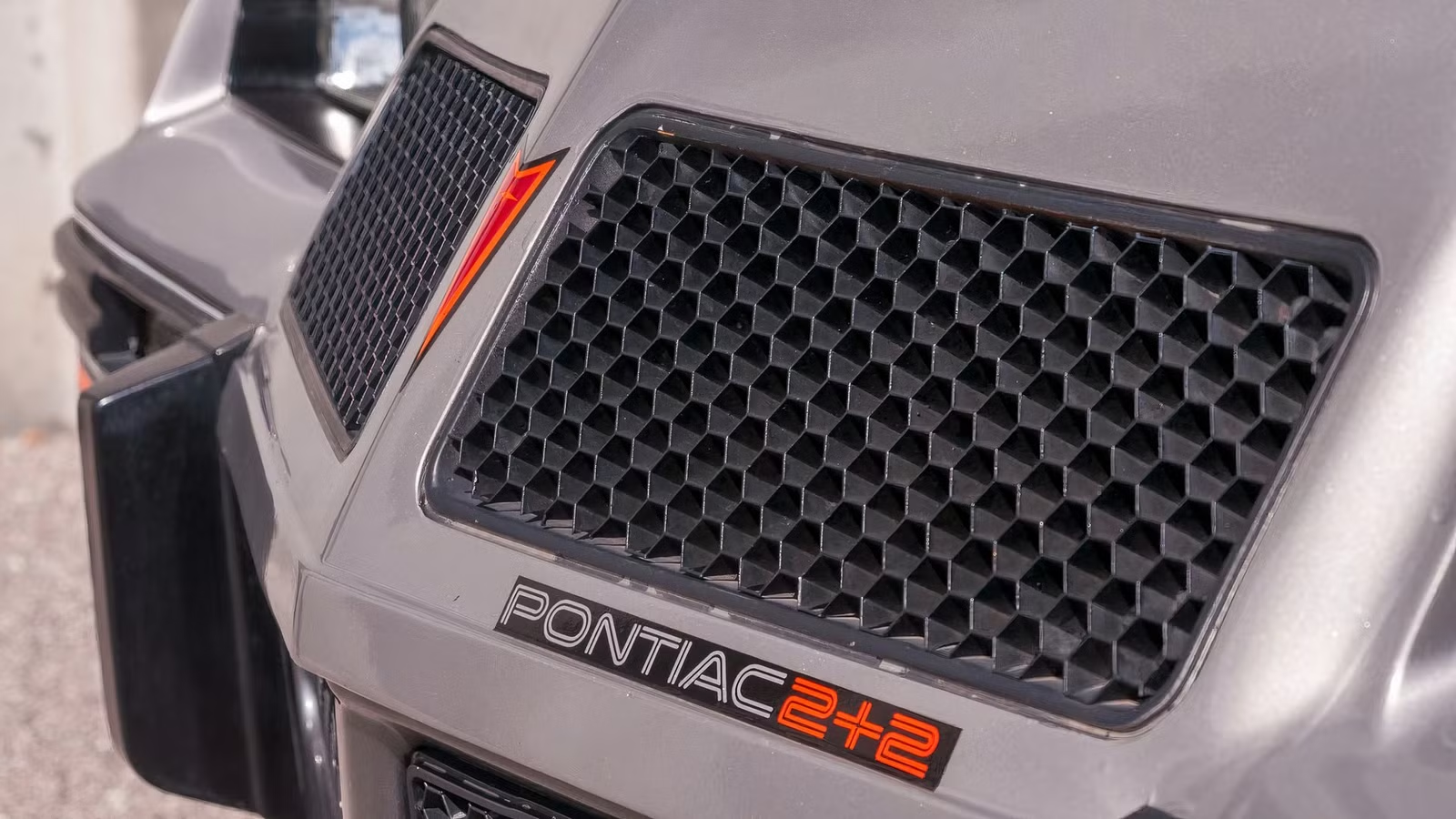
Meet the 1986 Pontiac Grand Prix 2+2, the street-legal product of Pontiac’s run at NASCAR glory. It solved for aero in a bunch of ways that would matter on the big oval, which happened to also deliver a streetable coupe that looked as menacing as it did aerodynamic. It had a smoother, more pointed nose up front and a rear end with dramatically sloping glass, a shortened deck lid, and a tidy rear spoiler. The back end that made the car look ready to pounce also created an almost comically small trunk opening, though it’s worth pointing out that the actual cargo space stayed about the same—an easy tradeoff to accept as these things go.
Officially, this was the Pontiac Grand Prix 2+2, though you’ve probably never heard those words strung together out loud. It became known simply as the “Aerocoupe” and Pontiac reportedly built just 1,225 of them for 1986 only, which makes it a homologation special in the truest sense of the word.
Chevrolet Had Its Own Aerocoupe

Meanwhile, over on the Monte Carlo side of the house, engineers were trying to solve the same problems Pontiac was with the Aerocoupe. They spent less time on the front of the car and instead focused on the wind-buffeting notchback rear end, which was problematic on the oval and impossible to ignore in the wind tunnel. The result looked perhaps less interesting than the Pontiac, but they introduced the world to the Monte Carlo SS Aero Coupe. (Any aero benefit of adding the space between “Aero” and “Coupe” remains speculative.)
Still, the Aero Coupe proved to be something of an icon in its own right, at least among the Chevrolet faithful. Rather than being limited to a single year of production like the spaceless Aerocoupe, the Monte Carlo was built for two years: 200 in ‘86 and a comparatively whopping 6,052 in ‘87. Chevy focused on the southern U.S. where the first handful were introduced to the roaring public at the very superspeedway events where the racecar version would rack up enough wins to drive serious interest among NASCAR fans who wanted the street-legal equivalent of the hero vehicle they saw on the track. Pontiac might have built the more impressive car, but the Monte Carlo moved units.
They Looked Faster Than They Really Were

Like a lot of great cars when viewed through a rose-colored rearview mirror, something worth stating plainly about GM’s pair of homologation specials is that they weren’t particularly fast. They aren’t fast by today’s standards and they weren’t particularly fast in-period, either. The Pontiac had a 305-cubic-inch V8 with 165 hp, and the Chevy squeezed slightly more power out of the same displacement, for all of 180 hp. The transmission was a four-speed automatic in both cars, topping off a total package of power and performance that didn’t really come close to the presence that either car had when sitting still.
Looking back, this is of course deeply disappointing, but when you remember what these cars were for, it makes all the sense in the world. This wasn’t Group B homologation where the production car had to start with much more of the same basic mechanical underpinnings as the car that raced. By 1986, NASCAR homologation rules were principally concerned with making the production-car bodywork eligible for use on a purpose-built stock car with a dedicated racing chassis and significantly more capable powertrain. There was no rule requiring manufacturers to put anything resembling the race car’s performance under the hood of the homologation version.
NASCAR Made Them Weird, Rare, And Worth Remembering

The Pontiac Grand Prix 2+2 Aerocoupe remains about as rare as the name is long, and despite the eye-catching design and low production numbers, it never really caught on with collectors like some other American icons with NASCAR provenance. In fact, a perfectly nice one sold at auction earlier this year for under $16,000. It’s an underwhelming showing for what might be the ultimate ‘80s muscle car, but it’s nice to know that all these years later such a weird historical gem can still be had for something resembling regular used-car money.
It’s more a piece of NASCAR history than enthusiast culture, and it captured a point in time when the speeds were climbing, wind tunnels were blowing, and GM could satisfy NASCAR’s homologation rules without owing buyers anything resembling the power and performance of the race cars they saw blasting around the oval on Sundays. It probably wasn’t on your bedroom wall as a kid, and you might not have seen one lately, but if you really want an Aerocoupe in your garage, it’s likely a dream you could make happen.
Sources: MotorTrend, Hemmings, NASCAR, FIA, Hagerty

Related posts



Latest Post


No Comments