
The Forgotten Performance Car That Predicted Today’s Sports Sedans
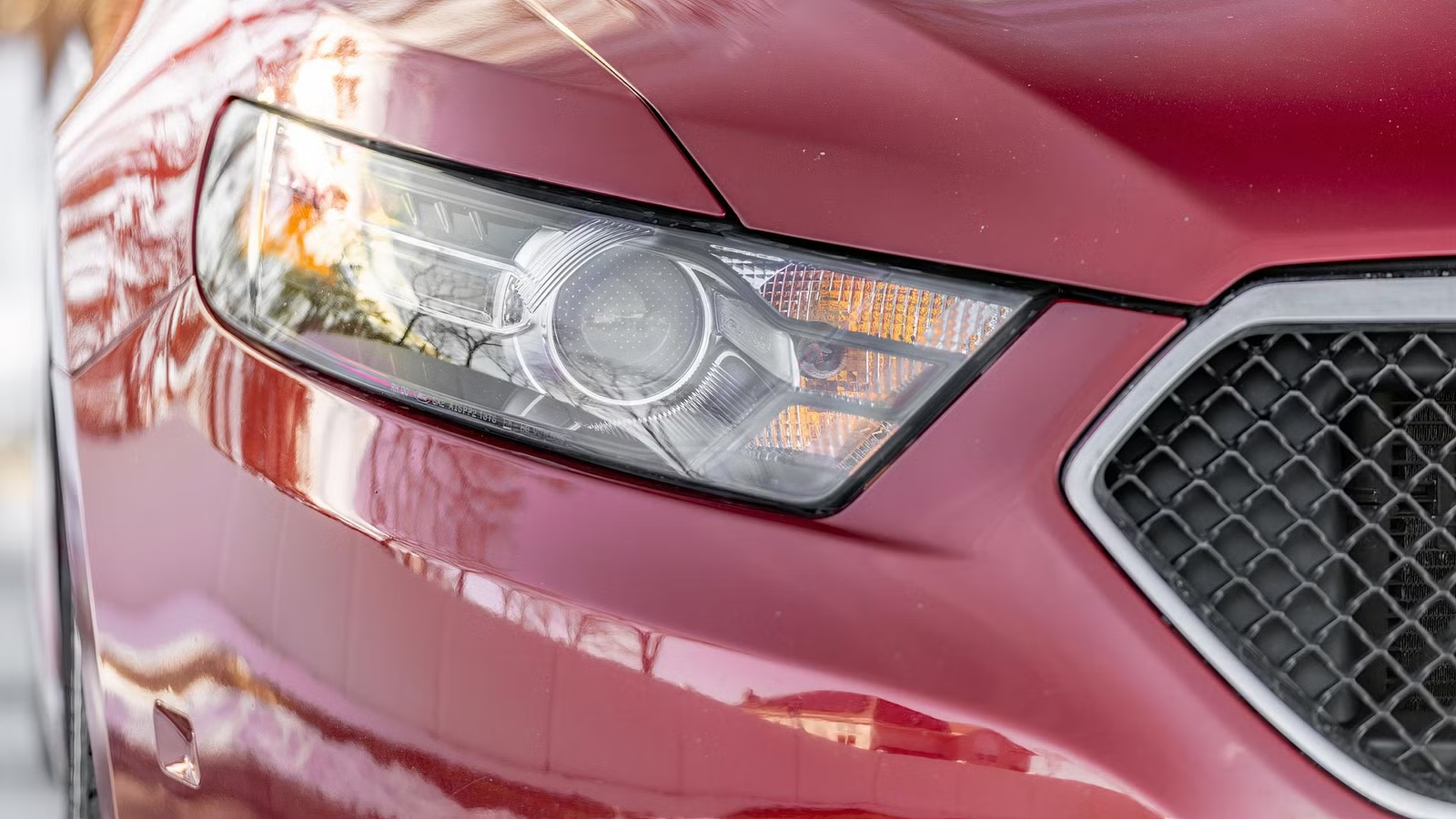
While the idea of a performance sedan is commonplace nowadays, back in the late 1980s, a fast four-door usually meant coughing up some serious cash for a BMW or Mercedes. At the same time, Ford was figuring out how to convince Americans that a FWD family sedan could compete with the Japanese imports that were beginning to dominate the market. While the Taurus didn’t single-handedly change that competitive landscape, Ford did succeed in turning a conventional family car into a genuine performance machine capable of challenging the German sports sedans of the era. And even now, it still doesn’t get the respect it deserves.
Ford’s New Chapter Of The American Family Sedan

Before Ford created one of America’s most unusual performance sedans, the company was undergoing a major shift in how it designed and marketed passenger cars. The new strategy would produce a mainstream sedan unlike anything else in Ford’s lineup—and create the perfect foundation for an unlikely performance experiment.
How One Million Taurus Sales Gave Ford Permission To Get Weird

Back in 1986, Ford introduced one of the most significant vehicles in its history: the Ford Taurus. The Taurus represented a philosophical shift in the American sedan market, moving away from the comically large, RWD sedans that had defined the market for decades toward a FWD layout focused on compact packaging and efficiency. The Taurus was also the first Ford vehicle designed using statistical process control, a system that would help transform quality standards and analysis in automotive production.
Ford’s bet paid off, as the Taurus quickly became a major commercial success, with its smooth, aerodynamic body and rounded design catching on with buyers. More than one million Taurus units were sold within its first three years, giving Ford the leeway to move outside its comfort zone and produce more interesting and specialized variants. Yet, could this FWD family sedan really serve as the foundation for a genuine performance platform?
Ford’s Performance Image Took A Unique Shape


Of course, when you think of Ford performance products, the first thing that comes to mind is the RWD, V-8-powered Ford Mustang, one of the most recognizable cars ever produced, regardless of generation. That’s why, back in the 1980s, the Taurus was an unlikely candidate for a performance variant.
At the time, the BMW 3 Series was already flourishing as a go-to performance sedan of its era, while Audi and Mercedes-Benz also offered comparable fast four-door models. Even the Nissan Maxima was a more obvious choice if you were considering an economical performance sedan. Yet Ford had the right idea: build a platform that buyers already wanted, then add more features and specialized capability over time.
The Taurus SHO Invented A Formula Modern Sports Sedans Still Use

In 1989, Ford applied an almost absurdly serious powertrain to its family sedan and created a car that was far more sophisticated than its anonymous appearance suggested. The result wasn’t merely a quick Taurus—it was an early example of the understated, practical performance sedan formula that manufacturers still use today.
A Yamaha V6 And Five-Speed Manual Made The First SHO Special

If you hadn’t guessed it yet, the vehicle in question is none other than the 1989 Ford Taurus SHO (Super High Output). While the SHO may not look quite as aggressive or angular as today’s performance sedans, what really mattered was what it was hiding under its skin: a stunning Yamaha-developed V-6 powertrain. The SHO utilized a 220-horsepower, 3.0-liter DOHC, 24-valve V-6 with a 7,000-rpm redline, mated to a Mazda-designed five-speed manual transmission.
When compared to the base Taurus MT-5’s 90-horsepower 2.5-liter inline-four or even the more powerful 140-horsepower V-6 options, the SHO was in an entirely different tier of performance. The variable-length intake manifold alone is a work of art, but its legitimate functionality makes it legendary, with butterfly valves and vacuum actuators that could open and close intake runners according to RPM and load conditions.

The SHO was capable of a 6.6-second 0-to-60 mph sprint and a 143-mph top speed, making the American sedan one of the fastest options available in the U.S. at the time. If you wanted something quicker, you generally had to spend considerably more on a German luxury sedan. Yet, the SHO was so much more than a conventional family sedan with a bigger engine; it was engineered as a performance car from top to bottom.
The First SHO Had The Same Ingredients As Today’s Sport Sedans

While the Yamaha-developed V-6 engine is the obvious star of the show, the SHO’s performance upgrades did not stop there. Like today’s sport sedans, the SHO also featured a full suite of chassis upgrades, including upgraded dampers, stiffer springs, thicker anti-roll bars, stiffer bushings, upgraded wheels and tires, and sportier seats.
If that sounds like a complete performance package, that’s because it is, and the modern equivalent of the Taurus SHO is essentially something like a BMW M340i. The formula for creating a practical yet high-performance sedan hasn’t changed much: take a highly functional chassis, add a powerful engine, and upgrade the suspension and supporting hardware without making the car too extreme to serve as a daily driver.

If anything, the first-generation SHO was a true sleeper sedan before the concept became commonplace, and it wasn’t a huge sales success despite the Taurus’ popularity, with about 15,000 sold from 1989 to 1991. The following two generations would prove that balancing mainstream appeal, performance, and cost in a car like the SHO would be easier said than done.
Ford Kept Reinventing The Formula—Sometimes For Better, Sometimes Worse

The original formula was too interesting for Ford to abandon, but making it more accessible came with compromises. Over the next decade, the performance sedan gained more displacement, an automatic transmission, and eventually two additional cylinders—but not every change made it a better driver’s car.
The Second Generation Got More Buyers — And Lost Some Of Its Soul In The Process

In 1992, the SHO returned for its second generation while retaining the Yamaha-developed V-6 engine and five-speed manual transmission. However, to expand its mainstream appeal, Ford introduced a 3.2-liter version of the V-6 that produced 15 pound-feet more torque and was available with a four-speed automatic transmission.
With both manual and automatic versions available, the SHO was now more accessible than ever before, though you could argue that it lost some of its hardcore appeal in the process. However, Ford was also anticipating exactly what would become an important part of the modern performance-sedan formula, as it is now more difficult than ever to find manual-equipped models, let alone performance sedans that are exclusively offered with a manual transmission. Even then, the second-generation SHO retained its fundamental sleeper appeal, and this generation clearly looked sleeker and more refined than its predecessor.
The V-8 Generation Proved More Cylinders Did Not Guarantee A Better Car


Then, in 1996, the third-generation SHO debuted with a dramatically different exterior design that was more rounded and oval-shaped than any previous generation. The iconic Yamaha-developed engine also returned; however, this time around, Ford and Yamaha added two cylinders and increased displacement to 3.4 liters, resulting in a V-8 that produced 234 horsepower and 230 pound-feet of torque. The SHO also differed from the standard Taurus with unique seats, wheels, and bumpers; however, it struggled to match the sales success of earlier versions, with a peak of about 9,000 units in 1997.
The reason for its lukewarm reception was relatively straightforward: Ford had moved the SHO further away from the formula that originally made it so appealing. The third-generation SHO was offered exclusively with an automatic transmission, removing the manual option that had helped establish its enthusiast credentials, while the car also became an expensive proposition for casual buyers who simply wanted something more interesting than a standard Taurus.

Then, the V-8 became notorious for an issue involving the camshaft sprocket, which could result in catastrophic engine failure. The third-generation SHO demonstrated that adding more power and cylinders doesn’t necessarily improve a performance car if the changes come at the expense of the characteristics that made the original special. Once production ended in 1999, there would be a long wait before the SHO name would return to Ford’s lineup.
The Modern SHO Translated The Formula For A New Era
When Ford revived the SHO for 2010, it had nearly every ingredient that defines a modern performance sedan, even though the car had grown dramatically larger and heavier. Its final interpretation also shows why the original idea still matters—and why an overlooked Taurus can be such an interesting performance-car bargain today.
The Fourth-Generation SHO Had 365 HP And Weighed As Much As A Toyota 4Runner

While the first- and second-generation SHO models may rightfully get most of the attention, the fourth-generation SHO that debuted in 2010 deserves its own spotlight as well. The Yamaha-developed V-6 was long gone, replaced by a 3.5-liter EcoBoost twin-turbo V-6 that produced 365 horsepower and 350 pound-feet of torque, mated to a six-speed automatic with standard AWD.
On paper, that sounds like a strong performance package, and it was. The SHO’s limiting factor, however, was its dramatically increased weight of around 4,388 pounds. That’s right, this performance sedan weighs roughly as much as a fifth-generation Toyota 4Runner and is even heavier than some versions of the Ford F-150. Despite its size, the SHO still managed a 5.2-second 0-to-60 mph time and a 13.7-second quarter-mile.

With the available Performance Package, the SHO also received upgraded brake pads, revised steering and stability-control programming, cooling upgrades, a shorter final-drive ratio, and high-performance summer tires. It may not feel or look the same as the original, but the fourth-generation SHO was effectively that concept translated into the language of the modern performance market: turbocharged power, automatic transmission, all-wheel drive, and enough practicality to serve as a daily driver.
Ownership And Current SHO Market Values

Are you now convinced that the Taurus SHO is the greatest car ever made, and now you won’t rest until you have one waiting for you in your garage? Well, there is a bright side: the SHO can still be found across a wide and relatively affordable price range on the used market today.
According to Classic.com data, here are the one-year average sale prices for the Ford Taurus. Note that for the first three generations, the data includes all Taurus trims, not exclusively the SHO. The first-generation Taurus has a one-year average sale price of $7,022, the second-generation averages $9,759, and the third-generation averages $7,700. For 2010–2019 Taurus SHO and Police Interceptor models, the average price is $16,431.

Early manual-equipped SHO models are not easy to come by, with relatively few examples appearing on the market compared with more common performance sedans from the same era. Even so, these cars remain particularly interesting because they anticipated the modern sleeper-sedan formula, proving that practicality and performance didn’t have to be mutually exclusive. Ford discovered decades ago that sometimes the fastest car in the parking lot doesn’t have to look fast at all, and automakers are still reinventing that same recipe today.
Sources: Ford, BMW, Mercedes, Audi, Classic.com

Related posts


Latest Post


No Comments