The Japanese SUV That Can Challenge German Luxury On Comfort Alone
8 minutes reading
Monday, 28 Sep 2026 16:00 0 9 autotech
Guess the price of a three-row SUV with a cabin quiet enough to mute highway noise, seats deep enough to survive a six-hour drive, and materials good enough to make you second-guess the badge on the hood. Most people land tens of thousands of dollars too high. That gap between sticker price and how a vehicle actually feels from behind the wheel is the whole story here. One Japanese automaker has spent the better part of a decade quietly refining ride quality, cabin acoustics, and material choices until its flagship SUV started encroaching on territory usually reserved for German luxury brands. This isn’t a marketing claim. It’s measurable, and it’s worth examining closely.
Three-row SUVs have a comfort problem. Cramming seven or eight seats into one chassis usually means compromises. A stiffer platform to handle the extra weight, thinner padding to save interior space, and a ride that punishes occupants in the back two rows. Most mainstream three-row SUVs accept this trade-off as the cost of doing business. The 2026 Mazda CX-90 doesn’t.
Built on a new rear-wheel-drive platform shared loosely with the smaller CX-70, the CX-90 uses a longitudinal engine layout, a configuration typically reserved for premium and luxury vehicles because it allows better weight distribution and smoother power delivery than the transverse layouts found in most family SUVs. Mazda paired that architecture with a double-wishbone front suspension and a multi-link rear setup, the same basic recipe you’ll find underpinning a BMW X5 or a Mercedes GLE.
Rear 3/4 shot of 2026 Mazda CX-90 Towing A MotorcycleMazda
The result is a chassis that soaks up broken pavement, expansion joints, and highway ruts with a composure that has nothing to do with price point. Mazda didn’t cut corners on the parts that actually determine ride quality just because the CX-90 starts closer to $40,000 than $70,000. That decision alone puts this SUV in a different comfort conversation than its price would suggest.
A Quiet Cabin And Refined Ride Make The CX-90 Feel More Expensive Than It Is
Shot of 2026 Mazda CX-90 Interior View From Back to FrontMazda
Ride quality is only half the comfort equation. The other half is what you hear, or don’t hear, while the suspension is doing its job. This is where the Mazda CX-90 quietly separates itself from nearly every other vehicle in its price bracket.
Mazda engineered the CX-90’s cabin with extensive sound-deadening materials in the floor, doors, and dash, along with acoustic glass on the windshield and front side windows, a feature usually reserved for luxury trims costing considerably more. Wind noise at highway speeds stays remarkably subdued for a boxy SUV with the aerodynamic profile of, well, a boxy SUV. Road noise from the tires is filtered out before it becomes intrusive, even on coarse asphalt.
2025 Mazda CX-90 front seatsChris Chin | TopSpeed
The turbocharged inline-six engine, offered in the CX-90’s higher trims, contributes to this refined feel too. Inline-six engines are inherently smoother than the turbocharged four-cylinders and V-6 engines common in this segment, producing less vibration through the chassis and a more linear, cultured power delivery.
It’s a mechanical choice almost no other automaker makes at this price point, and it pays off directly in how settled the cabin feels under acceleration. Put it all together, and the CX-90 does something unusual. It makes silence and smoothness feel like a baseline expectation rather than an upcharge. That’s precisely the sensation German luxury brands have built entire marketing campaigns around.
Premium Materials And Thoughtful Details Give Mazda’s SUV A Luxury-Car Ambience
Shot of 2025 Mazda CX-90 front cabin showing dashboardChris Chin | TopSpeed
Comfort isn’t purely mechanical. It’s also psychological, and a huge part of that comes from what your hands touch and your eyes see inside the cabin. Mazda understands this better than most non-luxury automakers, and the CX-90’s interior reflects a level of material investment that punches well above its segment.
Higher trims, particularly the Premium Plus and Signature grades, feature Nappa leather upholstery, real open-pore wood trim, and stitched surfaces on the dashboard and door panels rather than hard plastic. Genuine wood and Nappa leather are details typically found in cars costing $15,000 to $20,000 more, and their presence here isn’t cosmetic dressing over a budget interior. The switchgear feels weighted and deliberate. The rotary infotainment controller, rather than a touchscreen-only interface, mirrors the setup found in BMW’s iDrive system, a layout choice that reduces distraction and adds a sense of mechanical precision to everyday interaction.
2025 Mazda CX-90 rear seatsChris Chin | TopSpeed
Even smaller details reinforce the effect: brushed metal accents around the vents, a flush-mounted digital gauge cluster, and ambient lighting that avoids the gaudy multicolor displays some competitors lean on, in favor of a more restrained, tasteful glow. None of this is accidental. Mazda has explicitly positioned the CX-90 as a step toward luxury, borrowing cues from Japanese design philosophy that favors quiet quality over ostentatious branding. Sit in the CX-90 and the cabin’s ambience does most of the persuading before you’ve even started the engine.
The CX-90’s Long-Distance Comfort Is Where Its Luxury Credentials Really Show
2025 Mazda CX-90 engineChris Chin | TopSpeed
Anyone can build a comfortable car for a ten-minute test drive. The real test of a luxury-grade cabin is what it feels like three hours into a road trip, and this is where the CX-90 makes its strongest case. Front seats on Premium Plus and Signature trims are available with ventilation and heating, along with deeper bolstering and thicker cushion padding than those in Mazda’s smaller models.
The extra cushion depth matters more than it sounds: it reduces pressure points on longer drives, delaying the fatigue that flatter, thinner seats tend to induce after 90 minutes or more behind the wheel. Second-row captain’s chairs, standard on most trims, offer 39.6 inches of legroom, a figure that comfortably beats the Acura MDX and sits within a fraction of an inch of the BMW X5’s second row, despite the CX-90 costing thousands less.
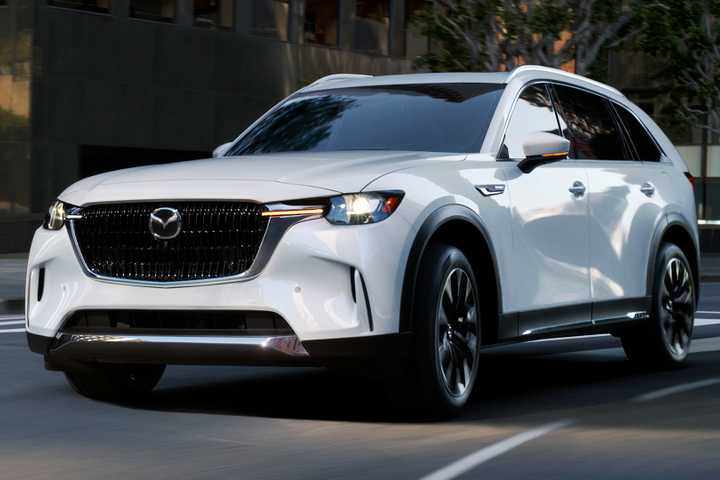
Profile shot of 2026 Mazda CX-90 parkedMazda
Noise levels stay controlled at sustained highway speeds too, a detail that matters enormously on long hauls, since sustained road and wind noise, even at moderate volumes, is one of the primary contributors to driver fatigue on multi-hour trips. Owners and reviewers consistently note that the CX-90 feels noticeably calmer inside at 70 mph than rivals like the Toyota Grand Highlander or Kia Telluride, both of which let more tire roar into the cabin over coarse pavement. The third row remains the CX-90’s weakest link — tight for adults on extended trips — but for the first two rows, where most families and most drivers actually spend their time, this is a cabin built for the kind of comfort that only reveals itself after real mileage, not a showroom walkaround.
Why The Mazda CX-90 Makes A Strong Case Against More Expensive German SUVs
Here’s where the comfort argument turns into a financial one. A 2026 Mazda CX-90 starts at roughly $40,000 for the base Select trim, with a well-equipped Premium Plus trim — the one carrying most of the comfort features discussed above — landing in the mid-$50,000s. A similarly equipped BMW X5 starts north of $67,000 before options, and a comparably trimmed Mercedes-Benz GLE pushes past $65,000. Even the Volvo XC90, a European alternative with a strong reputation for cabin comfort, starts around $56,000 and climbs quickly once you add the features that come standard on a loaded CX-90.
That’s a real-world gap of $10,000 to $25,000 depending on trim level and rival chosen, for a vehicle that matches or beats those competitors on ride refinement, cabin quietness, and interior materials — categories that traditionally justified the German premium in the first place. Where the CX-90 concedes ground is brand cachet and third-row space, areas where a badge and a few extra inches genuinely matter to some buyers.
But for anyone cross-shopping strictly on how a vehicle feels to drive and ride in every day, the CX-90 forces an honest question. Is the three-pointed star or the roundel actually worth that premium, or has Mazda quietly closed the gap enough that the extra money buys prestige rather than comfort? For a growing number of buyers, the answer is increasingly clear — and it isn’t the one German dealerships want to hear.











No Comments