
The First Production Motorcycle To Break 100 Horsepower
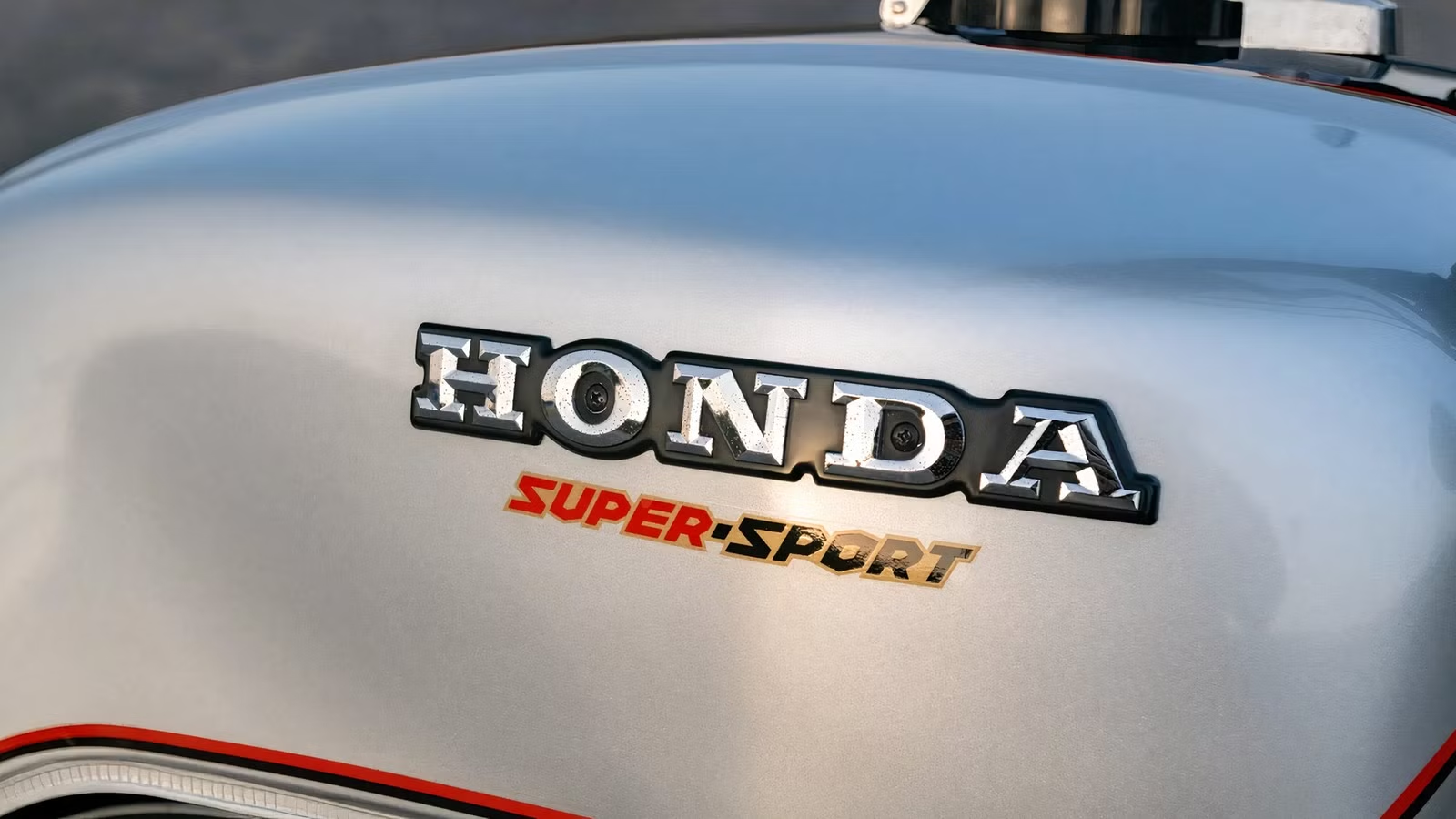
In our day and age, a 100-horsepower motorcycle is nothing to write home about, but the three-digit threshold was a pretty big deal many years ago. Even the quickest production bikes out there were only making around 70 hp by the time the seventies rolled around, and Kawasaki raised the bar with the iconic 82 hp Z1 in 1972. Meanwhile, the Honda CB750 had just 67 hp, Suzuki came up with the GS750 producing just as many, and it took Yamaha until 1978 to release the XS1100 with 95 hp on tap. But what was the first production motorcycle to exceed 100 horsepower and when did it finally land?
Clarifying An Important Caveat

Well, the answer depends entirely on what you define as a production bike, because a boutique manufacturer from Germany was already at triple digits since 1973. Enter the Münch Mammoth 1200 TTS-E, generating exactly 100 horsepower and hailed as the world’s first motorcycle with fuel injection. It was a crude mechanical system as opposed to the electronic ones developed later on, though, slapped onto a big old 1,177cc NSU car engine or an even bigger 1,278cc mill. That should make the 1200 TTS-E a worthy contender for today’s article, but it doesn’t quite qualify as a production motorcycle.
On the one hand, only around 130 units were ever built by Münch and even fewer of them were actually equipped with that larger 100-hp engine. Every TTS-E was built by hand and custom-made for each client’s individual needs, too, so they don’t entirely fit the traditional definition of a production motorcycle. That being said, we’ll have to go back to Japan in order to uncover the machine we’re looking for, and it only arrived in the late seventies. With the UJM craze well underway by then, Honda’s first-gen CB750 was getting a bit long in the tooth and the idea of replacing it with a new flagship had been on the table for some time.

The German-Designed Japanese Superbike That Was Briefly The Fastest Production Bike On Earth
This bike was radical, divisive, and incredibly fast — and for a brief window, no production motorcycle on earth could touch it.
Honda Sought To Get Back Into The Limelight

Wanting to dominate the street performance game yet again, Honda was preparing to make a bold move in the hopes of getting ahead of its competition. And although the company wasn’t explicitly trying to break 100 hp with its newest development at the time, the model did end up becoming the world’s first production road bike to break that barrier. Not only that, but it also came with two additional cylinders compared to the popular Japanese inline-fours which had taken over the motorcycling industry a few years prior. You might’ve guessed what model we’re referring to by now, so let’s dive into the deep end without further ado.
10 Big-Bore Vintage Superbikes Real Riders Worship Forever
These legendary machines from motorcycling’s golden era continue to command massive respect and serious auction money decades later.
The Honda CBX Took Things To The Next Level

Debuting as a 1979 model, the CBX was an absolute marvel of Japanese engineering and the most powerful production motorcycle at the time of its release. It came with a buff, transversely mounted 1,047cc inline-six powerhouse, which was extensively praised for its smoothness and race-derived DNA. The 24-valve engine could produce about 105 hp at 9,000 rpm, confidently bringing the CBX into three-digit territory and playing quite a soundtrack while doing so. In fact, many would say the CBX is the best-sounding bike in existence, often comparing it to the screaming Formula 1 cars of yore. Power was routed to the rear wheel via a five-speed transmission, resulting in speeds of up to 135 mph.
Technical Specifications
|
Engine |
Air-Cooled Transverse Inline-Six |
|
Displacement |
1,047cc |
|
Valvetrain |
DOHC, 4 Valves Per Cylinder |
|
Horsepower |
103-105 HP |
|
Transmission |
5-Speed |
|
Quarter-Mile |
11.36 Seconds |
|
Top Speed |
~135 MPH |
Besides that, Honda’s six-cylinder phenom boasted a quarter-mile time of just 11.36 seconds according to period tests from Motorcyclist magazine. It clearly was a force to be reckoned with in a straight line, but a few notable disadvantages prevented it from being an excellent all-round performer. First, there was the CBX’s weight, coming in at around 600 pounds with all the necessary fluids. That’s very much on the heavier side even by 1970s standards, so the bike wasn’t exactly nimble or easy to wrestle around corners. Then there was the problem which plagued pretty much every superbike at the time — a flimsy chassis barely able to contain the engine’s power. For instance, the bike’s skinny frame tubing and rudimentary suspension felt far from reassuring when it was pushed hard.
So, as potent as the CBX might’ve been, it certainly didn’t come without issues and was also hampered by the complexity of its six-cylinder engine. That meant additional manufacturing and servicing costs, as well as a higher sticker price than what Honda’s rivals were offering at the time. Ultimately, the model wasn’t nearly as successful as the company would’ve hoped, despite being one of the wildest things out on the road as the seventies drew to a close. Honda didn’t give up on it straight away, though, instead trying to pivot toward the sport-touring genre with a comprehensive revamp of the CBX nameplate.
Repurposing The Mighty Six-Cylinder Beast

For the model-year 1981, Honda had the CBX fitted with a front fairing and storage panniers, while also redesigning its rear end to accommodate a monoshock suspension setup. The engine was detuned to just under 100 hp while gaining better mid-range torque, and a slightly beefier pair of air-assisted forks were tasked with managing front-end suspension duties. Upgraded brakes and wider wheels were also part of the package, along with other minor changes not directly related to performance. Essentially, the manufacturer sought to target an entirely different crowd and simultaneously address some of the issues with the CBX, but all its efforts were sadly in vain.
The model continued to underperform commercially, outsold by the competition and even Honda’s own CB900F. It was thus quietly discontinued in 1982, and six-cylinder engines remain relatively uncommon in motorcycles to this day. When you think about it, the CBX should’ve been a smash hit, especially given all the attention surrounding it in the press, but it just couldn’t withstand the real-world pressures of a highly competitive market. However, it eventually went on to get the love it deserved many years after the end of production, and collectors will nowadays spend some serious cash on clean examples at auction.
This Honda Motorcycle Revs Higher Than An F1 Car
It only boasts 250cc of displacement, but this little Honda four-cylinder is a true screamer once you wind it out.
Where The CBX Stands Today

Indeed, the Honda CBX has attained cult-classic status, frequently commanding north of $20,000 on the secondhand market. Because although it might’ve been underappreciated back in the day, it still stands as a symbol of technological excess from the golden age of UJMs. And being the first mass-produced motorcycle to enter the triple-digit horsepower club, it basically opened the floodgates for all the insane superbikes that came later on. That’s what the CBX is remembered for today, and this enduring legacy is why we often see pristine specimens sold for a small fortune on websites like Bring a Trailer. So, despite its flaws and unsuccessful production run, the model did succeed in becoming one of Japan’s most treasured classics long after it was discontinued.
Sources: Cycle World, Motorcyclist, Old Bike Barn, CBX Riders Club, Bring a Trailer

Related posts

Latest Post


No Comments