
The Forgotten Ford Muscle Car That Became A Sports Truck
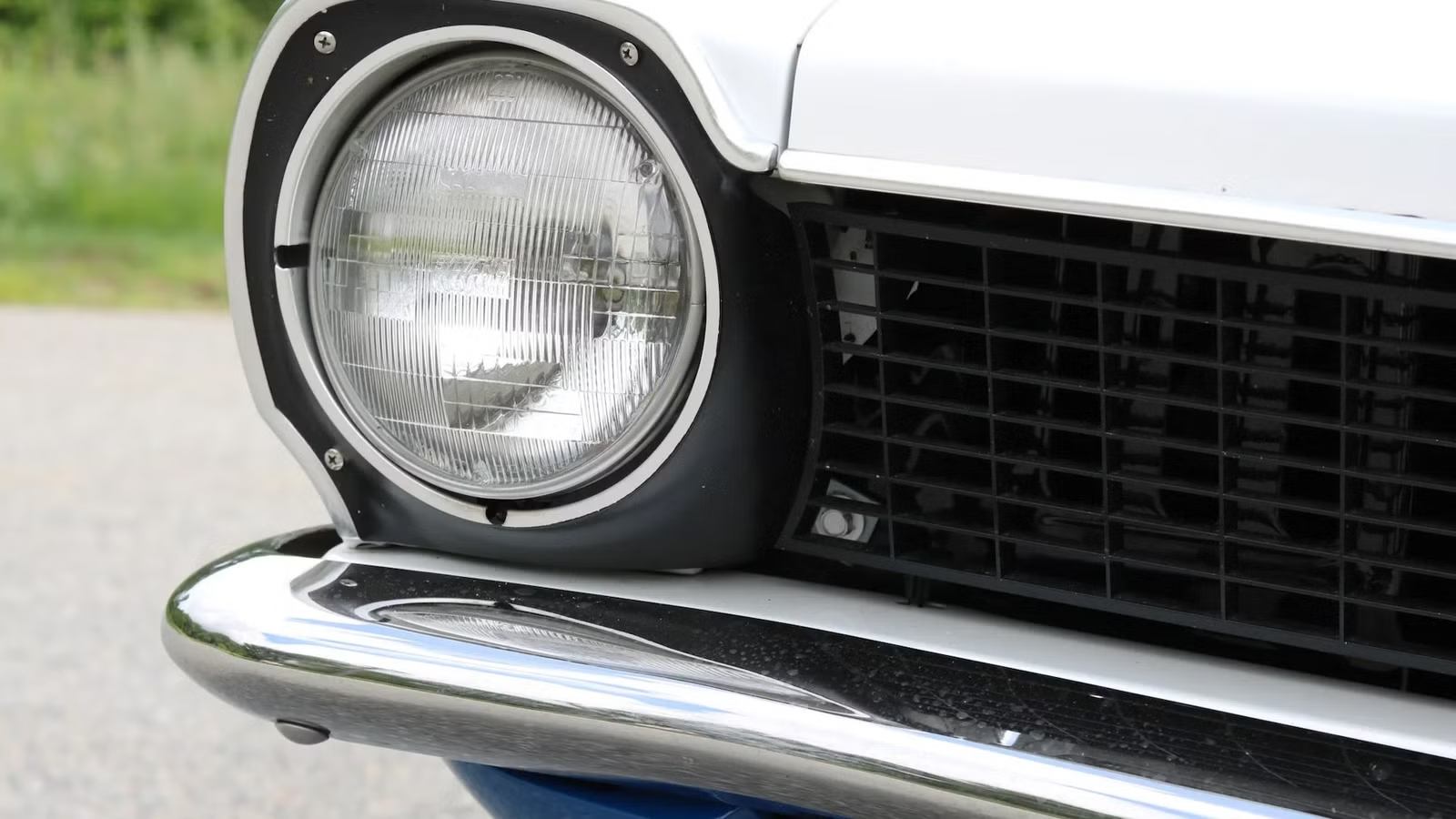
It’s pretty common for classic muscle car names to get discontinued only to be revived later as a completely different type of beast. For example, the Ford Lightning was a compact, gas-slurping sports truck back in the 1990s. Then over 20 years later, the Lightning moniker returned with the Ford F-150 Lightning. At least the full-size electric truck lived up to the title by being extremely fast. However, a forgotten Ford muscle car has an even wilder transformation story.
Ford Needed To Replace The Falcon

In the late 1960s, Ford needed to replace the outdated Falcon to better compete against foreign rivals like the Datsun 240Z and Toyota Corona. Models like the Volkswagen Beetle were selling with original MSRPs for around $1,699. Meanwhile, the Ford Falcon rang in at about $2,252.
The Ford Falcon debuted in 1960 and was doing fairly well until the Mustang launched in 1964. Despite having the same mechanical base as the Mustang, the Mustang decimated the Falcon’s sales. Unfortunately for the Falcon, the Mustang was an immediate hit with a more aggressive style.
Plus, the Falcon got sidelined by other mid-size models like the Torino and Pinto, which were squeezing it out of the market. On top of that, drivers wanted more economical cars as gas prices rose, and the Falcon was struggling to meet increasing environmental regulations at an affordable cost, so it was discontinued in 1970.


Just to put things in perspective, when the Ford Falcon launched in 1960, it sold an astonishing 435,676 models and peaked in 1961 with 474,292 sales. Then sales declined each year. In 1969, the Falcon limped by with 95,015 sales. In 1965, when Ford Mustang production fully ramped up, it sold 559,451 units; then in 1969 it moved 299,824 models.
The Ford Maverick Grabber Brings The Heat

The Ford Maverick replaced the Falcon and achieved most of the company’s goals. For example, it had an original MSRP of $1,995 to target imported rivals. Ford reused the basic mechanical Falcon platform to cut manufacturing costs. It was also more efficient, getting an estimated 22.5 mpg combined compared to the Falcon’s 15 mpg combined.
Also, the Maverick rocked an attractive modern style to attract more youth-oriented buyers. The compact car got a Mustang-inspired long hood and fastback roof design that earned it the nickname ‘Mini-Mustang’. The 1970 Mustang started at around $2,721, so the mini version provided substantial savings.
At first, the Ford Maverick Grabber emerged as a sporty appearance package, but in 1971 it gained V8 power. The 302 cubic-inch (4.9-liter) engine delivers 210 hp and 269 lb-ft of torque. It accelerates from 0 to 60 mph in 7.9 seconds and completes a quarter mile in 15.9 seconds at about 85 mph. Also, this compact car has a top speed of 119 mph.

The Grabber package spiced things up with a dual-dome hood and simulated side air scoops, side stripe graphics, a decklid spoiler, and a blacked-out grille. Grille-mounted road lamps really helped the Maverick Grabber pop. It rode on 14-inch wheels equipped with trim rings and hubcaps. They were wrapped in D70-14 tires.
But The Ford Maverick Sports Car Was Short-Lived

Toward the end of the 1970s, the Ford Maverick was facing similar problems that put the final nails in the Falcon’s coffin. It was showing its age, and it didn’t help that it was based on the ancient Falcon platform. The Maverick was showing its age in the middle of the decade as consumer preferences shifted.
The Ford Maverick was only supposed to hang around until 1975 anyway. However, it stayed around until the end of 1977. Driver demand for an affordable, fuel-efficient car amid the energy crisis kept it alive for a few extra years. But the implementation of modern federally mandated safety features such as larger, energy-absorbing bumpers threw off its clean style.
As the industry changed, the older Maverick remained surprisingly popular with 1.3 million sales by 1973. It was the top-selling car in the compact segment, proving that the segment was a hit. However, rivals such as the Chevy Nova, Toyota Corolla, and Ford Pinto were rocking fresh redesigns that attracted buyers.

In 1977, the Ford Maverick only sold 98,506 units. The Ford Mustang only sold 153,173 models, and the Pinto moved 225,097 cars to crush them both. Then the Maverick was replaced by the upcoming Granada and modernized Ford Fairmont that both utilized the new Fox platform. Both exploded in the compact segment.
The Ford Maverick Truck Carries The Spirit Of The Car

Flash forward to 2021, when the world saw the return of the Ford Maverick as a compact truck for 2022. Now, going from a muscle car to a truck might not make sense, but the Maverick carries multiple qualities from the 1970s Mini-Mustang. For example, it launched as an affordable option with an MSRP of $19,995, purposely starting under $20,000, as the original car started under $2,000.
It is also a more fuel-efficient option to consider. The Ford Maverick Hybrid gets an EPA-estimated 38 mpg combined with front-wheel drive. Plus, the mini-truck has styling cues related to the rugged Ford Bronco and Ford Ranger for a modern, attractive look. However, two sport packages provide more style and performance enhancements.

The Ford Maverick Lobo lowers the suspension, rides on 19-inch turbofan wheels, has a unique grille, features body-colored lower accents, and a black-painted roof. Power stands at 250 hp and 277 lb-ft of torque. The engine is paired with a performance-tuned suspension, faster steering rack, a twin-clutch torque-vectoring rear differential, a seven-speed quick-shift automatic transmission, and ST front brakes.
Then the Ford Maverick SV300T takes things to a whole new level. It features a 2.3-liter turbocharger from the Mustang EcoBoost, an upgraded intercooler, and a Borla cat-back exhaust to deliver 300 hp and 350 lb-ft of torque. It can accelerate from 0 to 60 mph in about 6.1 seconds. Sadly, an official quarter-mile time hasn’t been released.

The package also includes 20-inch bronze or black wheels, lowering springs, larger stabilizer bars, performance-tuned shocks, and upgraded bushings. It wears a lower front spoiler with a distinct hood and body/rocker panel graphics. This Maverick certainly looks more aggressive than the base trim, with a nod to its muscle car heritage.
Source: Hagerty, Classic Industries

Related posts

Latest Post


No Comments