
The Detuned Shelby Dodge Built Specifically For A Rental Car Counter
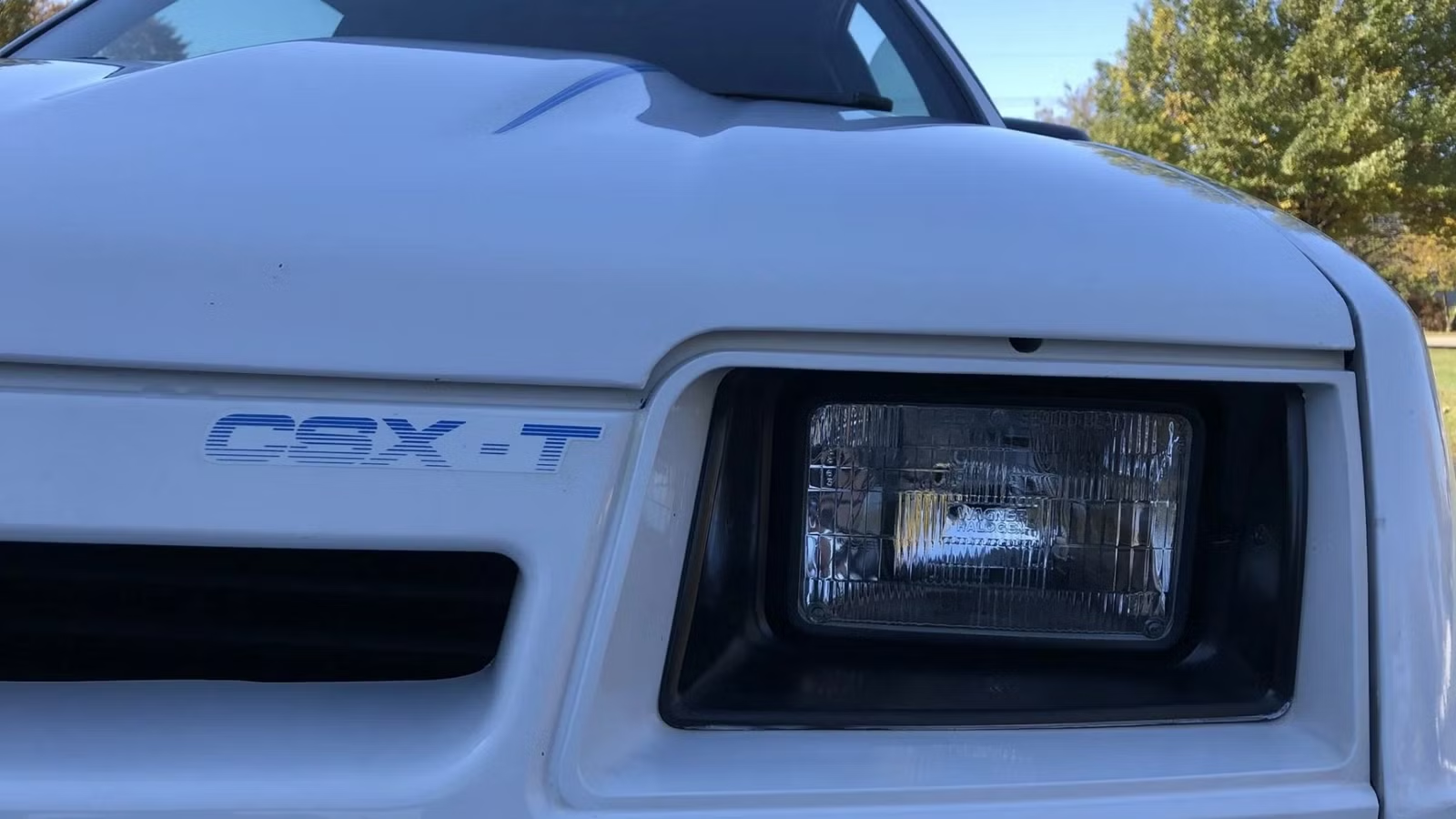
Rental cars usually live at the dull end of the automotive food chain—they need to be cheap, simple, durable, and difficult for customers to turn into expensive repair bills. In 1988, one rental company took a very different route. It ordered a limited-production Shelby with a turbocharged engine, a five-speed manual, serious brakes, and real suspension work. There was only one catch: Shelby’s original recipe was considered a little too spicy.
Rental Companies Once Had A Very Different Idea Of “Economy”

The idea had precedent. In 1966, Hertz put the Shelby GT350H into its rental fleet and created the famous “Rent-a-Racer” program. Members of the Hertz Sports Car Club who met the age requirements could rent a 306-hp Shelby Mustang for $17 per day plus mileage. Hertz ordered roughly 1,000 of them.
Instead of staring at a Shelby through a showroom window, an enthusiast with a credit card could borrow one for a business trip, a vacation, or whatever other completely innocent activity happened to require a high-performance Mustang for the weekend. But from a fleet-management standpoint, the plan bordered on comedy. Performance cars have expensive tires, brakes, engines, and clutches. Rental customers, meanwhile, do not traditionally form deep emotional bonds with clutch life.

Yet the marketing value was obvious – Hertz gained a car people actively wanted to rent, Shelby put its machinery directly into thousands of hands, and Ford received exposure that no magazine advertisement could quite reproduce. The legends about customers racing the cars, swapping parts, or returning them after rough weekends grew almost as famous as the GT350H itself, although some of those stories remain difficult to separate from decades of enthusiast folklore.

Two decades later, American performance looked very different. Big engines had not vanished, but some of the most interesting machinery of the 1980s came from a different playbook: turbochargers, electronic engine controls, front-wheel drive, and relatively light compact platforms. Chrysler leaned especially hard into turbocharging, while Carroll Shelby’s work with the company proved that front-drive economy-car bones could support surprisingly serious performance. A rental-counter sequel to the GT350H no longer needed a V8, rear-wheel drive, or tire smoke pouring from both rear quarters. It needed boost, low weight, and somebody brave enough to sign the fleet order.
The Rental Company Had One Problem: Shelby’s Car Was Too Hot

Shelby already had the right raw material. For 1987, Shelby Automobiles took the Dodge Shadow-based P-body and turned it into the Shelby CSX. Its intercooled 2.2-liter Turbo II four-cylinder made 175 hp and 175 lb-ft of torque, substantial output for a compact front-driver of the period. Shelby also fitted firmer, lower springs, Monroe Formula GP dampers, a larger rear anti-roll bar, four-wheel disc brakes, and its own wheels. Shelby built 750, and 165 went to Thrifty.
Those cars apparently taught Thrifty something important: 175 turbocharged horsepower might have been more entertainment than a rental fleet needed. Thrifty reportedly considered the intercooled cars too powerful and asked for the 1988 rental order to be detuned. Shelby therefore skipped the intercooler and used Chrysler‘s standard non-intercooled 2.2-liter Turbo I setup instead. Thrifty effectively walked into Shelby’s office and asked the man famous for making cars faster to please calm one down.

Only the engine specification became milder, though. The basic recipe remained bizarrely enthusiastic for rental duty: turbo power, a five-speed manual gearbox, Shelby suspension tuning, four-wheel disc brakes, and customers who would eventually return the car and walk away from whatever remained of the clutch and front tires.
The 1988 Shelby CSX-T Was A Factory-Built Thrifty Rent-A-Racer

That car was the 1988 Shelby CSX-T, and the “T” stood for Thrifty. It started with Dodge Shadow/P-body hardware, then went through Shelby Automobiles in Whittier, California. Production stopped at 1,000 examples. Every regular-production car wore the same unmistakably period combination of white paint, gray lower bodywork, and blue Shelby graphics. It looked like a company car that had consumed several cans of energy drink.
Under the hood sat Chrysler’s 2.2-liter Turbo I four-cylinder without an intercooler. Factory output was 146 hp and 168 lb-ft of torque, sent through a five-speed Getrag manual transaxle to the front wheels. The car weighed roughly 2,700 pounds, depending on how a particular example was equipped and measured. The 0-60 mph sprint took 7.7 seconds, while the quarter-mile discipline reportedly took 15.7 seconds. That was genuine performance-car territory for an inexpensive front-driver of the time.

Shelby also left much of the good hardware alone. The package included Monroe Formula GP gas-charged struts and shocks, four-wheel disc brakes, 205/50VR15 Goodyear Eagle Gatorbacks, Shelby bodywork, and cast-aluminum wheels. The CSX-T used distinctive 15×6.5-inch five-spoke “LeMans” wheels with polished faces, larger than the 15×6-inch wheels fitted to the previous CSX. Inside, the rental Shelby retained full analog gauges, a Shelby steering wheel, and a boost gauge mounted high in the center stack. A numbered dash plaque identified each car and tied it to the Thrifty program. Shelby even recommended synthetic Mobil 1 in its maintenance instructions, an unexpectedly fussy detail for a car destined to spend its youth collecting rental agreements.
The strangest specification, however, was not under the hood. It appeared on the rental contract – the Shelby Registry records a daily rate of about $34.95. A customer could simply walk into a participating location, sign paperwork, and leave in a numbered Shelby with a turbocharger and a manual transmission. That is the sort of sentence that makes modern fleet accountants quietly close the laptop and go home. Once the cars finished rental service, many entered private hands like ordinary retired fleet vehicles. Their years as rentals would eventually become a major part of what made surviving cars interesting.
Detuned Didn’t Mean Defanged

Calling the CSX-T “detuned” can make it sound softer than it really was. Removing the intercooler dropped output from the previous CSX’s 175 hp to 146 hp, but Shelby did not gut the rest of the car. The suspension remained purposeful, the four-wheel discs remained, the five-speed remained, and so did the boost gauge, performance tires, aero pieces, and Shelby-specific trim. Even the power reduction deserves perspective: torque only fell to 168 lb-ft, which meant the car still had the low- and midrange shove that made turbo Mopars fun. The 7.7-second 0-60 figure put it only about seven-tenths behind the hotter 1987 CSX.

That makes “sleeper” a slightly awkward label. The CSX-T had large Shelby graphics, a body kit, special wheels, and enough visual noise to warn nearby traffic that something unusual was happening. A better description is a limited-production factory performance rental. Its rarity today also makes sense once its first job enters the equation – rental cars rack up miles, pass through many drivers, suffer parking-lot damage, and eventually leave fleets as used cars without anyone expecting them to become collectibles. Turbocharged 1980s compacts also spent decades being modified, used up, rusted out, or simply discarded. Shelby’s Registry currently lists only a fraction of total production among voluntarily registered cars, though that database should not be treated as a complete survival count.
Collectors have started paying attention to unusually clean survivors. In August 2024, Bring a Trailer sold CSX-T No. 545, showing about 14,000 miles, for $18,450. One auction does not establish a universal market value, but it shows that low-mile examples can attract serious interest.
The CSX-T May Have Been The Last Real Rent-A-Racer

The CSX-T was not literally the final high-performance Shelby available from a rental counter. Hertz later revived the idea, including the Shelby GT-H and, decades later, the 900-plus-hp GT500-H. But the 1988 Thrifty program still feels like one of the last examples of the old formula in its wonderfully simple form: take a genuinely entertaining production-based car, put a rental-company logo on the paperwork, and hand ordinary customers the keys. The GT350H and CSX-T shared almost nothing mechanically, but the business proposition underneath them was remarkably similar.
That old approach feels much stranger now because rental fleets have become heavily instrumented businesses. Modern connected vehicles can report mileage, fuel use, vehicle condition, location, acceleration, braking, speed, and other operating data, depending on the fleet and car. Rental companies use telematics for fleet management, billing, safety, security, and claims work. Insurance processes, data handling, corporate risk controls, and vehicle costs also add layers that a 1960s or 1980s program did not face in the same form. None of that makes another performance rental impossible—the later Shelby-Hertz cars prove otherwise—but an exact replay of the cheap, manual-transmission, lightly supervised rental rocket is difficult to imagine.

That leaves the CSX-T with one final joke hidden in its spec sheet. Thrifty had already sampled Shelby’s hotter intercooled compact and apparently decided renters needed protection from all 175 hp of it. The company asked Shelby to remove some heat before placing the next batch into fleet service, and Shelby obliged, dropping output to 146 hp. Then Thrifty proceeded to rent customers a roughly 2,700-pound, turbocharged, five-speed, front-wheel-drive Shelby with sport suspension and four-wheel disc brakes for $34.95 a day. Even when a 1988 rental company tried to make a Shelby more sensible, it somehow ended up with a rent-a-racer anyway.
Source: Chrysler, Dodge, Shelby, Shelby Registry

Related posts





Latest Post


No Comments