
The Overbuilt Jeep Inline-Six That Hits 300 HP On A Stock Bottom End
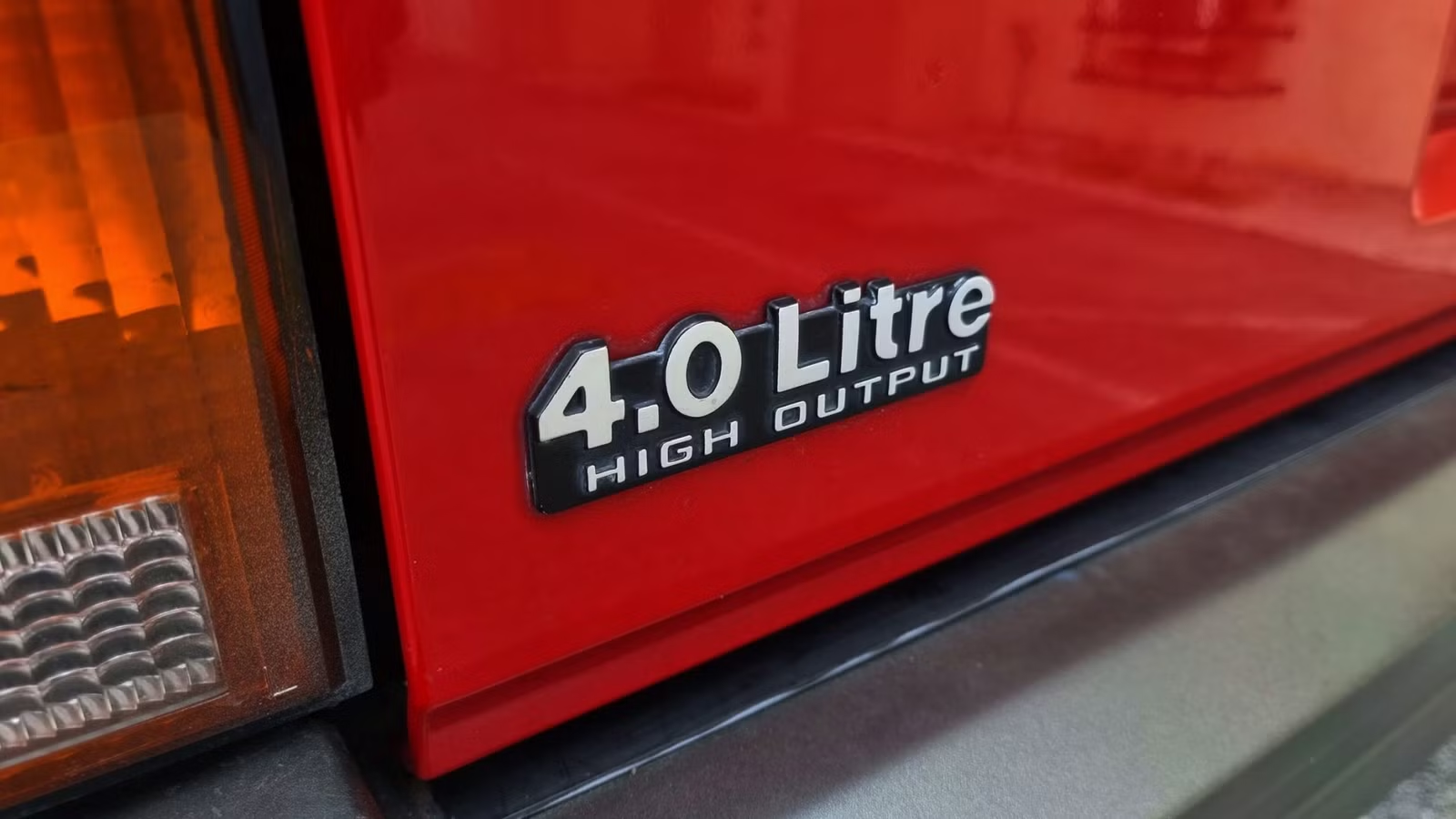
I see you out there thinking about destroying your Jeep with an LS swap. I can’t control what you do, but I can ask you to take a beat and reconsider this decision. An LS swap could be a costly $15,000 mistake when you already have a durable inline-six engine under the hood that provides the cheapest path to 300 hp on a stock bottom end. Trust me, the AMC 4.0-liter is ready to confidently manage extra power at $3,000.
Jeep’s 4.0-liter Inline-Six Engine Is Misunderstood

The AMC-derived 4.0-liter inline-six has a bit of a reputation for being sluggish. Depending on the year, it churns out 173 to 190 hp and 215 to 235 lb-ft of torque. It helps the Jeep Cherokee XJ accelerate from 0 to 60 mph in about 8.4 seconds and complete a quarter mile in around 16.5 seconds at 83 mph, with a top speed of 115 mph.
While it isn’t exactly a speed demon, it’s a stout torque powerhouse for towing and rock crawling with the ability to pull up to 5,000 lbs. The heavy cast-iron block and head handle extreme heat instead of being prioritized for high revs and fast acceleration. People often claim that this engine was discontinued because it frequently leads to breakdowns.
But that’s not true. The engine was retired in 2005 because upgrading the older design to pass increasingly stringent emission standards would be too expensive. In reality, it can easily make it over 300,000 miles with basic care and regular maintenance. However, I understand the appeal of an LS swap.


People often want more power, and the standard 5.3-liter and 6.0-liter LS V8 engines easily increase the output to 300 and over 400 hp. They’re more efficient and have tons of aftermarket support. There are complete swap kits, wiring harnesses, and cooling systems specifically designed for LS-into-Jeep conversions.
The Inline-Six Can Be Pushed To Extreme Limits

Your Jeep Wrangler, Cherokee, or Grand Cherokee already has the path to more power under the hood with the 4.0-liter, thanks to its overbuilt, heavy-duty design for structural strength and thermal stability. The thick, cast-iron block and head resist warping and wear under extreme temperatures.
It operates under less internal stress for daily driving, off-roading, and heavy towing. Note that the simple overhead-valve (OHV) pushrod configuration with hydraulic lifters avoids the use of complicated, failure-prone components such as overhead camshafts, multi-valve setups, and turbochargers.
The crankshaft features seven main bearings instead of only four to evenly distribute rotational loads while minimizing flex under heavy loads. Also, the straight-six layout provides enhanced balance that negates secondary vibrations and reduces long-term wear on internal components and engine mounts. This engine’s stock bottom end and internals can reliably handle 300 wheel horsepower and 7 to 8 PSI of boost pressure before the cylinder pressure causes head gasket failures. Newcomer Racing achieved 861 hp and 881 lb-ft of torque on a modified 4.0-liter block at 21 PSI. They later managed to hit 1,082 hp and 1,017 lb-ft of torque.

Using a simple 6.5 PSI turbo kit on a stock 1990 Wrangler TJ resulted in a 44% increase in horsepower from 141 whp to 214 whp and a 47% increase in torque from 191 lb-ft to 281 lb-ft with no loss of low-end trail crawling capability. Long-tube headers alone can increase horsepower and torque by 30% by reducing back pressure.
Expensive LS Engine Swap Drawbacks

Yes, LS swaps have tons of benefits. For example, the engine is abundant and easy to find in Chevrolet trucks and SUVs left to rot in junkyards. Plus, the LS engines are a bit more modern and can be paired with electronically controlled automatic transmissions. But only hearing the positives gives you an incomplete picture.
First of all, it’s more expensive, with a price tag of around $15,000, while a simple Jeep Cherokee turbokit only costs $3,000. Consider the cost of the necessary custom parts, adapters, and labor too. Fitting a larger V8 engine in a bay designed for an inline-six requires custom motor mounts, clearance adjustments, and an upgraded high-capacity radiator to handle extra heat.
Also, Chrysler and Jeep electronics don’t pair well with General Motors’ powertrain control modules and lead to communication challenges. It often requires the integration of gauges and dashboard functions. The OBD-II diagnostics may require a custom harness or dual operating systems.

Plus, you would need to watch out for drivetrain overload. The stock transmission, like the AX15 or 42RLE, transfer case, and axles like the Dana 35 can’t handle the sudden surge in horsepower and torque, leading to a total drivetrain replacement. Overall, the conversion could take much longer as costs continue increasing.
Keys For 4.0-Liter Enhancing Success

There are a few things to keep in mind with a 4.0-liter Jeep turbo kit. First, replace the stock exhaust manifold with long-tube headers. The OEM headers are cast iron, so they’re heavy. Plus, they’re restrictive and prone to cracking under repeated heat cycling over 150,000 miles. By removing the catalytic converter, you get improved exhaust flow for faster-moving air and more power.
1996 and later models can be tuned with ECU tuners. Unfortunately, earlier models cannot be tuned. But for the later Jeeps, tuning is a fast way to increase horsepower and torque without any bolt-on modifications. Simply adjust parameters like the ignition timing, fuel pressure, and air-to-fuel ratios.

Then think about forced induction to gain more power with a blower. Superchargers have an advantage with naturally aspirated engines because they work by running off a belt connected to a crankshaft. Meanwhile, turbochargers require a turbo exhaust since they work by running exhaust gas coming from the engine.
Last but not least, a stroker kit is recommended to turn the Jeep into a 4.6 stroker. A stroked motor is achieved by lengthening the piston stroke to increase combustion chamber volume. This allows more air to enter and is the only way to enhance displacement for substantial power gains.
Source: Fastest Laps, Engine Labs, 8020 Automotive

Related posts


Latest Post


No Comments