
Why Toyota Dropping The Boxer Engine Is A Huge Deal
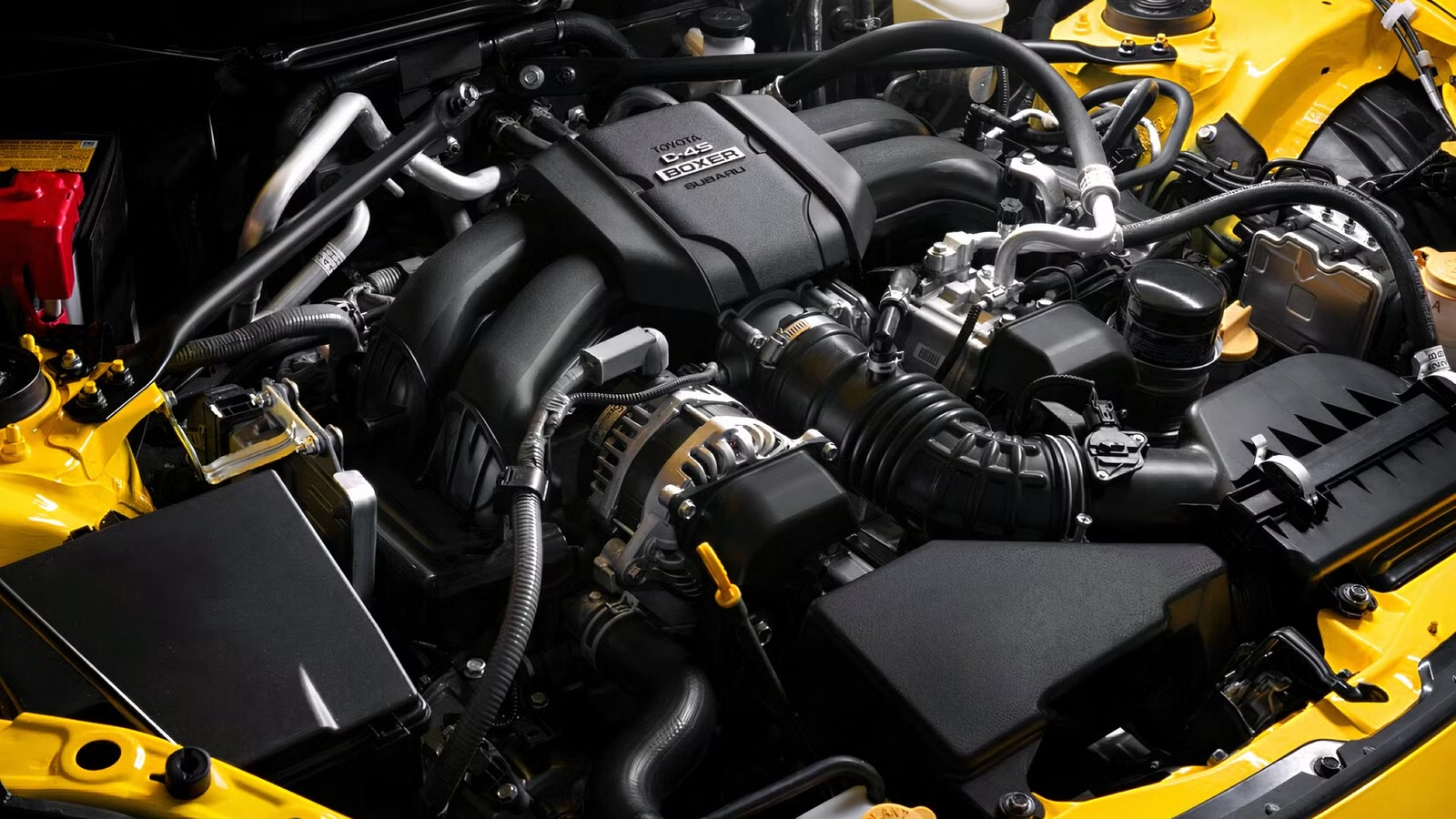
Toyota has never been a brand content to stand still, and the GR86 is about to prove it. The boxer engine — a flat-four shared with Subaru for well over a decade — is on its way out of the next-generation GR86, replaced by an inline-four developed entirely in-house by Toyota engineers. It’s a bigger shift than it might sound, and the ripple effects could reshape the entire small sports car segment.

The current Toyota GR86 was born from a collaboration between Subaru and Toyota, with Mazda also fielding a small sports car of its own in the same era. The GR86 has long shared its engine with the Subaru BRZ, but that arrangement is coming to an end. The next-generation model will arrive with a new power plant under the hood.
Toyota has already demonstrated what its engineers can do with a small-displacement performance engine: the GR Yaris (sold in markets outside North America) and the GR Corolla both use the same turbocharged inline-three powertrain, and it handily outpowers the current GR86’s naturally aspirated flat-four. Bringing that kind of firepower to the GR86 would put it firmly ahead of both the Subaru BRZ and the Mazda MX-5 Miata.
The Boxer Engine Limits Toyota’s Capabilities
The Subaru Engine Under Fire

The boxer engine is primarily a Subaru design that was shared with the previous Scion FR-S and the current Toyota GR86. This engine has come under scrutiny due to documented failures. The engine failure issue is mostly found in first and second-generation versions of the Scion FR-S and Toyota 86 models, as well as early examples of the Subaru BRZ. This issue has grown into a class-action lawsuit against the companies for engine failure that can occur while driving. In some cases, the engine suddenly loses power.
“In April 2023, Laura Young was driving her Toyota when it suddenly lost power, and the engine failed with the GR86 having about 64,000 miles on the odometer. The powertrain warranty coverage is for 60 months or 60,000 miles, whichever occurs first.”
– Car Complaints
This is one of many issues facing the boxer engine that has contributed to the class-action lawsuit surrounding it.
Naturally Aspirated Dependency
Beyond the reliability concerns, relying on this setup leaves Toyota dependent on Subaru for its engine supply — an arrangement that makes less and less sense as time goes on. Toyota has been steadily moving away from naturally aspirated engines in favor of turbocharged and hybrid powertrains. The current boxer engine provides limited power and severely hampers what Toyota can do with a small sports coupe that could be truly special. Currently, the Toyota GR86 powertrain specifications are:
|
Engine |
2.4-liter flat 4-cylinder |
|
Transmission |
6-speed manual, 6-speed automatic |
|
Horsepower |
228 hp |
|
Torque |
184 lb-ft |
|
Driveline |
RWD |
|
Fuel Mileage |
20/27 mpg, 21/31 mpg |
|
0-60 MPH |
6.1 seconds |
|
Top Speed |
135 MPH |
The GR86 Could Gain More Power From a Toyota Engine
Toyota Has The Engines
When the Scion FR-S was being developed — the car that eventually evolved into today’s Toyota GR86 — Toyota didn’t have any small performance-oriented engines ready to go. The automaker could have utilized the Corolla engine or the Prius engine, but instead chose to allow Subaru to develop a flat-four for the BRZ and FR-S. This made sense at the time because a flat engine moves the center of gravity lower in a vehicle, which improves driving dynamics.
When the Gazoo Racing team began developing small performance machines, the powertrain developed in-house left the naturally aspirated flat-four far behind. Although the boxer engine lowers the center of gravity, the small turbocharged unit used in the GR Corolla produces significantly more power — power that could easily elevate the GR86.
GR Corolla Powertrain Specifications
|
Engine |
1.6-liter turbocharged 3-cylinder |
|
Transmission |
6-speed manual |
|
Horsepower |
300 hp |
|
Torque |
273 lb-ft |
|
Driveline |
AWD |
|
Fuel Mileage |
21/28 mpg |
|
0-60 MPH |
4.9 seconds |
|
Top Speed |
143 mph (gov ltd) |
This powertrain is much more compact than the system currently used in the GR86, and it produces significantly more power than the 2.4-liter naturally aspirated engine. How much power and speed could this powertrain unlock in the GR86?
A Toyota Engine Gives The GR86 Versatility
Limitless Experimentation
If you picture automotive engineers as mad scientists eager to see what happens when they push boundaries, that’s essentially what the Toyota development team can experience with an in-house engine for the GR86. The dependence on Subaru for the boxer engine has run its course, and it’s time for this small, agile sports car to finally break free and chart its own path.
Concepts Revealed
Toyota is already working on the next development of the GR86 to bring the third generation of this car to market with more power and better performance. The automaker revealed a rally-inspired GR86 Concept that uses the current platform and draws inspiration from a classic Toyota performance car.
The original Toyota Celica GT-Four served as part of the inspiration for this new concept, which appeared at the SEMA show with a heavily modified version of the GR Corolla’s powertrain. That powertrain was transversely mounted, demonstrating just how flexible the GR86 platform can be and how much room Toyota has to experiment.
The GR86 Could Be More Powerful Than The GR Corolla
Which Engine Makes Sense?

The 2022 Toyota Tundra opened the floodgates for Toyota to move away from naturally aspirated engines and push for more power through forced induction. That philosophy has since filtered down through the lineup, with turbocharged and hybrid powertrains appearing from the Tundra all the way to the Tacoma. The GR86 looks like the next logical candidate for a new powertrain.
The question for Toyota is which engine belongs in the new GR86. The powertrain found in the GR Corolla makes logical sense as a starting point — it was developed specifically for a Gazoo Racing sports car and is already proven in both the GR Yaris and GR Corolla. While that 1.6-liter turbocharged engine is compelling, Toyota could also look to its 2.4-liter turbocharged unit, already available across the lineup, and tune it to suit a proper sports car application.
The Toyota Tacoma has a powertrain that might work to give the new GR86 more power. This powertrain is:
|
Engine |
2.4-liter turbocharged 4-cylinder |
|
Transmission |
8-speed automatic |
|
Horsepower |
278 hp |
|
Torque |
317 lb-ft |
|
Driveline |
4WD |
|
Fuel Mileage |
19/23 mpg |
It wouldn’t take much engineering effort to tune that engine to deliver greater horsepower for the next generation of the Toyota GR86.
A Hybrid i-Force Max Powertrain Might Be Next
The Mad Scientists At Work

Once Toyota takes full control of powertrain development for the new GR86, the possibilities are genuinely endless. You can almost picture the Toyota engineers eagerly mapping out every option now that nothing is off the table. The latest-generation Tundra did more for the entire Toyota lineup than many anticipated. That full-size truck introduced the i-Force Max hybrid powertrain, which combines Toyota’s deep hybrid expertise with turbocharging to produce impressive output.
Going i-Force To The Max
Could the new GR86 receive an i-Force Max hybrid powertrain? The version used in the Tundra is almost certainly too large for a compact sports car, but the i-Force Max setup from the Tacoma could be a viable fit. That system pairs the same turbocharged engine found in standard Tacoma models with a 48-horsepower, 184 pound-feet electric motor sandwiched between the engine and the 8-speed automatic transmission. Combined output in the midsize truck reaches 365 horsepower and 465 pound-feet of torque.
Imagine how much that figure could climb if the same i-Force Max hardware were dropped into the lightweight GR86 body. It’s just one possibility — but as the picture becomes clearer, it’s obvious that the next chapter for this small sports car could be its most exciting yet.

Related posts
Latest Post


No Comments