
Honda K-Series: The Cheap Engine That Does Everything
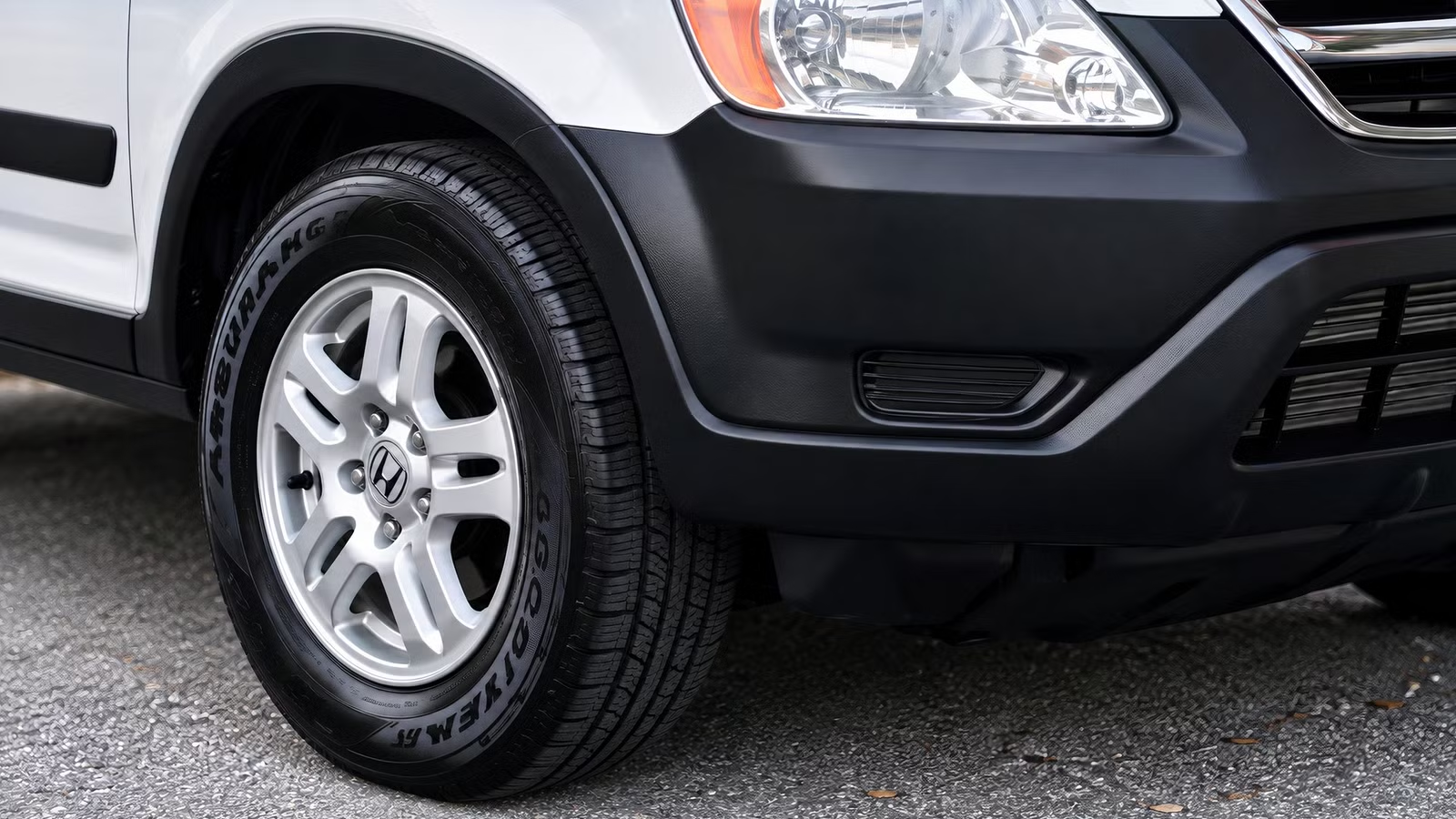
For years, the engine-swap pecking order felt settled. The 2JZ and RB26 wore the JDM crown, while the LS handled the “put it in everything” jobs. Those Japanese engine legends earned that reputation. Meanwhile, Honda quietly installed millions of practical four-cylinders in commuters, family cars, and crossovers. That boring origin is the point. The same engine family that spent weekdays hauling groceries has become one of the cheapest routes into serious boost, rear-wheel drive, and even four-digit horsepower.
The Honda K-Series Was Hiding In Grocery Getters

The engine is Honda’s K-series, specifically the K20 and K24 families that arrived around 2001 before spreading through Civics, Accords, CR-Vs, Elements, RSXs, TSXs, and plenty more. On paper, that sounds like the résumé of an ordinary mass-market four-cylinder. Under the skin, it was anything but.
Compared with the older B-series, the K brought DOHC i-VTEC, chain-driven cams, roller rockers, and coil-on-plug distributor-less ignition. Performance versions also used an aluminum block with cast-iron liners and a forged-steel crankshaft. The K20 has an 8.3-inch (212 mm) deck height and an 86 mm bore and stroke, while the taller K24 stretches to 9.1 inches (231.5 mm) and uses a longer 99 mm stroke. Put simply, the K20 likes to rev, while the larger K24 brings more displacement and torque. That is serious hardware for an engine you could find under the hood of a school-run Accord.

Then Honda turbocharged the idea. The current U.S.-spec 2026 Civic Type R uses a 1,996cc K20C1 with an 86.0 x 85.9 mm bore and stroke, 9.8:1 compression, 25.2 psi of boost, 315 horsepower, 310 lb-ft of torque, and a 7,000-rpm redline. The previous FK8 ran 23.2 psi, which explains why the “23 psi” K20C1 figure still floats around. Technical references commonly describe the K20C1 as semi-closed-deck, while Honda says the K20C architecture itself was substantially reworked to survive more than 300 PS and hard Nürburgring running.

The valvetrain is another place where “K-series” can hide an important difference. The naturally aspirated K20A2 uses VTEC switching on both the intake and exhaust sides, while Honda’s own engineering history says the turbo K20C uses VTEC on the exhaust side only, with VTC cam phasing on both intake and exhaust. That is not trivia for trivia’s sake. It helps explain why the modern turbo K does not behave exactly like the old high-revving K20A2 even though both live under the same family name.
This Cheap Four-Cylinder Makes The Power Math Hard To Ignore

The K-series gets interesting before you even touch a turbo. JDM Topline currently lists common K20 and K24 donors from roughly $750 to $1,400, while saying its imported engines typically arrive with 40,000–70,000 km (about 25,000–43,000 miles). Higher-spec engines cost more, with desirable K20A Type R examples climbing into the $2,000–$3,500 range. So even the roughly $2,000–$4,000 budget often associated with a nicer K-series long-block leaves plenty of room below the old JDM royalty.
Against the big sixes, the price gap gets much wider. Current importer pricing puts a complete 2JZ-GTE swap engine around $3,000–$8,000, while an RB26DETT can run $5,000–$12,000. That isn’t a perfect long-block-to-complete-swap comparison, but it explains how a K-series can genuinely come in at around half the engine cost of a desirable RB26 before the serious spending even starts.

Of course, cheap engine does not mean cheap finished car. Mounts, wiring, ECU work, fuel system, cooling, transmission parts, and turbo hardware can eat through that head start quickly. And the K-series does not beat everything at everything: the Barra brings 4.0 liters and later BF Mk2 engines with rods that Haltech says can support 450 kW at the wheels, while the LS still enjoys an enormous catalog of ready-made swap systems. The K’s advantage is the mix—small size, huge supply, modern hardware, and a low starting price.
Then there is the power ceiling. The K20C1 has documented bolt-on turbo combinations making well over 450 whp, and stock-internal builds around the 500-whp mark are firmly established tuner territory rather than fantasy. But four-digit claims need context. RevlineKC’s Cylinder Support System is rated at 800 whp for standard K20/K24 applications, 900 whp for its higher-power setup, and 800 whp for the K20C. In other words, 900 horsepower is not a stock-internals party trick. A K24-swapped Charger making more power than a Hellcat shows how wild the platform can get, but getting there means building the engine for the job.
The Real Game-Changer Is How Easily It Goes RWD

RWD compatibility is what turns the K-series from a cheap Honda engine into a much broader swap platform. Unlike older Honda fours, the K20/K24 rotates clockwise, making it much friendlier to conventional rear-drive transmissions. That one architectural choice helped open the door to a swap scene that would have looked slightly unhinged 20 years ago.
The aftermarket did the rest. RWD Motorsport sells hardware that mates a K20 or K24 to Ford Type 9-pattern gearboxes, including Type 9 five-speeds and several sequential transmissions. KPower now sells packages for BMW ZF five- and six-speed gearboxes, while Wiring Specialties offers Nissan S14 K-series harnesses with options for BMW ZF five- and six-speeds, CD009s, and other transmissions. This does not make every conversion bolt-in—oil pans, steering racks, engine angle, shifter position, tunnel clearance, cooling, and electronics still matter—but a lot of the hard engineering has become stuff you can buy instead of invent.
That is why K-swaps now show up in Mazda Miatas, Nissan S-chassis cars, Toyota MR2s, and even Porsches. Touge Factory currently sells a billet K24 mount for the Porsche 993. Twenty years ago, that combination would have sounded like a one-off fabrication project. Now it is another sign of just how far the K-series swap ecosystem has spread.
Why The K-Series Is Becoming The Import World’s Small-Block Chevy

Calling the K-series the import world’s Small Block Chevy once sounded like enthusiast hyperbole. Not anymore. The Chevy formula worked because engines were plentiful, parts were everywhere, people knew how to make them run, and somebody probably sold the mounts. The K-series is following the same path, except it starts with a four-cylinder pulled from everyday Hondas instead of an American V8.
It also has something the 2JZ and RB26 cannot offer: a current factory bloodline. Honda still sells the K20C1 in the 2026 Civic Type R, and in July 2026 HRC opened sales of the current FL5-spec K20C1 crate engine for racing and off-highway use. It includes the long block, turbo, alternator, starter, and stock harness, and HRC even points RWD builders toward transmission solutions. It isn’t street legal and carries no warranty, but Honda will still sell you one.

That leaves a huge ladder to climb. You can start with a sub-$1,000 Accord or CR-V donor, reinforce or sleeve an OEM block, or ditch the production casting altogether. Four Piston says its billet K-series short block is commonly used in 1,500–2,000+ hp builds. Bullet rates its billet K block at 1,700 hp, while a Magnus billet K block is designed for more than 1,700 hp. These are race-engine parts, not proof that a junkyard K24 will survive four-digit power.
And those four-digit race builds are not just catalog fantasy. A Honda-powered Mazda RX-7 has already run 6.23 seconds at 219 mph with a billet K24 making roughly 2,000 horsepower. The K-series does not beat a 2JZ, RB26, Barra, B-series, or LS at every job, and it doesn’t need to. What makes it remarkable is the range. The same engine family can underpin a grassroots swap, live on in a new showroom car, and scale all the way to purpose-built, four-digit race power. Then Lucimar Racing pushed the ceiling even higher: its rear-wheel-drive Honda has run 6.19 seconds at 224 mph. For an engine that spent so much of its life carrying groceries, that is one hell of a place to end up.

Related posts


Latest Post


No Comments