
Pontiac Built A Nova-Bodied Coupe With A Grand Prix Dashboard And Firebird Suspension
There’s no other way to put it. By 1975, the American performance car had entered an extremely awkward phase. Horsepower was shrinking, emissions rules were tightening, and the old formula of stuffing more engine into everything suddenly had limits.

Pontiac responded with something more interesting than another detuned muscle car. It took a familiar General Motors compact platform and started borrowing smarter hardware from elsewhere, creating a small coupe with more ambition than its modest output suggested.
Pontiac’s Compact Muscle Car Formula Had Run Its Course
Pontiac waltzed into the ’70s with some of America’s most recognizable muscle cars, but the landscape changed quickly. The 1974 GTO had already moved onto the compact Ventura platform, pairing Pontiac’s famous performance badge with a 350 V8 rated at roughly 200 hp. It was a dramatic departure from the big-engine GTOs that had defined the name just a few years earlier.

That version of the Pontiac GTO disappeared after 1974, but Pontiac hadn’t given up on making its compact interesting. The challenge for 1975 was figuring out what performance could mean when horsepower figures no longer did all the talking. Even the stronger V8 available in the following year’s Ventura couldn’t recreate the numbers that had made Pontiac a muscle car heavyweight across the USA.
No More Pretending

The available 350 V8 illustrated the new reality. A two-barrel version was rated at 145 hp, while the four-barrel version raised that to 165 hp. You’d be right in thinking that those figures sound modest by classic Pontiac standards, particularly when compared with its 1960s muscle cars, but straight-line speed was becoming only part of the equation.
Pontiac instead started giving its compact a broader personality. The emphasis shifted toward handling and a more sophisticated driving environment. That philosophy made far more sense in mid-’70s America than trying to pretend the horsepower wars were still raging outside every Pontiac showroom.
The Nova Shell Was Only The Starting Point

The Ventura’s Chevrolet Nova connection was hardly a secret. Both cars belonged to GM’s compact X-body family, and the 1975 Pontiac rode on a 111.1-inch wheelbase. Look underneath the different styling and there was plenty of shared engineering, which made the Ventura an easy car to dismiss as another exercise in corporate badge swapping.
Doing that misses what happened for 1975. GM revised its compact cars with suspension hardware related to the second-gen Chevrolet Camaro and Pontiac Firebird, giving the Ventura a much more interesting mechanical connection than its Nova-based reputation suggests. Front disc brakes also became standard, adding another meaningful improvement to the chassis.
That didn’t suddenly turn a Pontiac Ventura into a miniature Trans Am. It did, however, give the compact a better foundation at exactly the moment when American performance cars needed to become more rounded. Pontiac could no longer rely on an outrageous horsepower figure to sell the idea, so making the car feel sharper from behind the wheel became a smarter move.
The 1975 Ventura SJ Mixed Grand Prix Luxury With Firebird DNA

Pontiac’s answer arrived in the form of the 1975 Ventura SJ, and this is where the obscure X-body becomes genuinely fascinating. Instead of treating the Ventura as basic transportation with a few sporty badges, Pontiac pushed the SJ toward the sport luxury side of the market. What you ended up with was much more ambitious than the car’s humble compact origins suggested.
Inside, the Ventura SJ got reclining bucket seats and a center console. More importantly, Pontiac brought in a dashboard influenced by the larger Grand Prix, complete with full Rally instrumentation. That gave the cabin a distinctly Pontiac character and helped separate the SJ from the cheaper compact car atmosphere that might have been expected from a Nova relative.
The engine lineup stayed grounded in 1975 reality. The available Pontiac 350 V8 came with either a two-barrel carburetor and 145 hp or a four-barrel setup rated at 165 hp. Nobody was going to confuse those numbers with a Ram Air-era Pontiac, but the SJ wasn’t chasing the same goal. Its appeal came from combining useful V8 torque with a more driver-focused chassis.
Pontiac built roughly 2,571 Ventura SJ two-door coupes for 1975, which helps explain why the model rarely appears in conversations about classic American cars today. The Firebird and Trans Am were far easier to remember, especially when one looked like it had been designed specifically to appear on bedroom walls. The Ventura SJ was perhaps too subtle for its own good.
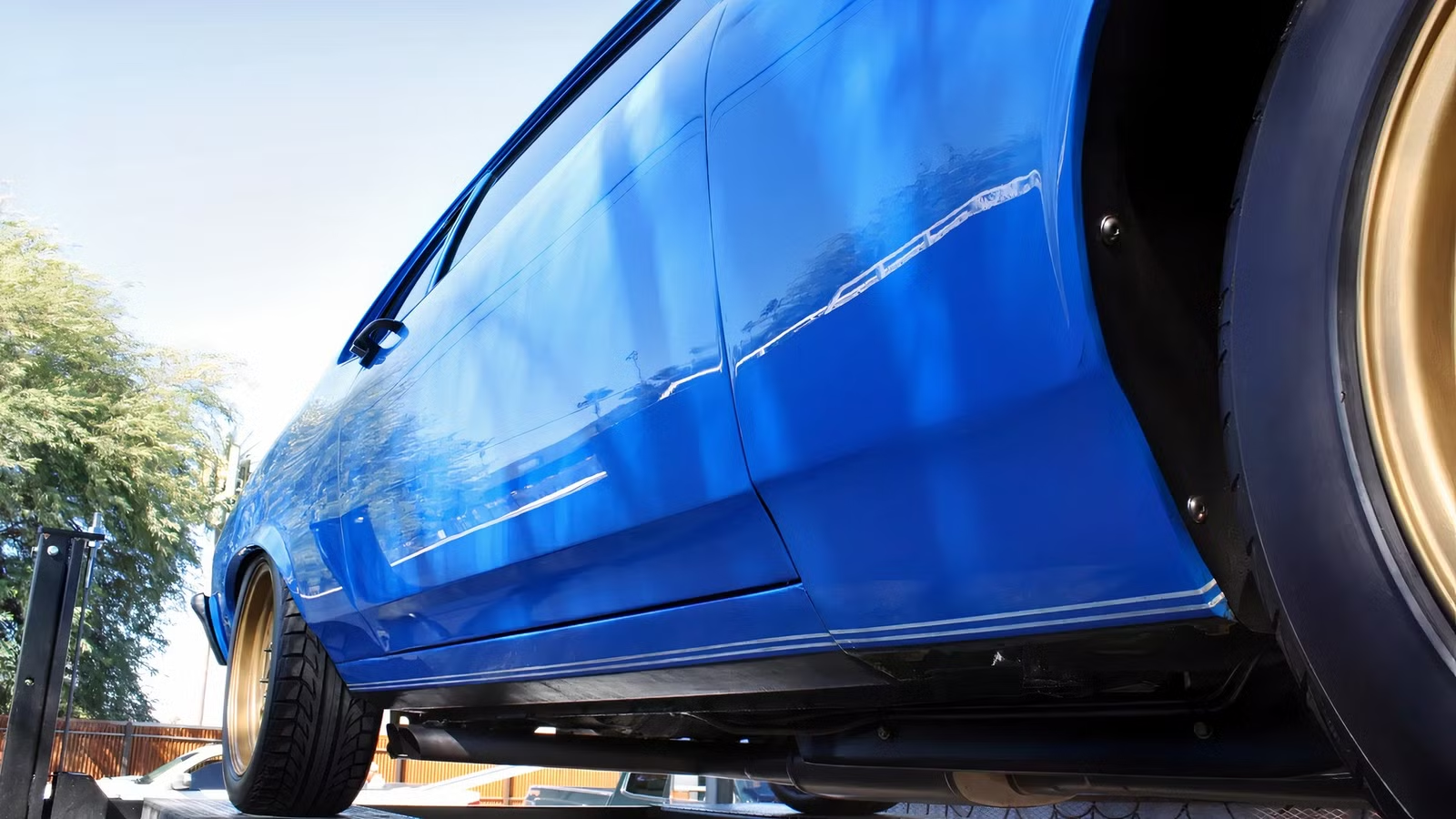
Images of the 1975 Ventura SJ are difficult to source, so the photos shown are of a custom 1972 Ventura SJ and are used for representational purposes only.
Firebird Suspension Mattered More Than Big Horsepower

Look underneath the 1975 Pontiac Ventura SJ for its coolest aspect. Suspension hardware shared with GM’s second-generation F-body family meant the compact benefited from engineering associated with the Camaro and Firebird. In an era when performance figures were heading in the wrong direction, chassis development offered Pontiac another way to make a car entertaining.
That approach becomes even clearer with the Sprint option group. Depending on specification, the sporty package brought equipment such as a floor-shifted transmission, a sport steering wheel, and distinctive exterior graphics. Wider 14×6-inch wheels also entered the picture, while Pontiac’s familiar Rally II wheels could sharpen the Ventura’s appearance considerably.
This is where calling the Ventura SJ merely a “Pontiac Nova” starts feeling unfair. The X-body connection is absolutely part of the story, but Pontiac’s choices matter more than the shared shell. The company took an ordinary compact foundation and added hardware that encouraged drivers to care about corners at a time when American performance was learning to live without monster horsepower.
Pontiac Was Thinking Beyond Straight-Line Muscle

The 1975 Ventura SJ becomes much easier to appreciate when viewed through what Pontiac did later. During the second half of the ’70s, the brand increasingly understood that an American performance car could earn its reputation through chassis tuning as well as engine output. The Firebird Trans Am would become the much more famous expression of that thinking.
There’s no need to invent a direct engineering bloodline between the Ventura SJ and every later handling-focused Pontiac. What matters is that years before handling packages became some of Pontiac’s most memorable performance hardware, this compact coupe was already combining a relatively modest V8 with chassis upgrades and a driver-focused interior.
What Happens After?

The SJ also wasn’t confined strictly to 1975. It continued through 1976 and into early 1977, so its debut year matters more as the point where this particular combination came together. During 1977, the Phoenix name began replacing the Ventura as Pontiac reshuffled its compact lineup, eventually closing the chapter on one of the company’s more overlooked nameplates.
That only makes it all the more appealing today. Search for classic Pontiac muscle cars in America and the usual GTO, Firebird, and Trans Am names dominate immediately. The 1975 Pontiac Ventura SJ’s story, though, is arguably stranger. The Ventura SJ showed that Pontiac was already thinking about what happened after the road stopped being straight.
Sources: carguide.com, Hemmings.

Related posts





Latest Post


No Comments