
BYRA 1000: The 80-HP Spanish Endurance Racer Built From Two 500cc Twins
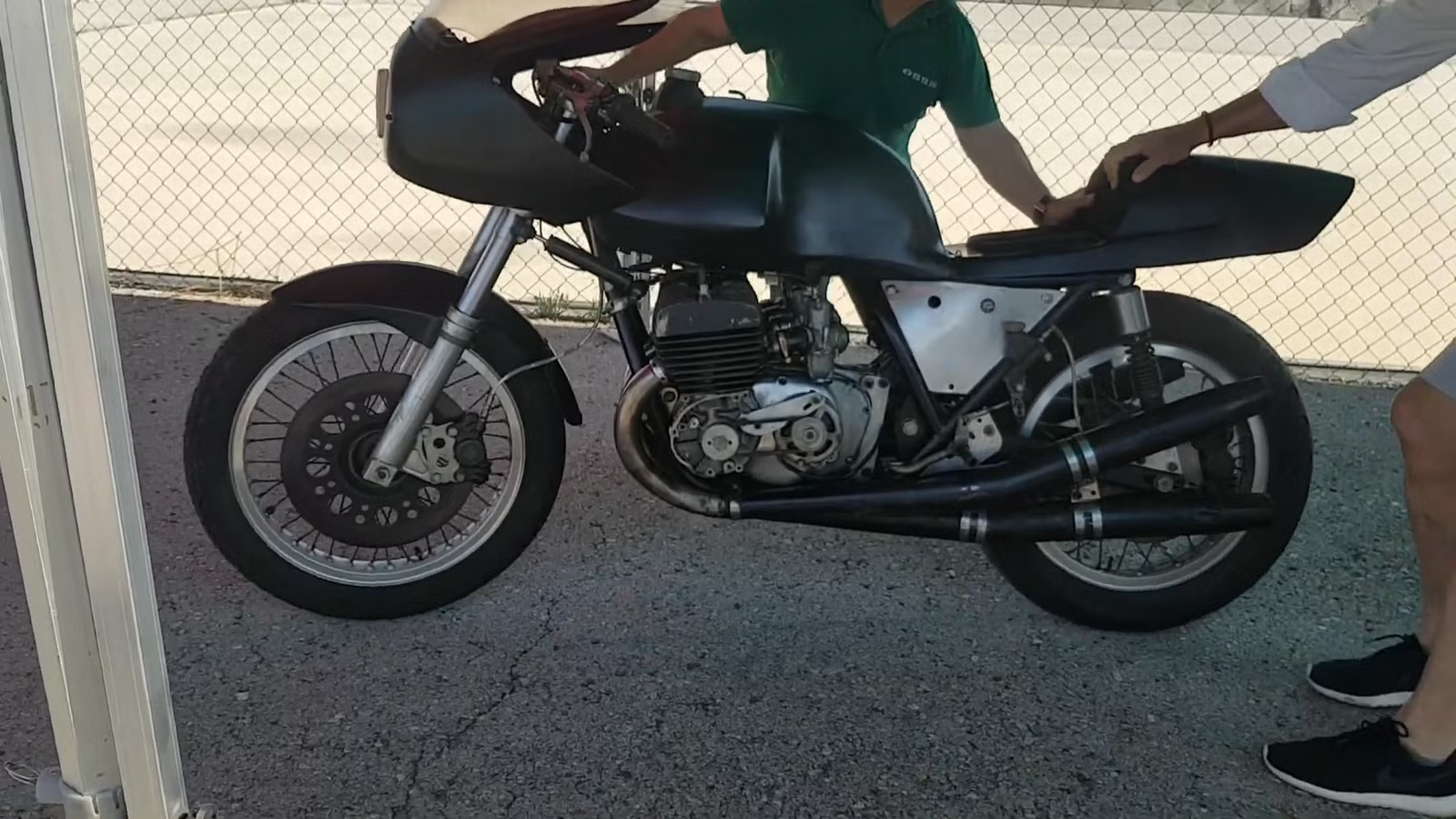
It was 1972. The location was the Montjuich Park 24 Hours race. The smell of Castrol oil and unburnt gasoline hung thick in the air. Among the deep, rhythmic four-stroke growl of factory Laverda and Norton twins, a deafening high-pitched screech stood out. It was a home-brewed Spanish endurance race motorcycle, made of two 500cc two-stroke twin-cylinder engines fused together into a single 977cc, quad-cylinder creation. This motorcycle had a terrifying pace, but more than that, it hid a special secret: an experimental firing order that accidentally laid the foundation for how modern MotoGP motorcycles achieve traction — two decades before the world sat up and took notice.

The Barcelona Frankencrank
This mechanical genius was the brainchild of a Barcelona engineer, someone who looked at the ’70s superbike scene and seemed dissatisfied with what he saw. His solution, while simple, bordered on insanity: join two two-stroke engines together at the crank. The donor engines were certified insane as well. The Yankee Z500 twin-cylinder engine was funded by an American conglomerate, and designed and manufactured by Spanish motorcycle manufacturer Ossa. This engine was already featherweight, weighing 29 pounds less than a Yamaha RD400, and 46 pounds less than a Suzuki T500. It was rare too, with just 764 Yankee Z500 engines made between 1971 and 1972, making the call to cut and join two Yankee crankcases an outrageous one.
This mad engineering experiment needed a custom crankcase to join the two parallel twin engine blocks, thus creating a massive 977cc four-cylinder two-stroke powerplant. In its 1972 coverage, Cycle World reported the air-cooled engine produced 79 horsepower. However, other sources cited power figures close to 100. With that kind of horsepower, the race bike was able to nudge a heady 149mph down Montjuich’s fast straights. It was the last word in shed-built engineering, pairing a lightweight motorcycle with an engine that put power down like a sledgehammer. In case you haven’t googled it already, the motorcycle was the BYRA 1000, the creation of Spanish engineer Fernando Batlló.

The Accidental Big Bang
Developing a 977cc two-stroke four-cylinder engine is one thing. Getting its power clean to the ground on 1970s skinny bias-ply tires was a completely different challenge in itself. A two-stroke engine delivers a power stroke every crankshaft revolution, and with a four-cylinder motor, at least one cylinder is delivering a power stroke at any given time. When all four cylinders delivered the power stroke conventionally in an evenly spaced sequence, the sudden rush of two-stroke power broke rear wheel traction instantly, making the motorcycle almost unrideable.
Ossa’s brilliant engineer, Eduardo Giró, solved this brutal two-stroke wheelspin conundrum. He began by experimenting with the engine’s firing intervals, testing altered timing setups and trying out 60-degree and 90-degree firing intervals to change how power pulses reached the road. By bunching the firing sequence closer together, Giró created a long “rest” period in the engine cycle where the cylinders didn’t fire. This brief pause gave the rear tire time to recover, hook up and dig into the asphalt before the next violent bunch of power strokes hit. Without realizing it, Giró had figured out the “Big Bang” engine philosophy — the mechanical trich Honda would end up using in 1992 to tame Mick Doohan’s unrideable NSR500 MotoGP bike.
“Ungovernable” at Montjuich
The BYRA 1000 became a showstopper the moment it lined up on the Montjuich grid for the 1972 Barcelona 24 Hours race. Cycle World raved about the motorcycle as the unicorn four-cylinder two-stroker among a sea of single, twin, and triple four-stroke motorcycles. It instantly became the Spanish crowd’s favorite, as the underdog homegrown David went against the Goliath factory teams.
Riding the machine, however, turned out to be the opposite of romanticism. The Montjuich circuit was a treacherous street circuit lined with trees, stone walls, and minimal guardrails. Riding a powerful, air-cooled 977cc two-stroke motorcycle through these narrow city streets required nerves of steel. The frame flexed under the engine’s sudden and massive torque, engine heat was unbearable, and the sudden arrival of the powerband kept the rider in a perpetual state of self-preservation.
Riders described the BYRA 1000 as “ungovernable.” When the engine reached its powerband, the acceleration was vicious, needing delicate throttle control to keep the bike from spitting you off. Yet, despite its ungovernable nature, the BYRA 1000 was a force to be reckoned with and ended up making a name for itself. It was a screaming missile that put a small team of Spanish engineers in the spotlight for going toe-to-toe against the racing elite.
The Tragic End Of The BYRA 1000
The spectacular story of the BYRA 1000 was sadly short-lived. While its 1972 debut cemented the motorcycle’s status as a mechanical marvel, the bike’s competitive rise was brief. The team continued developing the motorcycle into the mid-70s, with most of the work going into improving the chassis and trying to rein in the motor’s aggressive tendencies.
The sad end came during the 1974 Montjuich 24 Hours race. While some historical accounts place this event in 1972, records confirm that during the 1974 race, the BYRA 1000 was involved in a fatal crash. This tragedy shocked the local racing fraternity, and effectively sounded the death knell to the development of the four-cylinder two-stroke race engine.
As time went by, the BYRA 1000 faded into motorcycle history, often coming up in mentions of wacky, eccentric motorcycle prototypes. But writing it off as just another weird Frankenstein build is missing the plot entirely. Fernando Batlló’s willingness to cut up not one but two rare Yankee Z500 engines, combined with Eduardo Giró’s visionary firing-interval solution created a machine that was way ahead of its time. The BYRA 1000 was as important as the Britten V1000. These motorcycles are proof that even a small outfit can go up against factory teams with deep pockets through sheer will and engineering expertise.

Related posts



Latest Post


No Comments