
The Honda Bike That Just Refuses To Wear Out
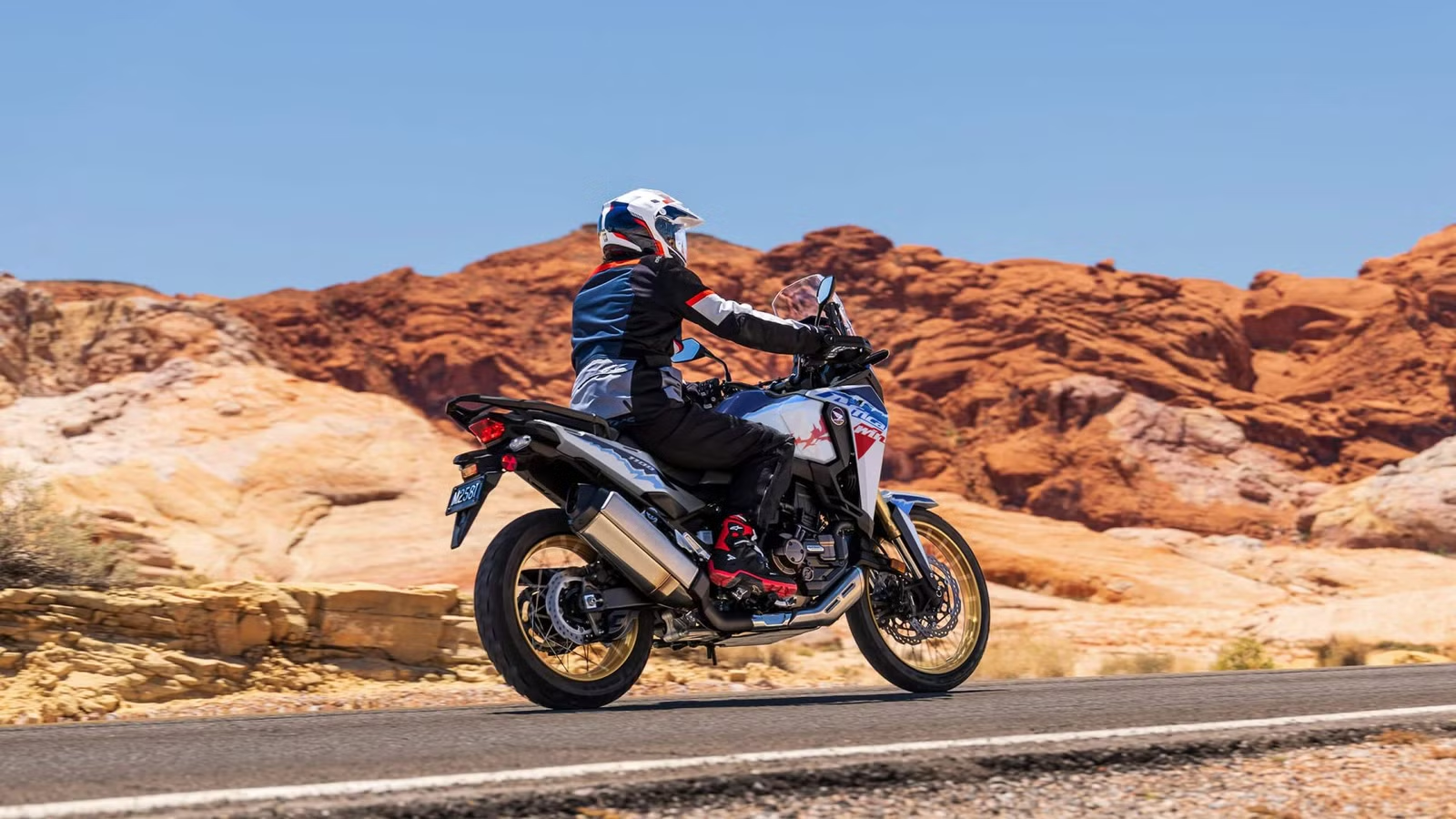
Honda has spent decades building motorcycles that don’t need to be the flashiest machines in their respective segments to earn a reputation for going the distance. From the iconic Gold Wing and its long-haul touring credentials to the rugged dual-sport models that have become staples of adventure riding, Honda’s philosophy has consistently favored durability, usability, and engineering built to withstand years of abuse. That reputation carries even greater weight in the adventure bike segment, where riders expect a single motorcycle to tackle daily commutes, highway miles, rough trails, and long-distance journeys without breaking a sweat.
How Honda Built Its Legacy Around Long-Distance Reliability

Honda’s legendary reputation for reliability wasn’t built through clever marketing; it was earned over decades of engineering motorcycles to withstand the realities of everyday use. When you look back at the brand’s early bulletproof commuters and iconic tourers, a familiar philosophy emerges. Honda has consistently prioritized mechanical resilience above all else. That approach has helped create some remarkably high-mileage products.
Long-distance riders regularly share examples of Honda’s motorcycles surpassing 100,000 miles and continuing to rack up more on their original engines. That kind of longevity isn’t the result of a single groundbreaking feature, but of countless engineering decisions focused on durability, simplicity, and dependable performance in the real world. And few categories put those qualities to the test quite like ADVs, which are expected to endure everything from daily commutes and highway slogs to remote trails and cross-country journeys.
The Best Adventure Bikes Make Tough Journeys Feel Routine

The best adventure bikes don’t just survive tough roads; they make difficult terrain feel almost ordinary. A predictable engine, comfortable ergonomics, and capable suspension let riders enjoy the journey rather than constantly manage the motorcycle beneath them. Long-distance adventure riding is as much a mental game as a physical one, and a motorcycle engineered for bulletproof reliability can turn potentially nerve-wracking journeys into routine adventures. It is this combination of durability, comfort, and all-road capability that has made Honda’s flagship adventure offering such a compelling choice for riders.

The Honda Africa Twin DCT Is Built Around A Proven Formula
Starting MSRP: $15,999

Among Japanese adventure bikes, few have built a stronger reputation for dependable long-distance touring than the Honda Africa Twin. Its roots can be traced to Honda’s dominant Dakar Rally machines of the 1980s, and when the iconic nameplate returned in 2016, the modern CRF1100L brought that rugged DNA to a production adventure bike designed to travel far beyond paved roads. Since then, the Africa Twin has established itself as one of the world’s most respected adventure motorcycles, earning praise for its versatility, reliability, and go-anywhere capability.

For 2026, Honda offers the Africa Twin in multiple variants, with the DCT version standing out as the effortless long-distance choice. The 2026 Honda Africa Twin DCT starts at a base MSRP of $15,999, while the higher-spec Adventure Sports ES DCT is aimed more squarely at long-distance touring, adding a larger fuel tank and electronic suspension, with prices starting at $18,599.
A 1,084cc Parallel-Twin Engine With DCT Engineered For Effortless Miles

Powering the Africa Twin is Honda’s tried-and-tested 1,084cc liquid-cooled parallel-twin engine. Rather than chasing extreme horsepower numbers at the expense of engine longevity and everyday usability, Honda has tuned this 270-degree crankshaft motor for strong low-end torque, linear power delivery, and real-world tractability. The Unicam cylinder head layout also helps keep the engine compact and lightweight while optimizing combustion efficiency.
In terms of power output, the Africa Twin develops 101 horsepower at 7,500 RPM and 83 pound-feet of torque at 5,500 RPM. Those numbers might sound humble by modern standards, but they are well suited to an adventure motorcycle, delivering relaxed highway cruising and confident overtaking without requiring the rider to constantly rev the engine. Depending on the variant, it comes paired with either a six-speed manual transmission or Honda’s six-speed automatic Dual-Clutch Transmission (DCT).

The DCT is arguably one of the Africa Twin’s standout features. It can operate fully automatically or give riders manual control through handlebar-mounted paddle shifters, combining convenience with a greater sense of involvement when needed. Honda has also refined the system’s shift logic over the years, resulting in smoother low-speed operation and more natural gear changes. For riders spending hours in traffic or covering hundreds of highway miles, that means less work and fatigue, with the ability to take control when the terrain demands it.
A Dakar-Bred Chassis And Suspension Setup Built For Serious Off-Roading

The Africa Twin’s chassis stays true to its Dakar heritage, with a lightweight semi-double-cradle steel frame inspired by Honda’s HRC rally machines. The standard DCT variant rolls on a 21-inch front and 18-inch rear wheel, a proven off-road combination that helps the bike tackle rocks, ruts, sand, and uneven terrain with confidence. Its long-travel suspension features a 45mm Showa inverted fork with 9.1 inches of travel up front, while the rear employs a Pro-Link monoshock setup with 8.7-inches of travel, designed to absorb big hits without bottoming out.

For riders who prioritize long-distance comfort and load-carrying ability, Honda also offers the Adventure Sports ES DCT variant. It adds Showa Electronically Equipped Ride Adjustment (EERA) suspension, allowing riders to adjust preload and damping through the TFT display. This electronically adjustable suspension variant makes it easy to adapt the bike for two-up touring, luggage, or changing road conditions, further strengthening the Africa Twin’s credentials as a genuinely versatile adventure machine.
Smart Electronics Make The Africa Twin DCT Easier To Ride

Honda equips the Africa Twin DCT with a comprehensive electronics suite designed to make adventure riding more accessible. A six-axis Inertial Measurement Unit (IMU) governs the throttle-by-wire system and enables features such as Honda Selectable Torque Control (HSTC), wheelie control, and lean-sensitive cornering ABS. Riders can choose from six riding modes – Tour, Urban, Gravel, Off-Road, and two customizable User settings, allowing them to tailor power delivery, engine braking, traction control, and DCT shift logic to suit different riding conditions.

Braking duties are handled by dual 310mm front discs with radial-mounted four-piston calipers and a 256mm rear disc, paired with a three-mode ABS system that allows On-Road, Off-Road, and rear-ABS-delete settings. At the heart of the cockpit is a 6.5-inch TFT color touchscreen with Apple CarPlay and Android Auto, complemented by a secondary LCD for essential riding information. Cruise control further rounds out the package, making the Africa Twin DCT particularly well suited to covering long stretches of highway with minimal rider fatigue.
The Honda Africa Twin DCT Is The Kind Of Motorcycle You Can Keep For Years
The Honda Africa Twin DCT may not be the most powerful or technologically extravagant adventure motorcycle out there in the market, but its blend of proven engineering, versatility, and long-distance capability makes a compelling case for long-term ownership. In a segment packed with highly capable adventure tourers such as the BMW R 1300 GS, Triumph Tiger 900, and Ducati DesertX, the Africa Twin DCT occupies a particularly appealing middle ground.

The BMW R 1300 GS, priced from $20,395, offers greater performance and prestige, but also comes with a higher cost of entry and potentially higher ownership expenses. The Triumph Tiger 900, starting at $15,195, brings a distinctive triple-cylinder character, while the Ducati DesertX V2, priced from $16,995, leans into retro-inspired styling and off-road attitude. The Africa Twin, however, takes a different approach with its proven durability and genuine all-round capability. For riders who measure value by years of trouble-free ownership, the Africa Twin DCT makes a remarkably strong case for being the Honda that just refuses to wear out.
Source: Honda

Related posts

Latest Post


No Comments