The Thoroughbred American SUV That Refuses To Let Go Of Its Heritage
8 minutes reading
Friday, 25 Sep 2026 01:30 0 9 autotech
Automakers continuously shift modern SUVs toward unibody construction and fully independent suspension systems. Traditional ladder frames and solid axles provide durability, high towing capacities, and off-road articulation. However, these components increase total vehicle mass, limit interior packaging, and impair overall handling.
Consequently, modern SUVs function as comfortable daily transport while retaining light all-weather capability. Some brands stay true to the older designs of off-roading models, in a bid to cater to consumers who still demand a more traditional experience. These are now niche lifestyle models that continue to sell in high numbers, despite higher asking prices.
Jeep’s Historic Origins And Dedicated Design Principles
Three-fourths photo of 1953 Willys Jeep M38A1 parked in a view deckBring-A-Trailer
Jeep traces its origins all the way back to 1940, when the U.S. Department of War requested a lightweight, four-wheel-drive reconnaissance vehicle for Allied forces. Willys-Overland and Ford mass-produced the standardized design, creating a durable battlefield transport that soldiers colloquially nicknamed the Jeep.
Following World War II, product focus shifted toward commercial and agricultural utility, adapting the robust military chassis for civilian farm work and industrial tasks. As consumer markets expanded, focus evolved from pure work vehicles into family-oriented passenger transport. This shift established the modern sport utility segment by blending off-road hardware with enclosed bodies, passenger comforts, and refined road manners.
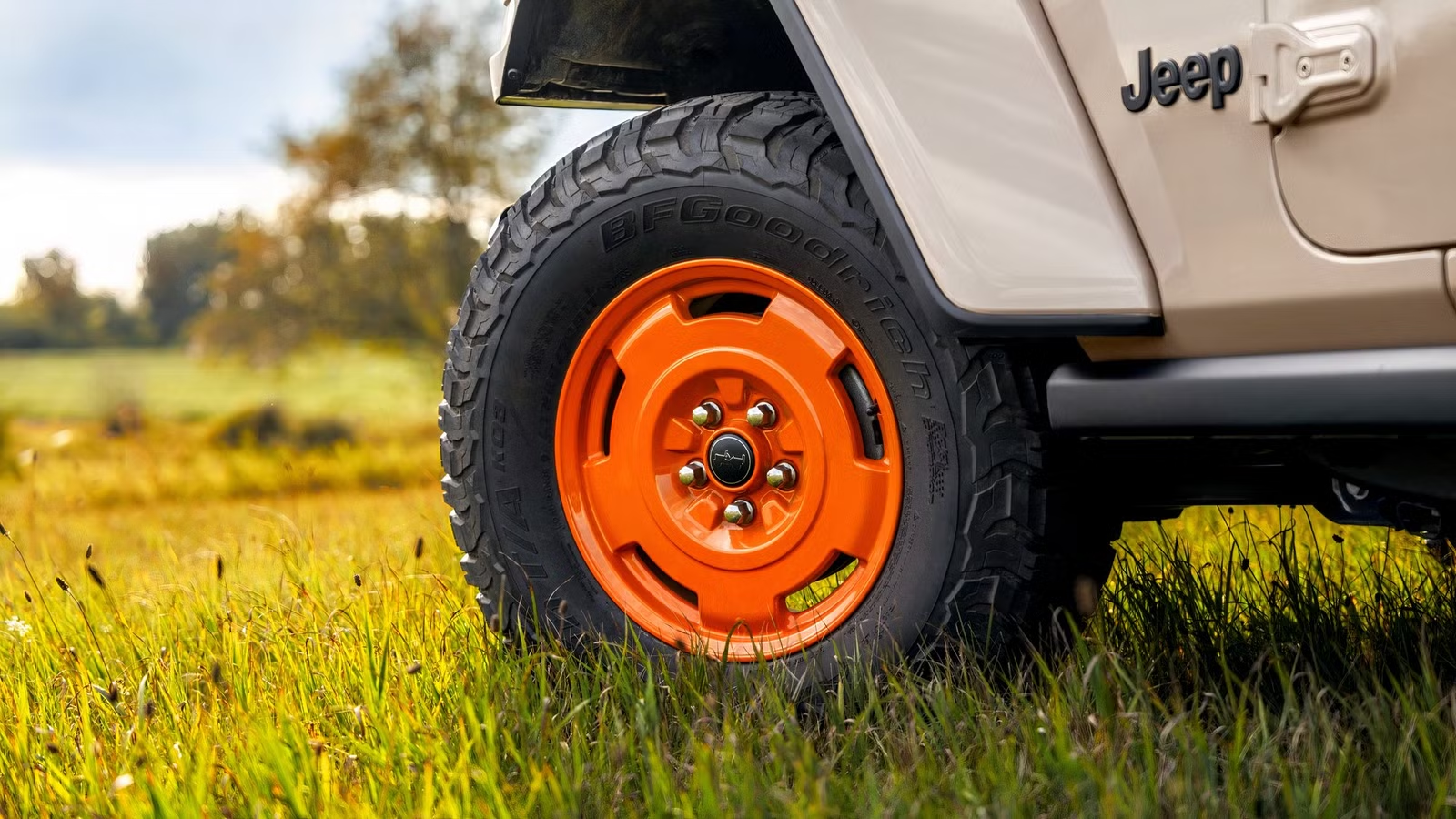
2027 Jeep Wrangler JL-2A wheel close-up.Jeep
Over the decades that followed, product strategy split into distinct categories to capture broader consumer markets. One core focus maintains absolute off-road capability, preserving adventure and freedom, solid axles, and rugged body-on-frame architecture for enthusiast adventure. At the same time, another primary focus emphasizes premium midsize and full-size luxury, prioritizing unibody construction, refined road dynamics, advanced safety technology, and plush interiors. Recent developments center on global electrification, integrating plug-in hybrid systems across both rugged off-roaders and daily drivers with reduced tailpipe emissions.
The 2027 Wrangler Stays True To The Original Willys
2027 Jeep Wrangler JL-2A old and new.Jeep
The 2027 Jeep Wrangler preserves the core identity that built the brand’s reputation. Built on a body-on-frame architecture, the SUV retains front and rear solid live axles to maximize suspension articulation, off-road durability, and heavy-duty trail capability. Classic styling cues remain intact, featuring the upright grille, round headlamps, exposed door hinges, and modular open-air body configurations with removable tops and doors.
Mechanically, the 2027 model’s chassis setup, powertrain choices, and solid-axle layout remain unchanged from the previous year. Structural updates center on convenience refinements introduced to the platform. The doors feature quick-release door hinges, allowing tool-free door removal via an integrated lever system. Lightweight aluminum doors and body panels continue to reduce overall weight, while structural revisions integrate safety features like full-length side-curtain airbags without compromising open-air versatility.
The New JL-2A Pays Tribute To The Willys
Jeep Wrangler JL-2A climbing up a hill.Jeep
The 2027 Jeep Wrangler JL-2A edition incorporates distinctive exterior design cues that pay homage to the original 1945 Willys CJ-2A. Built on the Rubicon platform, the model features 17-inch retro-styled alloy wheels painted in a signature Joose finish, directly referencing the Sunset Red wheels of its post-war predecessor.
Bright Desert Orange front and rear tow hooks contrast Dark Metallic Grey grille inserts and a body-color three-piece hardtop with matching fender flares. Exterior paint choices include historic shade iterations such as Gobi tan on two-door configurations and ’41 olive green on four-door builds, alongside standard colors like Bright White, Sting Gray, Ghost, and Joose. Standard 33-inch BFGoodrich KO2 All-Terrain tires complete the setup, blending classic 1940s agricultural styling accents with modern off-road proportions.
The Theme Continues Throughout The Cabin
Jeep Wrangler JL-2A dashboard.Jeep
The interior of the 2027 Jeep Wrangler JL-2A introduces a trim-exclusive color scheme that blends vintage aesthetic cues with modern luxury appointments. The cabin features a Wrangler-first combination of Heritage Tan Nappa leather upholstery on the seating surfaces, paired with rich Bison Brown accents across the lower instrument panel, door panels, and center console.
High-contrast Desert Orange stitching runs throughout the cabin along the seats, steering wheel, and soft-touch dashboard elements, echoing the exterior tow-hook finish. Platinum chrome surrounds accentuate the air vents and interior trim pieces, while custom Willys-Overland branding details reinforce the throwback theme. These unique appointments elevate the standard Rubicon layout into an exclusive, retro-themed passenger environment without compromising functional controls or water-resistant practicality.
The JL-2A’s Comprehensive Standard Specification List.
2027 Jeep Wrangler JL-2A gear selectorJeep
Every 2027 Jeep Wrangler includes a 12.3-inch Uconnect 5 touchscreen infotainment setup as standard, supporting wireless Apple CarPlay and Android Auto integration alongside an eight-speaker audio system. Standard convenience features cover push-button start, air conditioning, acoustic laminated windshield glass, and integrated auxiliary switches for aftermarket electrical accessories.
Optional equipment allows buyers to upgrade cabin comfort with 12-way power-adjustable front seats, heated front seating, a heated steering wheel, and dual-zone automatic climate control. Further entertainment and technology additions include an upgraded nine-speaker Alpine premium sound system with an all-weather subwoofer, integrated GPS navigation, an onboard Wi-Fi hotspot, a forward-facing Integrated Off-Road TrailCam, and the Sky One-Touch power-retractable top.
A Variety Of Powerful Engines
Jeep Wrangler JL-2A front-quarter drivingJeep
The 2027 Jeep Wrangler offers a versatile range of powertrains paired with either a six-speed manual or an eight-speed automatic transmission. The base 3.6-liter Pentastar V-6 produces 285 horsepower and 260 pound-feet of torque, achieving a 0-60 MPH acceleration time of 6.9 seconds and a limited top speed of 110 MPH. Select four-door configurations can tow a maximum of 5,000 pounds.
The optional 2.0-liter turbocharged inline-four engine delivers 270 hp and 295 lb-ft of torque, achieving a 0 to 60 MPH sprint in 6.5 seconds with the same 110 MPH top speed limit and towing capacity. The plug-in hybrid 4xe powertrain combines the 2.0-liter turbo engine with an electric motor to generate a combined output of 375 hp and 470 lb-ft of torque, reaching 0 to 60 mph in 5.5 seconds, a 112 MPH top speed, and a towing capacity limited to 3,500 pounds.
Regarding reliability, iSeeCars indicates that the entire Wrangler range achieves an average lifespan of 15.9 years or 135,525 miles, with an 8.2 percent probability of reaching 200,000 miles. While the Wrangler is a successful model, the 2026 model currently sits with a 3.3/5 overall score on the Edmunds consumer review platform, highlighting significant quality-related issues.
Front 3/4 shot of 2026 Jeep Wrangler Willys 4D crawling over rocksStellantis
The Wrangler’s four-wheel-drive performance relies on a transfer case and differential configurations tailored to specific trims. Standard models feature the Command-Trac part-time two-speed transfer case with a 2.72:1 low-range crawl ratio, while Selec-Trac provides a full-time two-speed transfer case with a matching 2.72:1 gear ratio for continuous torque distribution.
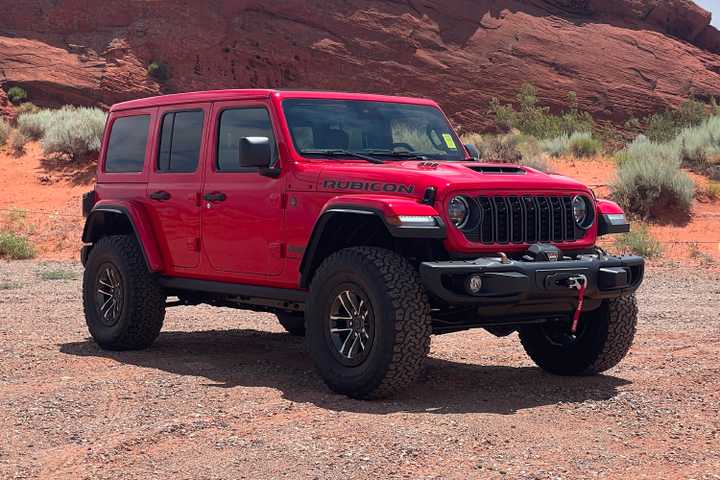
Off-road-focused Rubicon models employ the Rock-Trac transfer case, including a 4.0:1 low-range ratio in part-time form or a 4:1 full-time setup for maximum low-speed control over steep terrain. Differential setups include conventional open differentials with brake-actuated limited-slip functionality on base trims, available Trac-Lok mechanical limited-slip rear differentials, and Tru-Lok electronic locking front and rear differentials on Rubicon and Willys grades to deliver equal torque to both wheels during low-traction trail driving.
An Advanced Take On Jeep’s Old-School Chassis
Jeep Wrangler JL-2A rear-quarterJeep
The 2027 Jeep Wrangler’s chassis employs a heavy-duty coil-spring live-axle architecture, consisting of a five-link leading-arm front suspension and a five-link trailing-arm rear suspension. Jeep supports this by adding track bars, coil springs, and front and rear anti-roll bars.
Solid Dana 44 axles equip both front and rear ends on higher-tier builds like the Rubicon to optimize structural rigidity and wheel articulation during trail navigation. Four-wheel anti-lock disc brakes supply stopping power, utilizing 12.9-inch front vented rotors and 13.4-inch rear vented rotors.
Base trim models ride on 17-inch wheels wrapped in 245/75R17 all-terrain tires, whereas off-road trim lines feature 33-inch BFGoodrich KO2 tires. Extreme trail configurations accommodate factory options up to 35-inch terrain tires to expand ground clearance and approach angles.
Specifically Designed To Conquer Off-Roading Obstacles
2027 Jeep Wrangler Laredo from the front three-quarter angleStellantis
Exterior dimensions for the 2027 Jeep Wrangler vary depending on whether buyers select the two-door or four-door body configuration. Two-door models ride on a 96.8-inch wheelbase and measure 166.8 inches in overall length, while four-door variants extend to a 118.4-inch wheelbase and 188.4 inches in total body length. Across both body styles, the vehicle maintains a standard body width of 73.9 inches excluding side mirrors, alongside an overall height ranging from 73.6 to 74.5 inches. Front and rear track widths span 62.9 inches on base trims and extend up to 66.9 inches on wide-track variants like the Rubicon.
Off-roading geometry highlights the Wrangler’s mechanical layout, delivering trail metrics that change across wheel-and-tire packages and trim levels. Base trim configurations start with a minimum ground clearance of 9.7 inches, which increases to 10.8 inches on Rubicon models and reaches a maximum of 12.9 inches when equipped with the factory Xtreme 35 package. Approach angles begin at 41.4 degrees on standard builds and rise up to 47.4 degrees on extreme off-road grades. Departure angles span from 35.9 degrees to 40.4 degrees. Breakover angles measure 25.0 degrees on two-door configurations and 20.3 degrees on longer four-door models, scaling up to 27.8 degrees on top-tier trail configurations to prevent high-centering during obstacle navigation. Water fording capability enables crossings up to 34 inches deep.











No Comments