
The Older Motorcycle That Can Still Humble Newer Bikes
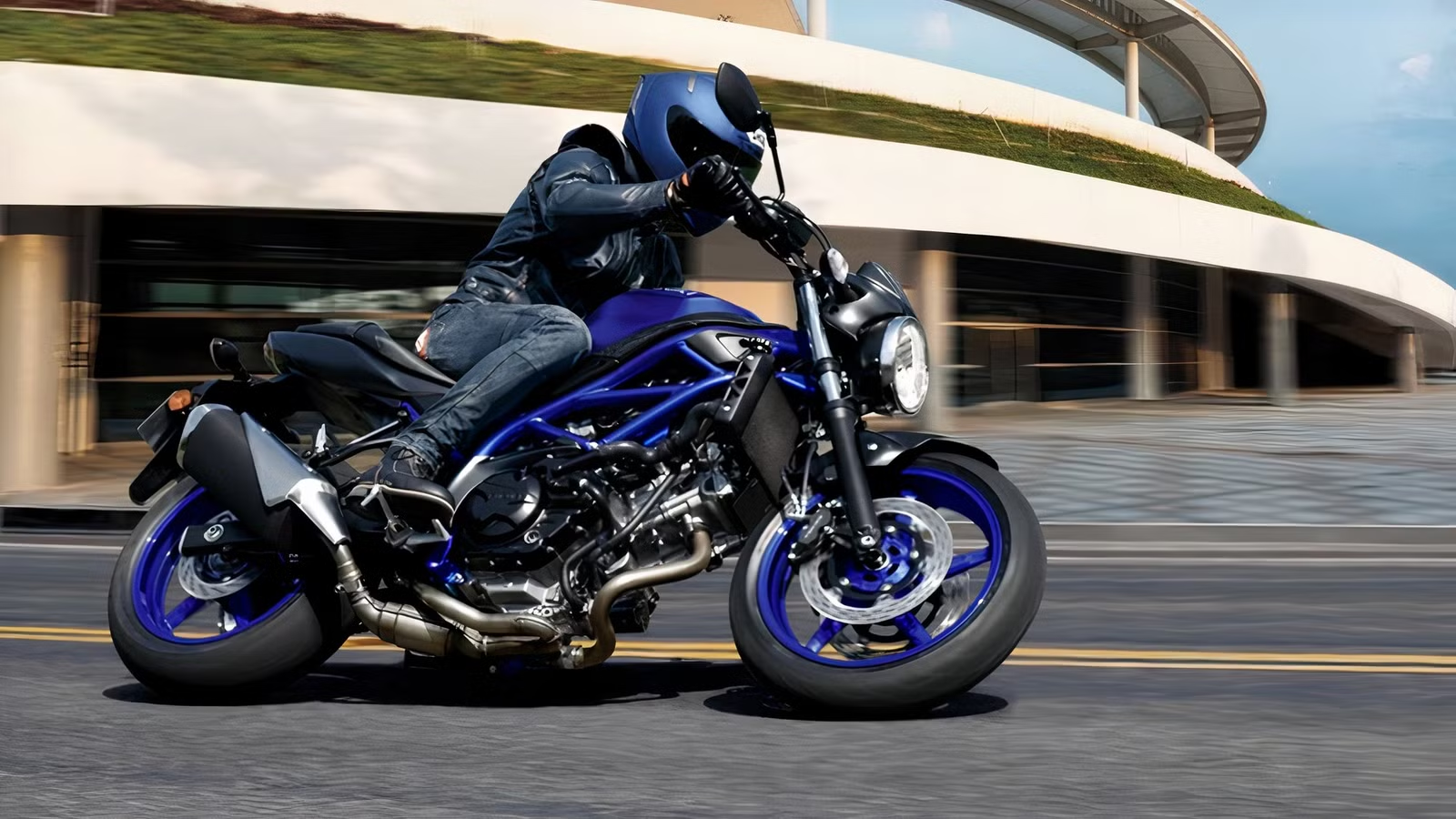
Motorcycles have never been more sophisticated than they are today. They are becoming faster, smarter, and increasingly packed with advanced technology. On paper, that should make every new generation better than the one before it. But motorcycling has never been entirely about specifications. A modern bike can be objectively more advanced while feeling less involved, heavier, or more expensive than the machine it replaces. For riders who value simplicity, an older formula can still be difficult to beat. A Suzuki naked bike proves exactly that today.
Why ‘Older’ Doesn’t Always Mean Outdated in the Middleweight Class

The middleweight motorcycle category has changed dramatically over the past two decades. Engines have become more efficient, electronics have become more sophisticated, and manufacturers have pushed performance figures closer to those of larger motorcycles. Yet the ideal middleweight has never been defined by horsepower alone. It needs to be comfortable, enjoyable, and affordable to own.
Newer motorcycles often bring clear advantages, but an ‘older’ design platform doesn’t always mean it is obsolete. Rather, it often means the manufacturer got the fundamentals right the very first time. That is particularly relevant in the middleweight class, where usable performance and a well-balanced chassis often matter more than outright numbers in the real world.
Simplicity Can Be A Serious Advantage In Motorcycling

Simplicity in a motorcycle isn’t a compromise; it’s an asset. While the middleweight formula has changed considerably over the years, the ingredients for an enjoyable street bike haven’t evolved nearly as much. A strong but manageable engine, friendly ergonomics, and predictable handling still matter more than having the latest electronics. Simplicity also matters outside the riding experience. Fewer complex systems can mean easier maintenance, lower repair costs, and less time spent navigating menus before enjoying a ride. This balance is what allows one long-running Suzuki to remain a serious threat to newer middleweight machines.

The Suzuki SV650 Proves That Old-School Engineering Works Best
Starting MSRP: $8,149

The motorcycle in question is the Suzuki SV650. First introduced in 1999, the SV650 quickly established itself as one of the most accessible and entertaining middleweight roadsters. More than two decades and several generations later, it remains one of the longest-running names in the middleweight motorcycle segment. Over the years, Suzuki has refined the SV650 without straying from its original formula, introducing steady evolutionary updates while preserving the character and simplicity of its classic V-twin engine.

*1999 model shown for reference
With a starting MSRP of $8,149, the 2026 Suzuki SV650 ABS stays remarkably faithful to its origins. That puts it squarely in the same price range as several newer midweight motorcycles. The SV650 delivers its performance without relying on an extensive suite of electronic aids. Instead, it follows a simpler approach that prioritizes a capable engine and an engaging riding experience. The result is an old-school motorcycle that has received just enough modernization to remain relevant without losing the qualities that made it popular in the first place.
A Punchy 645cc 90-Degree V-Twin With Pure Mechanical Soul

Powering the Suzuki SV650 is a 645cc, liquid-cooled, 90-degree V-twin engine that churns out 75 horsepower at 7,500 RPM and 47 pound-feet of torque at 8,100 RPM, paired with a six-speed manual gearbox. The DOHC eight-valve engine uses an 81.0mm bore and 62.6mm stroke, along with an 11.2:1 compression ratio, and gets Suzuki’s Dual Throttle Valve fuel-injection system.
The beauty of this engine lies in its broad, linear torque curve. Its 90-degree V-twin configuration provides inherent primary balance, allowing Suzuki to avoid a heavy counterbalancer while keeping the engine smooth and compact. There are no dead spots; power builds predictably, delivering instant punch out of tight corners.

Beyond the numbers, this engine delivers a soundtrack and mechanical character that modern parallel-twins simply cannot duplicate. The SV650 has also earned a strong reputation for durability when properly maintained. Its long production history has given owners and mechanics extensive familiarity with the engine, and even getting the Suzuki SV650 to 200,000 miles is entirely believable.
Simple Lightweight Chassis That Punches Well Above Its Weight

Wrapping around that gem of an engine is a high-strength steel trellis frame that plays a massive role in the SV650’s razor-sharp handling. With a wet curb weight of 437 pounds and a narrow profile, the SV650 feels light, nimble, and effortlessly flickable. The ergonomics hit a sweet spot with the riding position being upright enough for commuting but sufficiently active for enthusiastic cornering. Its 30.9-inch seat height is particularly approachable, while the 56.9-inch wheelbase contributes to its agile nature.

Suspension hardware is deliberately uncomplicated. A conventional 41mm telescopic front fork provides 4.9 inches of wheel travel, while the rear uses a link-type single shock with spring-preload adjustment. The setup does not offer the broad range of adjustment found on newer sportbikes, but its basic calibration gives the SV650 a useful mixture of comfort and control. Moreover, its 17-inch cast-aluminum wheels are fitted with 120/70 front and 160/60 rear Dunlop Roadsmart III tires.
The SV650 Doesn’t Need Excessive Electronics To Be Fun

In an era where spec sheets are dominated by acronyms for electronic rider aids, the SV650 keeps things focused. Its equipment list definitely makes its age obvious, but not necessarily in a negative way. There are no selectable riding modes, lean-sensitive traction-control systems, or enormous TFT screens. Instead, the motorcycle gets the basic essentials. Its most important electronic safety feature is dual-channel ABS, which works with dual 290mm discs upfront and a 240mm disc unit at the rear. There is also an LCD instrument panel that displays basic ride-related information.
The Suzuki SV650 Is Still One Of The Best Value Purchases In The Segment
The Suzuki SV650’s biggest challenge isn’t that it falls short in any meaningful way; it’s that newer motorcycles have become remarkably good. The SV650 competes in one of the most crowded parts of the motorcycle market, going up against new-age middleweight roadsters like the Yamaha MT-07, Kawasaki Z650, and Triumph Trident 660. While these motorcycles bring modern styling, high-tech features, and strong performance to the table, the SV650 continues to occupy a useful middle ground.

Suzuki isn’t trying to beat every newer motorcycle at its own game. Instead, it succeeds by offering something increasingly uncommon – a middleweight motorcycle where the engine and chassis remain the stars. More importantly, its 25-plus years of evolution have shown that the underlying formula works. Suzuki didn’t need to reinvent the SV650 every few years because the core motorcycle was already right. For riders who still value pure mechanical character and real-world usability, the SV650 has a lot going for it.
Source: Suzuki

Related posts



Latest Post



No Comments