
Harley Davidson Knuckleheads Cost Under $1000 In 1936. It’s Worth An Absurd Amount Today
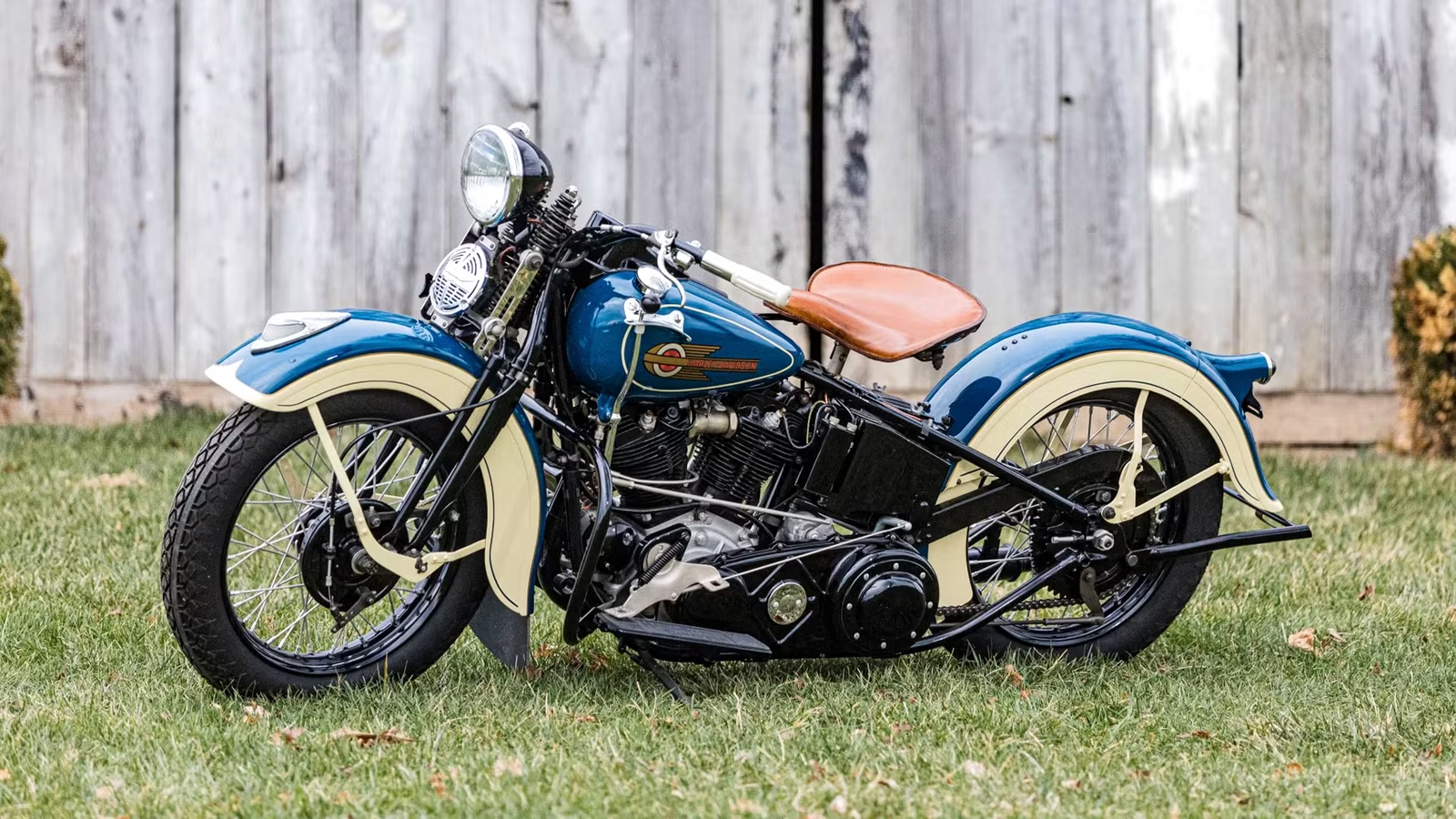
A new Harley-Davidson could be bought for well under $1,000 in 1936. The new 61-cubic-inch E-series carried a base price of about $380. It was a serious amount of money during the Great Depression, especially for a motorcycle built around an engine Harley had never offered to ordinary riders before. Today, a correct first-year example can be worth well into 6 figures.

That jump in value did not happen simply because the motorcycle is old. The 1936 machine introduced Harley’s first production overhead-valve Big Twin, a new oiling system, a 4-speed transmission, and styling that helped establish the company’s postwar identity. It also arrived with enough first-year problems to keep Milwaukee engineers busy after production started.
The Depression-Era Gamble That Risked Harley-Davidson’s Survival
Harley-Davidson did not have unlimited money to spend developing a new motorcycle during the Depression. Company history describes the board rejecting multiple proposals before approving a project internally known as “The 61.” Tooling an entirely new engine was expensive, and the company was cautious enough that the new motorcycle received little attention at its 1935 dealer meeting. Harley even advised dealers to continue concentrating their promotion on the existing model line.

There was good reason to be careful. Harley’s established Big Twins used side-valve engines, while the new 61 moved the valves above the combustion chambers and operated them through pushrods and rocker arms. The 45-degree V-twin layout remained familiar, but much of the engine around it was new. Harley was trying to get more power from its Big Twin without abandoning the basic layout customers already knew.
A New Knucklehead Cost Around $380

The price made the new motorcycle somewhat accessible. Both the standard E and higher-compression EL were advertised at approximately $380 before optional equipment. The EL was the performance version, using higher compression to produce about 40 horsepower from 61 cubic inches. It also came with a 4-speed transmission, giving riders another ratio compared with the 3-speed gearboxes common on earlier big Harleys.
The name “Knucklehead” was not the official model designation. Harley sold the motorcycles as the E-series, with the Model E serving as the standard solo machine and the EL receiving the higher-compression engine. The nickname came later from the shape of the rocker boxes and pushrod tubes, which resembled the knuckles of a clenched fist. It stuck so completely that the nickname eventually became more recognizable than the original model codes.
Surviving 1936 Knuckleheads Command More Than $150,000 Today

The first-year Knucklehead has moved far beyond ordinary vintage-motorcycle money. A 1936 Harley-Davidson EL from the Dr. George Pardos Collection sold through Mecum for $190,000 in 2023. That is roughly 500 times the motorcycle’s original $380 base price without attempting to adjust either figure for inflation. Earlier sales show that collectors have been paying serious money for these bikes for years.
Not every 1936 Knucklehead is a $150,000 motorcycle, and auction history makes that clear. RM Sotheby’s sold a restored 1936 EL for $82,500 in 2012, while Gooding sold a 1936 Model E for $93,500 in 2006. Condition, originality, restoration quality, provenance, and the correct first-year parts can move the final number considerably. The right motorcycle, however, has demonstrated that a price approaching $200,000 is possible.
First-Year Production Numbers Created A Blue-Chip Grail

Production is one reason the 1936 bikes receive so much attention. Historical production records generally put total first-year E-series output at roughly 1,700 motorcycles, with the high-compression EL accounting for most of them. The standard Model E was much scarcer. One of the Knuckleheads sold at Gooding Christy’s Car Auction was described as 1 of only 152 Model E motorcycles produced during the first year.
Survival is a separate question from production. These motorcycles were built to be ridden, repaired, modified, and kept running, not preserved for collectors nearly 90 years later. Parts were replaced as Harley updated the design, and owners frequently customized motorcycles that were simply old used bikes at the time. Finding a 1936 machine with the correct combination of early components is consequently much harder than the original production total suggests.
Teething Troubles Plagued The Early 61ci Overhead-Valve V-Twin

1936 Harley-Davidson EL Knucklehead
Via: RM Sothebys
The new engine represented a large step beyond Harley’s Flathead, but the first version was not completely sorted. Moving the valves into the cylinder heads brought rocker arms, pushrods, valve springs, and additional oiling requirements into the equation. Harley was also introducing a recirculating dry-sump lubrication system instead of relying on the older total-loss approach. There were simply more systems that had to work together.
Harley continued developing the motorcycle after it reached customers. First-year machines can differ in small but important ways depending on when they were assembled, which is one reason serious restorations require so much research. The changes involved oil lines, rocker components, valve springs, ignition timing, kickstarter gearing, and other hardware. What collectors now prize as unusual first-year detail was originally evidence of engineers fixing a new motorcycle.
Oil Leaks, Valve Springs, And Rocker Lubrication Caused Trouble

Keeping oil where it belonged was one of the early engine’s problems. The complicated upper end had several areas that needed lubrication and sealing, and the rocker assembly became a particular trouble spot. Oil could escape around the upper engine while some internal components still struggled to receive enough lubrication.
Valve springs also received revisions as development continued. That matters because the new overhead-valve engine depended on a valve train operating at speeds and loads different from Harley’s familiar side-valve Big Twins. Problems at the top of the engine could not simply be ignored as cosmetic leaks. Harley kept revising the system, and later Knuckleheads benefited directly from what the company learned during that first production year.
Running Changes Strengthened The First-Year Design

There was no single update that suddenly turned the 1936 motorcycle into the finished product. Changes continued throughout production. Different timing covers, oil-system parts, rocker components, valve springs, and frame details were modified as Harley worked through problems. This interesting bit of history also makes it a huge challenge when restoring an early bike. A component that is correct for a late-1936 motorcycle may not be right for one assembled earlier in the year.
Harley kept refining the basic design after 1936 as well. The 61-cubic-inch engine remained in production, and a larger 74-cubic-inch version arrived for 1941. The Knucklehead engine family survived through 1947 before the Panhead replaced it in 1948 with aluminum cylinder heads, hydraulic valve lifters, and improved oiling. The troublesome first-year design became an engine family Harley would keep for more than a decade.
Industrial Art Decided The Blueprint For Every Modern Cruiser

The mechanical changes get most of the attention, but the 1936 Harley was also a styling break from what came before it. Harley deliberately gave parts of the new engine a finished appearance rather than treating every mechanical component as something that simply needed to function. Polished rocker covers made the new cylinder heads stand out immediately. The engine became part of the motorcycle’s visual identity.
That decision still looks familiar on a modern Harley. The engine is not buried behind bodywork, and the shape of the cylinders, rocker covers, exhaust, and air cleaner remains central to the motorcycle’s appearance. Harley itself credits the Knucklehead with establishing the basic architecture followed by later air-cooled Big Twins. The Panhead, Shovelhead, Evolution, and later engines changed the hardware considerably, but the idea of making the Big Twin the visual center of the motorcycle remained.
Streamlined Art Deco Styling Replaced Square Tank Geometry

The rest of the motorcycle received the same attention. The 1936 design used flowing fenders, a tank-mounted instrument panel, and carefully shaped fuel and oil tanks rather than letting the new engine sit inside an otherwise dated package. Two-tone paint combinations gave buyers choices that included Sherwood Green, Teak Red, Dusk Gray, Venetian Blue, and Maroon combinations. The overall shape had the rounded, streamlined look associated with American Art Deco design of the period.
Practical changes went on beneath the styling. The new motorcycle used a double-downtube frame and a stronger front fork to support the performance of the overhead-valve engine. A horseshoe-shaped oil tank wrapped around the battery and became another recognizable Harley detail. Put together, those pieces made the 1936 model look less like an updated Flathead and more like the starting point for a new generation of Harley Big Twins.
The Final Verdict On America’s Most Expensive Production V-Twin

Calling every 1936 Knucklehead a $150,000 motorcycle would be misleading. Auction results show too much variation for that, and an incorrect restoration or a machine assembled from parts is not equivalent to a documented first-year bike with the right components. A buyer at this level is paying for details that would barely matter on an ordinary vintage motorcycle. Engine numbers, early production parts, paint, restoration history, and provenance can all affect the price.
What is difficult to dispute is the importance of the 1936 E-series itself. It introduced Harley-Davidson’s production OHV Big Twin architecture and recirculating oil system while giving the company a styling direction that remained recognizable long after the original Knucklehead disappeared. Harley took a considerable risk putting it into production, then spent the first year correcting the weaknesses that came with an all-new design. Nearly 90 years later, those imperfect early motorcycles are the ones collectors fight hardest to own.
The irony is that many of the details making a 1936 bike valuable today came from Harley still figuring out how to build it. Early and late production machines can differ because the factory was changing parts as problems appeared. That makes a correct survivor a snapshot of a very specific moment in Harley-Davidson history. For a motorcycle that cost about $380 when new, surviving that history intact has become extraordinarily expensive.
Source: Harley-Davidson, Harley-Davidson Museum, Mecum Auctions, RM Sotheby’s, Gooding & Company

Related posts


Latest Post


No Comments