
5 Performance Icons That Have Been Absolutely Ruined By Modern Tech
Modern technology can make a performance car brutally fast, safer, cleaner, and clever enough to embarrass yesterday’s supercars. It can also bury everything that made an enthusiast care about the badge: huge batteries add weight, software manufactures noise, and famous coupes become family crossovers. Sure, none of that automatically makes a bad car, but it can make a terrible successor. These five names show what happens when engineers aim for modern performance figures and product planners chase new buyers, only to leave much of the original magic behind.
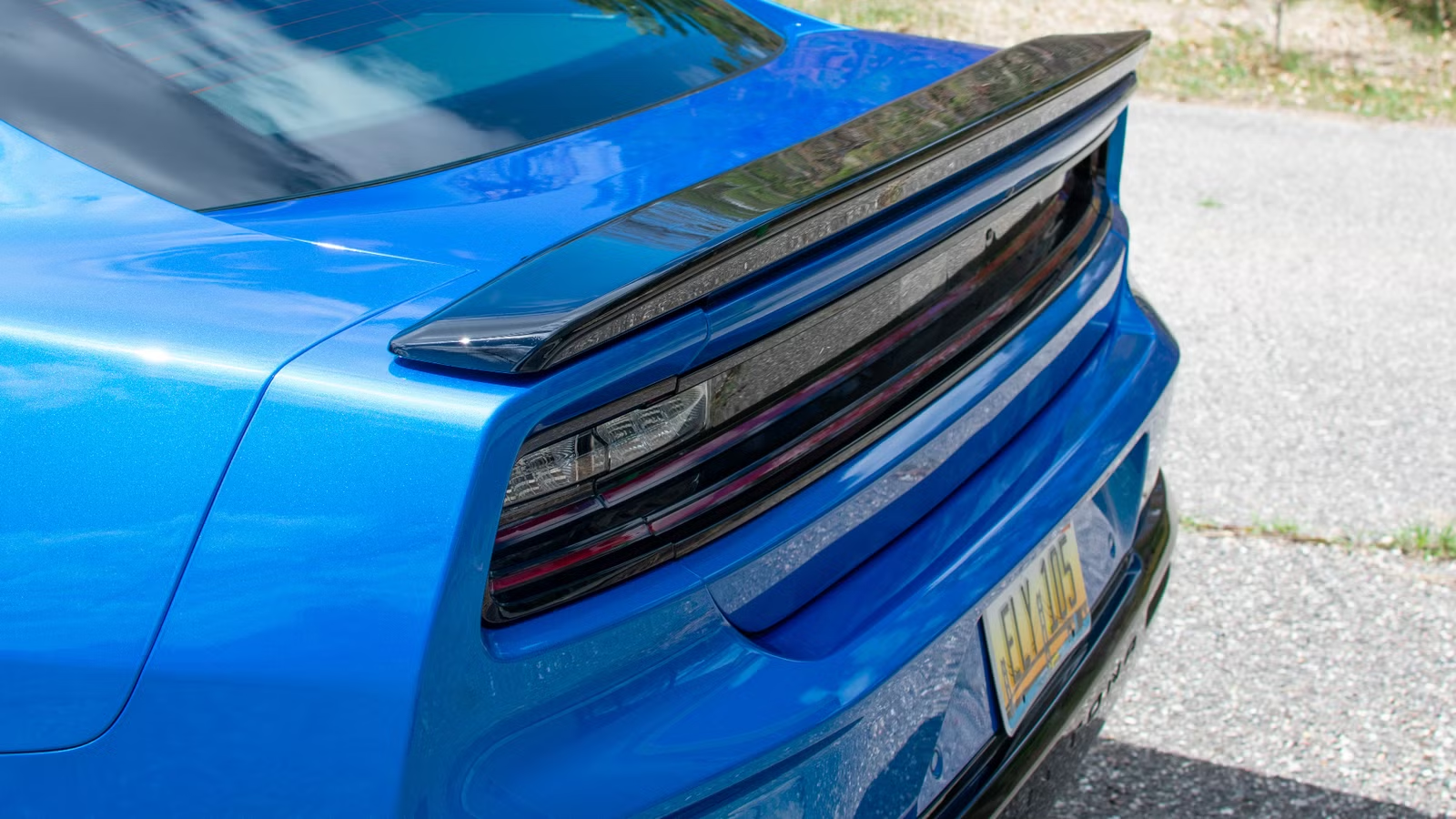
Dodge Charger Daytona

Few names carry more aerodynamic swagger than Charger Daytona. The 1969 original existed because Dodge wanted to win NASCAR races, so engineers gave the Charger a giant rear wing and an absurd nose cone instead of worrying whether anybody thought it looked normal. The strategy worked – the Daytona became the first stock car to break 200 mph on a closed course. The automaker built just over 500 road cars to satisfy NASCAR homologation rules.

The modern Charger Daytona also chases speed, but now silicon does most of the shouting. The electric Scat Pack makes 670 hp, hits 60 mph in 3.3 seconds, and uses dual motors, all-wheel drive, launch control, Drift mode, Donut mode, adjustable regenerative braking, and a temporary PowerShot boost. Most bizarrely, Dodge developed a 600-watt Fratzonic Chambered Exhaust to make an EV create its own synthetic muscle-car soundtrack. That is like replacing a drummer with a Bluetooth speaker and insisting the band sounds more authentic. The Daytona remains seriously quick, but its 136-mph governed top speed and near-three-ton mass make the old NASCAR-bred name feel attached to an entirely different species.
Mercedes-AMG C63


AMG once used the C-Class as a delivery system for engines that seemed far too large for the car. That was the joke, and also the appeal – previous C63 generations stuffed V8s into compact sedans and created something loud, slightly antisocial, and instantly recognizable. Mercedes-AMG took the opposite route with the current C63 S E Performance. It uses a hand-built 2.0-liter four-cylinder with an electrically assisted turbo, plus a rear electric motor, a high-voltage battery, all-wheel drive, rear-wheel steering, and enough computing power to make the old V8 look like it communicated through smoke signals.

The engineering deserves respect. The system produces 671 hp and 752 lb-ft in U.S. specification, while the rear motor even gets its own two-speed transmission. Independent tests recorded a savage 2.9-second sprint to 60 mph. There is just one small issue, if “small” can describe 4,749 pounds. The new car responds instantly and demolishes straights, yet much of its personality now comes from software, electric boost, drive modes, and amplified four-cylinder noise.
BMW M5

BMW at least kept the V8. That sounds like good news until the scales come out. The previous M5 Competition produced 617 hp from its twin-turbo 4.4-liter V8 and carried an official curb weight of 4,370 pounds. It already had all-wheel drive, an automatic transmission, adaptive suspension, and plenty of electronics, but it still somehow managed to feel like a super sedan rather than a luxury apartment building with launch control.

The latest M5 adds a plug-in hybrid system around another twin-turbo V8. Output climbs to 717 hp and 738 lb-ft, and a 14.8-kWh usable battery lets the car drive short distances on electricity. BMW quotes a staggering 5,390-pound curb weight – that is roughly half a ton more than the old Competition. Engineers use rear steering, adaptive suspension, active electronics, and the battery’s low mounting position to disguise that mass remarkably well, but physics never truly deletes its account. The new super sedan is capable of reaching 60 mph in 3.0 seconds, while the previous-generation M5 had managed 2.8. So the newer car has about 100 extra hp, a hybrid system, and substantially more complexity without improving the most important number from the spec sheet.
Ford Capri

The original Capri never needed exotic technology to earn a following. Ford launched the sporty European coupe in 1969 and eventually sold around 1.9 million examples. Motorsport gave the name serious credibility, particularly through cars such as the RS2600. Later, the 2.8 Injection came from Ford’s Special Vehicle Engineering team, an ancestor of today’s Ford Performance operation. Its 160-hp V6 could push the Capri to around 130 mph, which sounds modest now, but affordable rear-drive fun mattered far more than a spreadsheet full of horsepower.

Ford finally revived the Capri name as an electric family crossover. The new version rides on Volkswagen Group’s MEB EV platform, closely related to the ID.5, and stretches to more than 4.6 meters long. Depending on configuration, early versions weighed roughly 4,460 to 4,660 pounds. The 335-hp dual-motor model can hit 62 mph in 5.3 seconds, so it would easily outrun most classic Capris. But that almost makes the problem worse – the numbers say performance, but the recipe says practical five-door electric family transport. Platform sharing itself is hardly sinful, and reviewers have found some genuine rear-drive character in the modern Capri. Still, resurrecting one of Europe’s best-known affordable coupes as another tall EV feels like naming a microwave “Le Mans” because it heats things quickly.
Mitsubishi Eclipse

The Eclipse offers the funniest twist because its greatest versions already relied on corporate sharing. Mitsubishi built the original DSM cars alongside the Eagle Talon and Plymouth Laser in Illinois. Enthusiasts did not care because the top Eclipse GSX delivered the right hardware: a turbocharged 4G63 four-cylinder, all-wheel drive, and a five-speed manual. Second-generation GSX models made 210 hp, and the 4G63 family also powered machines including the Galant VR-4 and Lancer Evolution. Shared parts were never the problem. Boring parts were.

That distinction became painfully clear when Mitsubishi revived the Eclipse name for the Eclipse Cross in 2017. The current U.S. model remains a compact SUV with a 1.5-liter turbocharged four-cylinder, a continuously variable transmission with simulated steps, electric power steering, and S-AWC all-wheel control. Some of that technology is genuinely clever, such as the Active Yaw Control that gives the chassis a faint link to Mitsubishi’s rally-bred engineering past. But enthusiasts once heard “Eclipse” and pictured a boost gauge, a manual shifter, and a 4G63 begging for modifications. Now the name sits on a crossover with adaptive cruise control and room for groceries. Progress can do many things. Apparently, it can also turn a tuner icon into a school-run special.
Source: Dodge, Mercedes-AMG, BMW, Ford, Mitsubishi

Related posts



Latest Post


No Comments