
8 Legendary Vintage Superbikes Worth Big Money Today
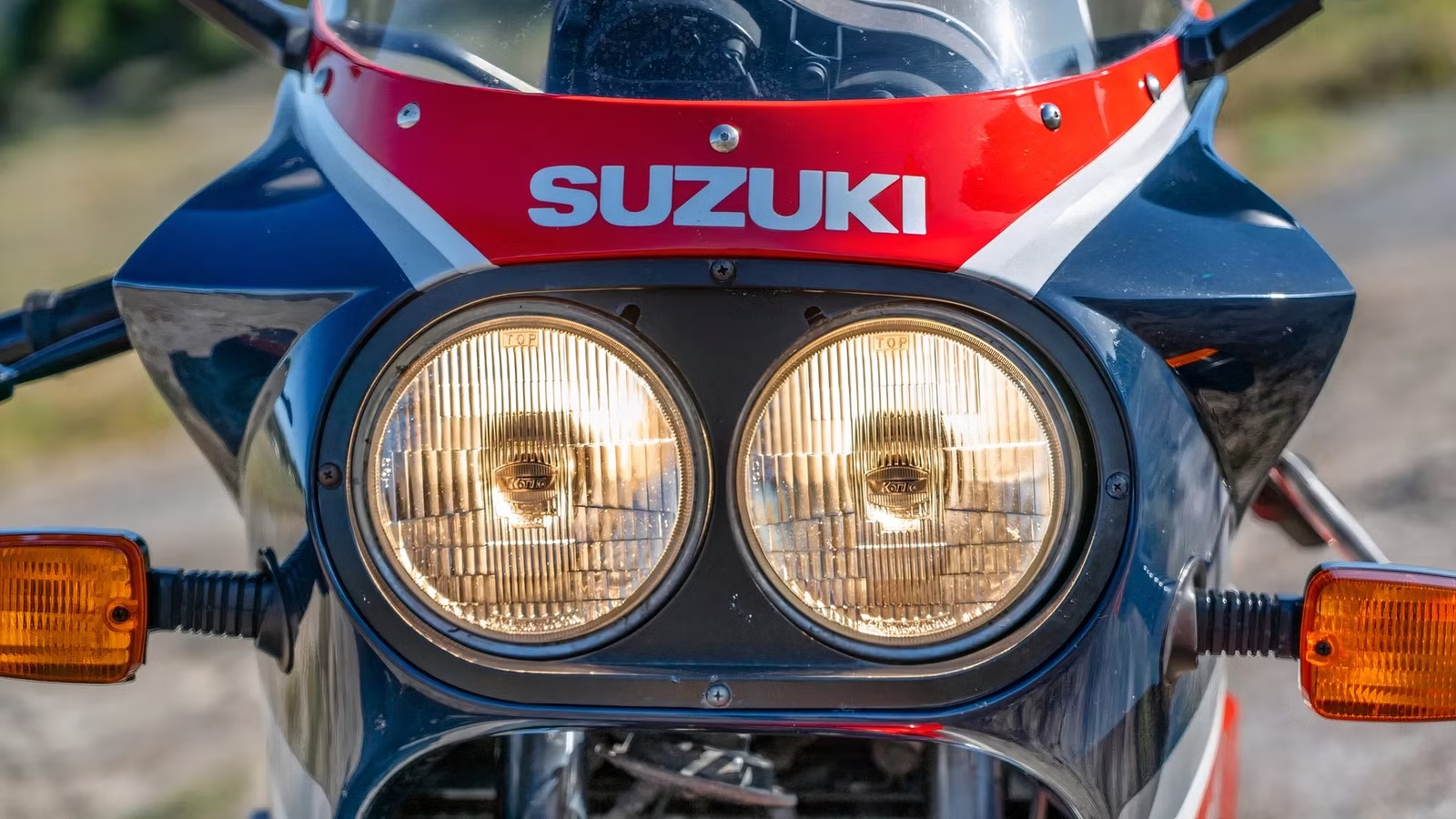
Old-school motorcycles go on to garner a cult following for various reasons, usually having to do with factors such as heritage, racing pedigree or cultural impact. Of course, the scope of what makes a classic bike desirable extends much further, but we were only scratching the surface for a little taster here.

That being said, we came up with a list of ten big bikes from back in the day worthy of a place in the motorcycling hall of fame, some picks being more obvious than others. Our list could definitely be a lot longer, but keeping it nice and concise lets us really focus on a handful of key models.

Yamaha Built A V4 Two-Stroke That Shook The World To Its Core
This Yamaha exploded onto the motorcycling scene and changed bikes forever
12
Kawasaki Z1
Production Years: 1972–1975

Now then, what better way to start today’s discussion than with the legendary Kawasaki Z1 released back in 1972? It went down in history as one of the most iconic UJMs ever created, having stolen the spotlight from the Honda CB750 and gone on to become the world’s fastest production motorcycle at the time of its debut. Top speed was rated at around 130 mph, thanks to a 903cc inline-four engine with just over 80 horsepower at its disposal. Not only that, but the Z1 could also finish the quarter-mile sprint somewhere in the low 12-second range.
Its legacy as a definitive constituent of the golden UJM era can hardly be overhyped, making it one of the most sought-after Japanese classics money can buy. Speaking of which, a well-maintained Z1 has the potential to command north of 20 grand at auction, the perfect example being a restored 1975 model sold on Bring a Trailer for $28,500 in 2025. Collectors have no problem throwing some serious cash at Z1s in excellent condition, drawn to the model’s historical significance from a time when the whole industry was undergoing an outright revolution.
11
Laverda 1000 Jota
Production Years: 1976–1982

Up next, we’re making our way over to Europe for a look at the coveted Laverda Jota. It came as a response to all the high-performance machines from Japan, put in motion by a transverse 981cc triple making something in the region of 90 horsepower. The 1000 Jota could hit speeds of up to 140 mph, which allowed it to knock Ducati’s 900SS off the throne as the fastest production bike out there. Interestingly enough, the 900SS had been the one to previously steal the Kawasaki Z1’s crown, but its reign was fairly short-lived in light of the Jota’s arrival in ‘76.
And the model wasn’t just fast, mind you, because its Brembo brakes, Marzocchi suspension and rigid framework made it handle rather nicely for a bike of that era. Folks noted excellent stability at high speeds, though wrestling the heavy Jota into corners was said to be something of a full-body workout. Fast-forward to the present day, and we find this beloved classic rubbing shoulders with the world’s most hunted collectibles, with prices generally landing in the $10-20k range depending on the bike’s condition. Exact production numbers are hard to come by, but fewer than 3,000 of these gems are believed to have been built before production ceased.
10
Moto Guzzi 850 Le Mans
Production Years: 1976–1985

The 850 Le Mans was produced in three iterations known as Mark I through III, and the first of them also became the most iconic. With its unmistakable cafe racer looks and thrilling performance to match, the Italian V-twin became one of the most cherished motorcycles of its era and one that’s constantly talked about to this day. Among its defining features is a longitudinal 844cc V-twin mill capable of producing up to 71 horsepower in the model’s early incarnations. This ultimately resulted in a 130-mph top speed, so the 850 Le Mans could go fast and look fantastic while doing it.
Various tweaks came along with the Mark II and III, released in 1978 and 1981, respectively. The most notable of them were related to the bike’s bodywork and the structural side of things, but the core formula remained pretty much the same right up until Moto Guzzi launched the Le Mans 1000. And with that legendary Tonti frame, the 850 Le Mans went down in history as one of Mandello del Lario’s most significant models. Clean Mark I examples tend to fetch around $15,000 at auction nowadays, whereas a beater may go for as little as five grand.

The Kawasaki Two-Stroke Triple Riders Still Fear
This legendary triple transformed Kawasaki’s reputation and still commands respect on the road today.
9
Honda CB1100R
Production Years: 1980–1983

Based on the CB900F and built as a road-legal race bike, the CB1100R is often referred to as Honda’s very first homologation special. It entered production in August 1980, and only two months later it went on to win the Castrol Six Hour endurance race in Australia. The bike carried an air-cooled 1,062cc inline-four at its core, good for up to 115 horsepower and a top speed exceeding 140 mph. Honda sought to deliver a solid chassis, too, so the CB1100R was known for excellent frame rigidity, potent stopping power, and a suspension package comprising adjustable anti-dive forks up front and Showa piggyback shocks out back.
The model’s racing success didn’t end with that Castrol Six Hour race, mind you, as it achieved many more subsequent victories in various endurance events. A little over 4,000 copies were produced before the CB1100R’s discontinuation in 1983, and they’re in high demand among collectors today. You’ll have to keep your eyes peeled in order to catch one at auction, though, because they rarely pop up and tend to command $15k or more when they do. Heck, even a rough (but running) project bike fetched $7,800 on Bring a Trailer back in 2024, whereas the other end of the spectrum is occupied by a 166-mile example sold for $43,014 via Iconic Motorbike Auctions last year.
8
Kawasaki GPZ900R
Production Years: 1984–2003

The Z1 made Kawasaki famous, but the GPZ900R took the company into entirely new territory. Developed over six years, the bike arrived in 1984 as a clean-sheet design aimed at leapfrogging every superbike on the market. It was also the first motorcycle to wear the Ninja name, a badge that would become one of the most recognizable in motorcycling.
In an era when a genuine 150-mph motorcycle still sounded far-fetched, Kawasaki delivered one. The GPZ900R’s 908cc liquid-cooled, 16-valve inline-four produced around 115 horsepower and was mounted unusually low in the chassis to improve handling. Anti-dive forks, Uni-Trak rear suspension, and a six-speed gearbox added to a package that felt years ahead of many rivals. The GPZ900R quickly proved its mettle with a one-two finish in the 1984 Isle of Man Production TT.
With production believed to be just shy of 100,000 units, surviving early models have become increasingly desirable. Today, clean examples often sell for $10,000 to $20,000, reflecting the enduring appeal of the original Ninja.
7
Yamaha V-Max
Production Years: 1985–2007

Having defined the power cruiser segment back in the eighties, the Yamaha V-Max hardly needs any sort of introduction. It was a force to be reckoned with when it came to straight-line acceleration, and Yamaha nailed the muscle bike formula to such a degree that it barely changed during the model’s first generation. We’re talking more than two decades here, mind you, from 1985 all the way up until 2007! Also known as the VMX1200, the first-generation V-Max featured a liquid-cooled 1,198cc V4 with Yamaha’s V-Boost intake system. Power output was rated at 145 ponies and 83 pound-feet of torque, which translated into quarter-mile runs below the eleven-second mark.
And with a top speed of around 145 mph, the V-Max was incredibly quick for a bike weighing more than 600 pounds wet. Nowadays, the model is still loved for its raw power and character, after paving the way for modern muscle cruisers like the Ducati Diavel. But unlike the other entries featured on our list so far, it’s a very accessible option for buyers on a budget, typically priced right around $5,000 on the second-hand market. That’s a ton of bang for buck to be enjoyed by those seeking high-speed thrills, all without breaking the bank in the process.
6
Suzuki GSX-R1100 Slabside
Production Years: 1986–1988

The first iteration of the GSX-R1100 came to be known as the Slabside thanks to its bulky tail and side panels, just like Suzuki’s earlier GSX-R750. Now, the Gixxer’s influence on the motorcycling landscape was absolutely massive, having taken the whole sport bike game to a new level back in the eighties. Powered by an air- and oil-cooled 1,052cc four-cylinder engine with close to 130 horsepower, the GSX-R1100 was able to reach a top speed of over 150 mph. Moreover, the motorcycle weighed in at 434 pounds dry—heavy by today’s standards but remarkably light back in the eighties.
Its aluminum twin-spar frame offered excellent rigidity, too, and a lot of people have called these early Slabside Gixxers the world’s first modern sport bikes. They occupy a very important place in motorcycling history, for sure, and the legendary status of the GSX-R1100 and its smaller sibling makes them highly collectible today. The bigger first-gen Gixxer will normally sell for something in the range of five to ten grand, but a pristine example might come closer to the $15,000 mark according to data from Bring a Trailer.

12 Japanese Motorcycles That Practically Last Forever
These ten Japanese motorcycles have one thing in common: with basic maintenance, they just keep going. Some owners have even seen six-figure mileage.
5
Ducati 851
Production Years: 1987–1992

Ducati has long been a force to be reckoned with in World Superbike racing, and all that success started with the 851 back in 1990. The bike took Frenchman Raymond Roche to a Riders’ Championship victory that year, while making Ducati’s brand image decidedly sporty in the process. And although the more popular 916 released in ‘93 tends to overshadow it, the 851 is still fantastic in its own right and a desirable piece of machinery among serious Ducatistas. It was brought to life by a liquid-cooled and fuel-injected 851cc L-twin dubbed Desmoquattro, with a peak power output of around 100 horsepower.
The 851 could reach speeds of up to 145 mph, and its chassis was extremely refined with its top-notch brakes and suspension. Fewer than 10,000 units were produced across all variants, so clean 851s aren’t exactly that common on the market today. Base Strada models will likely set you back about $10,000, while an SP or Tricolore can be worth considerably more. Take, for instance, the rare 1988-model Kit Tricolore sold on Bring a Trailer for nearly $41,000 in 2022, or an SP2 sale where the reserve wasn’t met despite bidding coming close to $25k.
4
Honda VFR750R RC30
Production Years: 1987–1990

The RC30 is a renowned, hand-built homologation special created by Honda to compete in the inaugural World Superbike Championship (WSBK). Produced between 1987 and 1990 with a strict production run limited to around 4,800 units globally, it remains one of the most revered and blue-chip collectible modern motorcycles in history. Ridden by Fred Merkel, it won the first two consecutive WSBK titles in 1988 and 1989, and more than three decades later, it’s still widely considered to be one of the greatest homologation specials ever produced.
The RC30 was effectively a race bike with mirrors and a license plate. It was powered by a 748cc liquid-cooled V4 producing approximately 112 horsepower, but the specifications only tell part of the story. The engine also featured gear-driven camshafts, titanium connecting rods, and a close-ratio six-speed gearbox, while a lightweight aluminum twin-spar frame and distinctive single-sided swingarm underscored its racing pedigree. The RC30’s V4 also used a 360-degree crank arrangement to improve rear-tire traction and mimic race-bike power delivery. With a dry weight of roughly 400 pounds, the RC30 delivered a level of balance and precision that few rivals could match.
Because so many RC30s were actively raced, finding a clean, unmolested road version is incredibly difficult. Pristine, low-mileage original examples frequently fetch anywhere from $35,000 to over $60,000 at auction, while exceptional units have exceeded the $100,000 mark.
3
Yamaha FZR1000 EXUP
Production Years: 1989–1995

In the 1980s, liter-bikes were remarkably fast in a straight line, but trying to corner one at speed was like wrestling a greased-up grizzly bear. Yamaha changed all of that with the FZR1000 EXUP, which combined raw horsepower with genuine Grand Prix-level handling engineering. The FZR1000 arrived in 1989 with Yamaha’s revolutionary EXUP (Exhaust Ultimate Power Valve) system, which broadened the engine’s powerband without sacrificing top-end performance.
Its 1,002cc liquid-cooled inline-four produced roughly 145 horsepower, making it one of the most powerful production motorcycles of its day. The EXUP valve improved midrange torque, while Yamaha’s aluminum Deltabox frame, fully adjustable suspension, and six-speed gearbox helped deliver exceptional stability and handling. With a top speed in the mid-to-high 160-mph range, the FZR1000 was every bit as capable in a straight line as it was in the corners. Contemporary magazines frequently ranked the FZR1000 among the best open-class sportbikes on the market thanks to its blend of power, stability, and everyday usability.
Although Yamaha built tens of thousands of FZR1000s over its six-year run, clean EXUP-equipped examples are becoming increasingly difficult to find. Nice ones generally trade between $5,000 and $10,000, while low-mileage survivors are attracting increasing attention from collectors who remember the bike’s dominance in period magazine comparison tests.

Related posts
Latest Post


No Comments