
1976 Cadillac Eldorado Bicentennial Edition: Last Big-Block
There was a time when you couldn’t go into a dive bar without hearing someone talking about their big block. We are, of course, referring to a type of engine that is generally large displacement, large power, and large torque. Before the days when people had to worry about things like gas prices and the environment, the easiest way to make a car go quickly, or a truck to pull a Bayliner trailer, was to install a big block V8. But at some point, the big block started to disappear. Sure, it’s still a topic of conversation at classic car meets, but you can’t buy one in a new car. So what exactly happened to the big block V8?
Big Blocks Were The Bedrock Of American Performance

If we rewind to the time when everyone was doing the twist and hosting Tupperware parties, aka the ’60s, the world of performance cars was very different. These were carefree times, when everyone was too busy staring at lava lamps to worry too much about OPEC, gas prices, or emissions. But all that came to an abrupt end at the beginning of the ’70s, when Watergate, an oil crisis, and avocado bathrooms arrived to spoil the vibe. Muscle cars had been getting more and more powerful in the ’60s, with the fashion being to put the largest big block engine available in the front of two-door coupes, with outputs pushing 500 hp and 500 lb-ft of torque. There simply was nothing like the sound and feel of a huge displacement engine in a sports car, but it wouldn’t last.
Big Block Meant Power And Torque

Big blocks don’t exclusively have to mean larger displacement, but that is generally what they end up with. The main difference between a small block and big block is “bore center distance”, essentially the distance between the centerlines of adjacent cylinder bores in an engine block. More spacing in big blocks means more room for larger cylinder bores, thus the displacement tends to end up being larger. A big block typically has a bore center distance of over 4.5 inches, although there is no standardized figure to use as a signifier.
A big block is often seen as 6.6 liters or more, but you can also get an Oldsmobile 403 cubic-inch (6.6-liter) V8. That aside, the gas crisis of the early ’70s kicked off the so-called Malaise Era, when muscle cars and luxury cars were drained of power and forced to have their huge engines replaced by wheezy fours, sixes, and small V8s. But one carried the big block flag for a few more years.

The 1976 Cadillac Eldorado Bicentennial Edition Was The Last Dinosaur On Earth

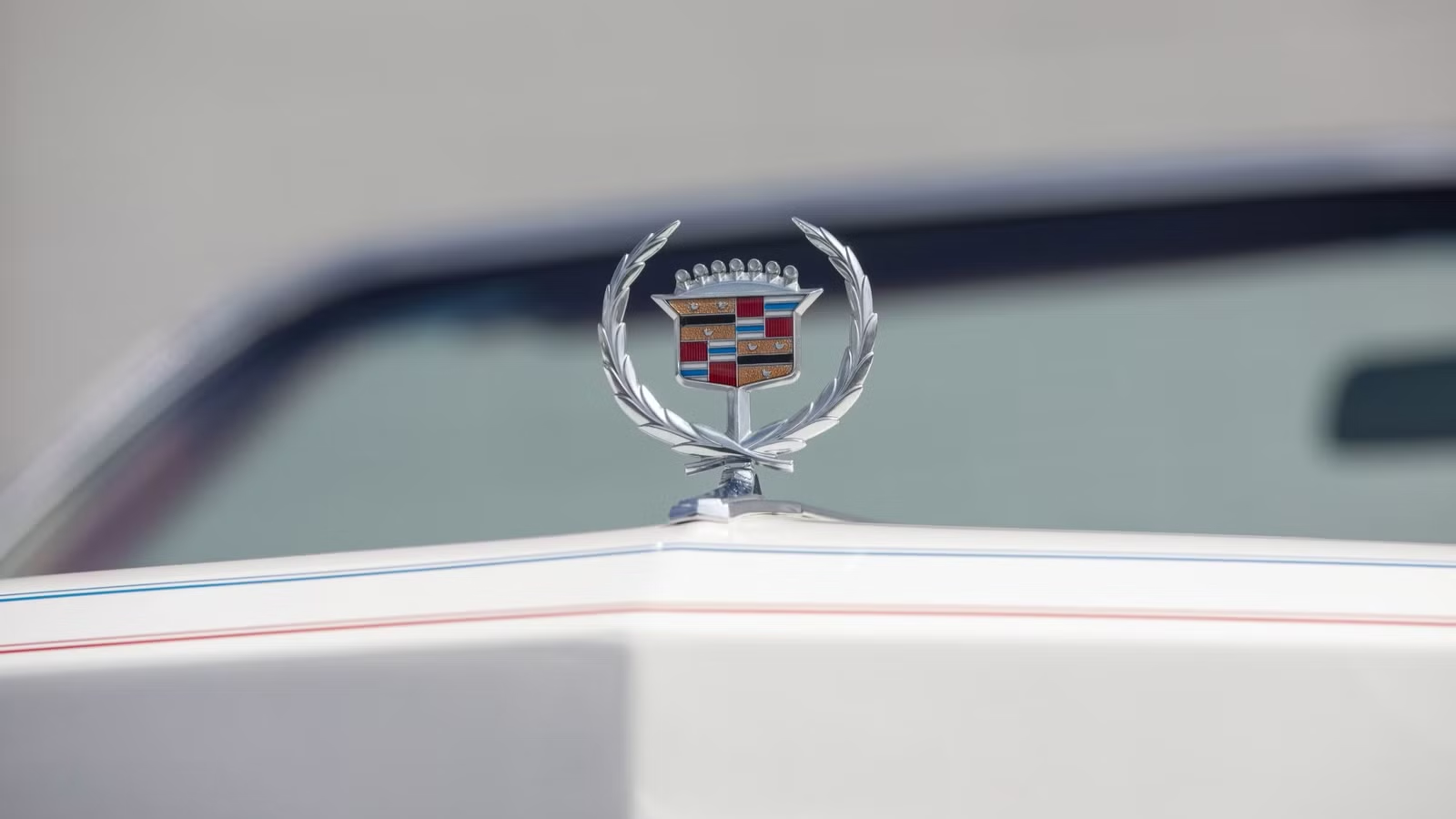
Even the name 1976 Cadillac Eldorado Bicentennial Edition sounds like a best of easy listening boxset. This is a car from another era, no, another world, designed for people who didn’t just like to hang out in Las Vegas lounges, they wanted to drive around in one too. Measuring 224.1 inches long, with a 126.3-inch wheelbase, and an unladen weight of 5133 pounds, the 200 Bicentennial Editions that were created to see off the 8.2-liter Caddy convertible in 1976 came in any color, as long as it was Cotillion White with red and blue accent pinstripes.
They were, and still are, spectacular. GM knew that these cars were the last of an era. Up front was a 500 ci big block V8, but tightening emissions were forcing GM to replace this unit with a smaller 425 ci V8 for 1977. Even though that was technically still a big block, the year 1976 would be the last for the classic, old-style monster 8.2-liter Caddy engine. So Caddy decided to see it off with a bang.
The Engine Was Ginormous

The 8.2-liter Caddy V8 was the largest displacement production passenger car V8 ever manufactured. It’s amazing to think that the 8.2-liter unit had a larger displacement than even a Viper V10, and the same as the W16 in a Bugatti Veyron. The 500 ci V8 was introduced to the Eldorado range in 1970. It was developed as an expansion of the 472 cubic-inch engine, with the stroke increased from 4.06 inches to 4.304 inches while keeping the 4.300-inch bore. Originally, the engine pumped out 400 hp and 550 lb-ft of torque — and this was through the front wheels too. A year later, power was down to 365 gross hp, and by the final year in 1976, it was down to just 190 hp, although 360 lb-ft of torque ensured it could actually move under its own weight.
The Bicentennial Edition Was Caddy’s Peak Maximalist Luxury Period

There is an opulence about the Cadillac that could only have been born out of the late ’70s. This was an era when people danced to disco at Studio 54, while the economy started to disintegrate. This was a time of over-the-top extravagance that seemed to be making its last stand — it’s no surprise that a 1979 Coupe DeVille features in Goodfellas as the ultimate (and unfortunate) expression of attention-grabbing excess. The Caddy Bicentennial Edition had futuristic features such as an AM/FM Signal-Seeking Stereo Radio, Automatic Level Control, 6-way power adjustable seat, and Automatic Climate Control. Inside, the cars were bedecked in white Sierra grain leather seats with red piping. There was red carpeting and even a red dash.
This Car Wouldn’t Be Built Today

Giant land yachts like the Eldorado went out of fashion in the next decade or two, with three-row SUVs largely taking their place. The big block did continue for a bit in passenger cars, with the Lincoln Mark V (1977 to 1979) being the last Lincoln personal luxury coupe and one of the final passenger cars to offer Ford’s 460-cubic-inch (7.5-liter) big-block V8. These huge engines also lived on in trucks.
Ultimately, it was forced induction that created the alternative to huge displacement. Smaller engines could replicate the might of huge big blocks with a supercharger or turbocharger bolted on, while complying with stricter emissions regs and providing better economy. Cadillac also doesn’t make huge wafty cars anymore, having reinvented itself as an American alternative to BMW and Mercedes. The top of the tree is the CT5-V Blackwing, which has a 6.2-liter supercharged V8 engine (LT4) from the General Motors small-block engine family. That mill is good for 668 hp and 659 lb-ft of torque.
Buying A 1976 Cadillac Eldorado Bicentennial Edition Is Not For The Faint Hearted

Aside from the fact that navigating a 1976 Cadillac Eldorado Bicentennial Edition will require the patience of an oil tanker captain, it is not the most practical daily. You could be looking at 12 mpg, right down to single digits, in this giant Caddy, wondering where all that gas is going when you stomp on the accelerator. Fast it most certainly is not.
But supermarket runs and drag racing were never what the Eldorado was about. It’s about cruising around having fun, and there are few cars that do this so well. They are rare, with only 200 produced, and actually quite affordable. Hagerty’s Valuation Tools put the price of a good condition 1976 Cadillac Eldorado Bicentennial Edition at $37,300, which makes it a lot of car for the money.
Sources: Hagerty.com

Related posts
Latest Post


No Comments