
GM’s LS4: The Only Transverse V8 in the LS Family
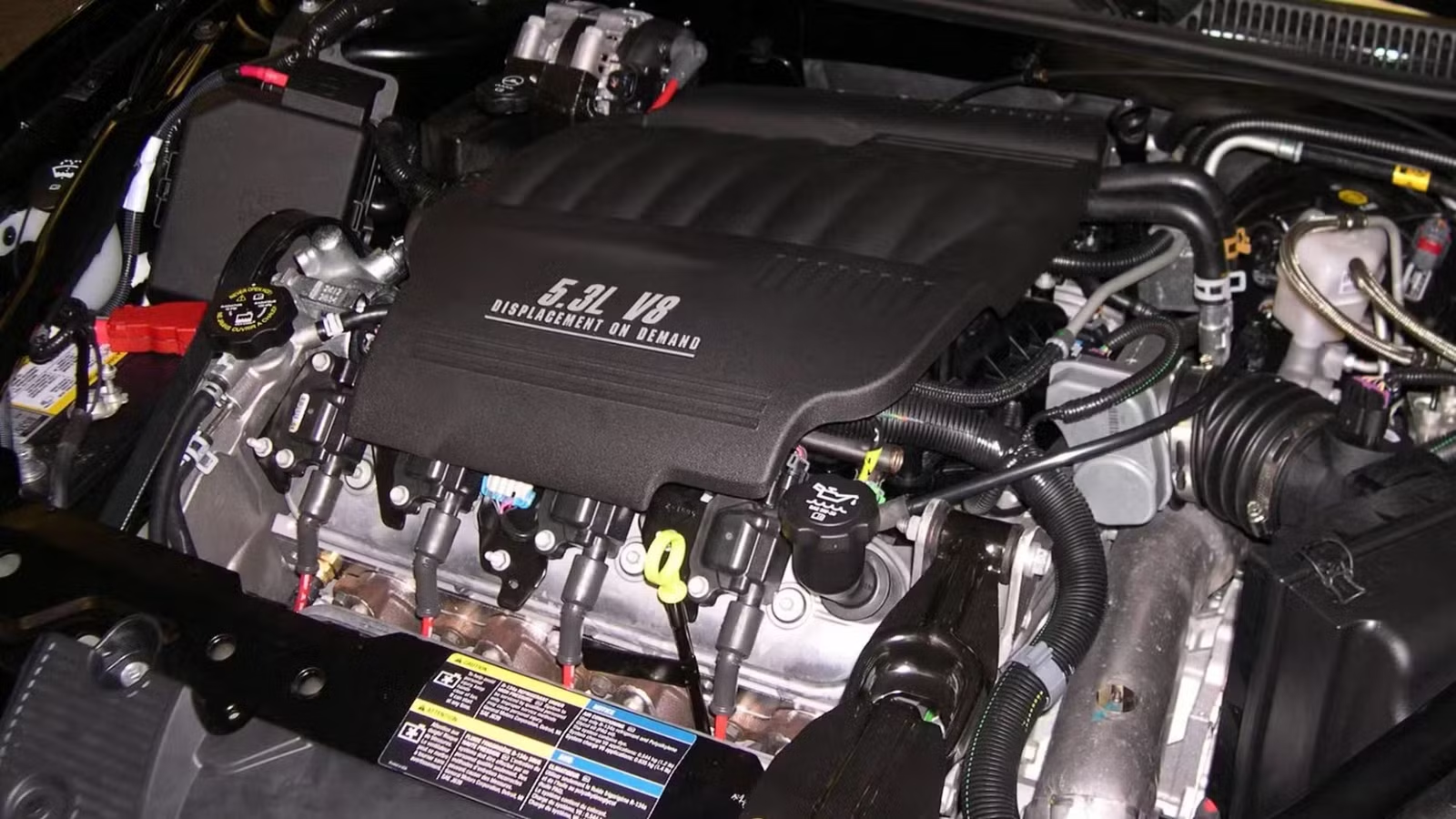
When odd engines show up, a lot of the time they can become abject failures. Sometimes, though, they can end up becoming great units. The engine we’re going to talk about here definitely counts as a success. A lot of enthusiasts haven’t heard of it, or the cars it powered. But for those who know, it’s the perfect ticket to cut-price muscle.
General Motors Has Become Known Over The Years For Its High-Performance Engines

One of the things that General Motors has developed a solid reputation for over the decades is for building fantastic high-performance engines. Whether they’re inline-4s, V6s, V8s and whether they’re naturally aspirated or have forced induction, GM can build a really great engine for any kind of high-performance car. They’re so good, in fact, that a lot of other automakers will buy GM-built engines off the shelf to use in their own cars. Or, alternatively, they’ll base their in-house engines on GM’s designs.
The LS Series Is One Of General Motors’s Most Beloved And Successful Engine Designs

Out of all of GM’s high-performance engines, perhaps the best have to be the ones from the LS family of V8s. First appearing in 1997 as a replacement for the old Chevrolet small-block V8, the LS later expanded into an entire family of engines across a wide spectrum of different sizes. It also gave birth to the Vortec engines that started powering GM’s vans, trucks and SUVs.

Most LS engines are fairly conventional. But there’s one LS that was developed in the 2000s that’s an odd black sheep of the family. It’s incredibly different, and that’s for a good reason.
The LS4 Is The Only LS Engine That Was Designed To Be Mounted Transversely

|
Type |
Displacement |
Power |
Torque |
|
V8 |
5.3 liters |
300-303 hp |
323 lb-ft |
Any other time you see an LS V8 in a car, it’s longitudinally mounted and driving either the rear wheels or all four wheels. The LS4 (which is part of the Gen IV iterations of the LS design) completely bucks that trend. This is the only engine that was designed from the outset to be transverse-mounted and work with front-wheel-drive setups. At 5.3 liters in size, it seems like this engine would be much too large to work in a transverse-mounted, front-wheel-drive setup. But it’s surprisingly compact, and that’s thanks to some clever engineering solutions that we’ll explore shortly. It was also a bit of an innovator in how the LS engine would move forward, as it was the first engine in the LS family to get Active Fuel Management. This is a system that is disliked by enthusiasts today, but back then it was an engineering revelation. By switching off some of the engine’s cylinders when the car was cruising around town or on the highway, it could be noticeably more fuel-efficient than previous LS engines.
Perhaps surprisingly for a high-performance V8 engine from the 2000s, the LS4 was only ever available with a 4-speed automatic transmission. No manual transmission was ever offered with any car that came fitted with it from the factory, and it never got a more modern 5- or 6-speed automatic transmission later on.
While it never got an improved transmission, the LS4 package did get some improvements elsewhere. In 2007, the LS4 had an electronics change. It went from using a 24X crank/1X cam trigger strategy to a 58X crank/4X cam trigger strategy. It also adopted the E67 Engine Control Module. This change was done across the entire Gen IV LS range, and it was done for better efficiency and to meet tightening emissions regulations.
GM Came Up With A Whole Bunch Of Engineering Solutions To Get The LS4 To Fit In A Transverse Layout
To make a V8 that could be transverse-mounted, General Motors had to really think outside the box when it came to designing an LS family engine. That’s something it achieved pretty successfully, coming up with several clever engineering solutions to make it happen. To cut the regular LS design down to size to fit in the more compact engine bays you get in a front-wheel-drive platform, GM made the crankshaft shorter. 3 mm (around 0.12 in) was cut off at the flywheel end, while 10 mm (around 0.4 in) was cut off where the accessory drive is. This is the main reason for its relatively small size of 5.3 liters for an LS engine. To further adapt this engine for front-wheel drive, it was designed to use a unique 60-degree V6-style bellhousing pattern with the starter integrated into the transmission side of this setup. To aid with saving even more space in the engine bay, the accessories and water pump were tightly packaged. This took the form of a single-belt accessory system and a remote-style water pump.
These Engineering Quirks Mean That It’s Orphaned From The Rest Of The LS Family
All these engineering quirks did their job in making the LS4 compact enough to fit in a transverse-mounted, front-wheel-drive setup. But it made the LS4 an engineering orphan compared to its siblings. While that V6-style bellhousing was one of the biggest engineering wins GM achieved when designing this engine for front-wheel-drive, it means that it’s completely incompatible with the rear-wheel-drive LS swaps you see a lot of tuners do. Add that to all the other major differences the LS4 has compared to other LS engines, and it can make maintaining them a real challenge. The unique nature of the engine requires unique parts and unique installations, something that only adds cost and complexity.
The LS4 only being compatible with front-wheel-drive cars doesn’t mean it’s totally excluded from engine swaps, though. As you’ll have seen above, somebody did manage to shoehorn one into a 1999 Chevrolet Cavalier! This is a car that didn’t have engines that were any bigger than a 2.4-liter inline-4 as standard. But, it somehow can have enough space under the hood to fit one of these V8 oddities in there.
It Powered Four Forgotten General Motors Cars From The 2000s

If you’ve ever encountered the LS4 at any point before, it’ll be because it was used in four General Motors models that were sold during the 2000s. These models are all based on the W-Body platform, which only allowed for front-wheel drive. That made the LS4 the perfect engine for top of the line cars that were built on this platform. In fact, it was exclusive to the cars built on this platform—it was the reason why the LS4 was developed in the first place. Developing a new variant of an already-existing engine design that could be dropped into the W Platform as it already existed was a better solution than developing a rear-wheel drive variant of the platform that could take a more regular V8.
The W Platform models that used the LS4 engine were the 2006–2007 Chevrolet Impala SS, the 2006–2007 Chevrolet Monte Carlo SS, the Buick LaCrosse Super, and the Pontiac Grand Prix GXP. All but one of these cars are otherwise ordinary family sedans. The Chevrolet Monte Carlo SS is a coupe, and designed to be more of a grand tourer with American V8 muscle than an out-and-out sports car. The two Chevrolets and the Pontiac were rated at an output of 303 hp, while the Buick was rated at 300 hp.
Perhaps the biggest deal when it came to giving these W-Body cars a V8 surrounded the 2006–2007 Chevrolet Monte Carlo SS. The Monte Carlo hadn’t had a V8 engine option in its lineup at all since 1988, and the original W Platform Monte Carlo SS had been powered by a V6. Bringing the V8 back via the LS4 was an addition that pleased a lot of enthusiasts, even if it was front-wheel drive.
Odd Setups Were Tried To Make Sure The LS4-Equipped Cars Handled Well

With such a powerful V8 engine put into cars that are exclusively front-wheel-drive, you’d expect that driveability would be a bit of a problem. We’ve all heard about the issues high-powered front-wheel-drive cars can have with torque steer, the phenomenon where the front wheels will steer to one side under heavy acceleration. This is caused by a number of different factors, including traction issues. The traction issues were something Pontiac actually attempted to solve on the Grand Prix GXP. The way it did that was doing what’s known as “reverse-staggered” tire sizes. The front tires are wider, measuring 255 mm (around 10.04 inches) in width as opposed to 225 mm (around 8.86 inches) in the rear. That seems like a strange oddity from the outside. But it did actually make sense from the perspective of trying to make this high-power, high-torque (relative for front-wheel drive) car more driveable.
These LS4-Equipped Cars Have Now Become Incredibly Cheap

A lot of people have forgotten about these W-Body General Motors muscle cars. As a result, they’re ludicrously cheap. You can pick up a 2008 Pontiac Grand Prix GXP in great condition for just $10,750 now. A 2007 Chevrolet Monte Carlo SS in great condition with low miles may also only cost you $17,600. When you consider how much other LS-powered performance cars can sell for, these really are bargain prices!
Sources: Bring A Trailer, Buick, Chevrolet, fastfieros.com, Mecum Auctions, Pontiac, W-Body Tech

Related posts





Latest Post


No Comments