
These Gorgeous Japanese Sport Bikes Make Italian Exotics Look Overdressed
All the way through the 80s, 90s, and 00s, Japanese manufacturers took the world by storm, coming out with one incredible superbike after another. Unfortunately, form often followed function, and with speed and performance the main objective, design was often something of an afterthought. Some bikes took this to the other extreme, and were, in fact, famously ugly creations.

There are, however, always exceptions to the rule. In some cases, the form that follows the function is actually appealing, or, over time, has become more appealing (subjectively speaking) than it may have been when the bike first came out. So, as much as the Italian manufacturers will always dominate a list of the “most beautiful” motorcycles, these Japanese sport bikes make those exotics all look a little overdressed for the occasion.
Buying a used motorcycle always has an element of risk attached, so please do your research, and proceed with caution. The motorcycles on this list go from oldest to newest.
8
1986 Suzuki GSX-R1100
Price Range: $8,000 – $10,000

For just a brief moment in time, this was actually the fastest production motorcycle in the world. It followed the same design principles as the original GSX-R750 that debuted in 1985 (and, by extension, the semi-faired 1984 GSX-R400), which epitomizes early sport bike design. It just has a bigger air-cooled inline-four, which yields an impressive-for-the-time 128 horsepower.
Naturally, you pay the penalty in the form of added weight. The chassis may have been advanced for the time, but by modern standards, it is rather crude, so this is not a motorcycle you would be buying for canyon runs. It is still fast in a straight line, though, and it is the very definition of an 80s sport bike.
7
1989 Yamaha FZR1000
Price Range: $5,000 – $7,000

For the FZR1000, you will need to find a very specific model year and color. Other bikes will be cheaper (and a fully restored bike like the one pictured will be more expensive), but the red, white, and blue 1989 model is a gorgeous motorcycle both inside and out. After the 1989 model year, Yamaha changed over to a single headlight, and the previous model years didn’t get the more powerful Genesis engine.

The very same 20-valve lump that would eventually find its way into the frame of the original YZF-R1 almost a decade later (albeit thoroughly redesigned for that more compact frame). Although the FZR’s Deltabox frame is heavier than the game-changing R1, it still packs a mighty 148 horsepower punch, and certainly won’t disappoint anyone looking for cheap thrills.
6
1988 Honda VFR750R (RC30)
Price Range: $40,000 – $50,000

If you didn’t have an inkling that we are fans of the dual headlight design, you may have worked it out by now. Unlike the aforementioned attainable classics, this is a proper homologation special that was sold in limited numbers (not to be confused with the VFR750F production model). It is now highly collectible, and worth a small fortune in the right condition.

The single-sided swingarm is a great example of the form following function, and still looking the part. It is there to aid quick tire changes in endurance racing, and can be credited for starting a trend the Italians have become obsessed with over the years. It is not the only time the Italians took inspiration from a Japanese bike, either.
5
1990 Kawasaki Ninja ZX-7
Price Range: $7,000 – $9,000
In terms of overall performance, the Ninja ZX-7 was a rather late, unconvincing answer to the game-changing GSX-R750. But, most especially with this green, white and blue livery, the bike looks fantastic. These bold colorways dominated the 90s sport bike landscape, and a string of throwback liveries is a testament to how this is coming back into fashion.

Everything is not equal with the ZX-7 year models. Original 1989 models now demand a premium, and, unless you are a collector, that doesn’t make a great deal of sense. The 1990 model is cheaper, slightly lighter, and still has the same fantastic design of the original. As is the case for all the motorcycles on this list, the price indicated is for a bike in good running order. Project bikes will rather obviously be a lot cheaper.
4
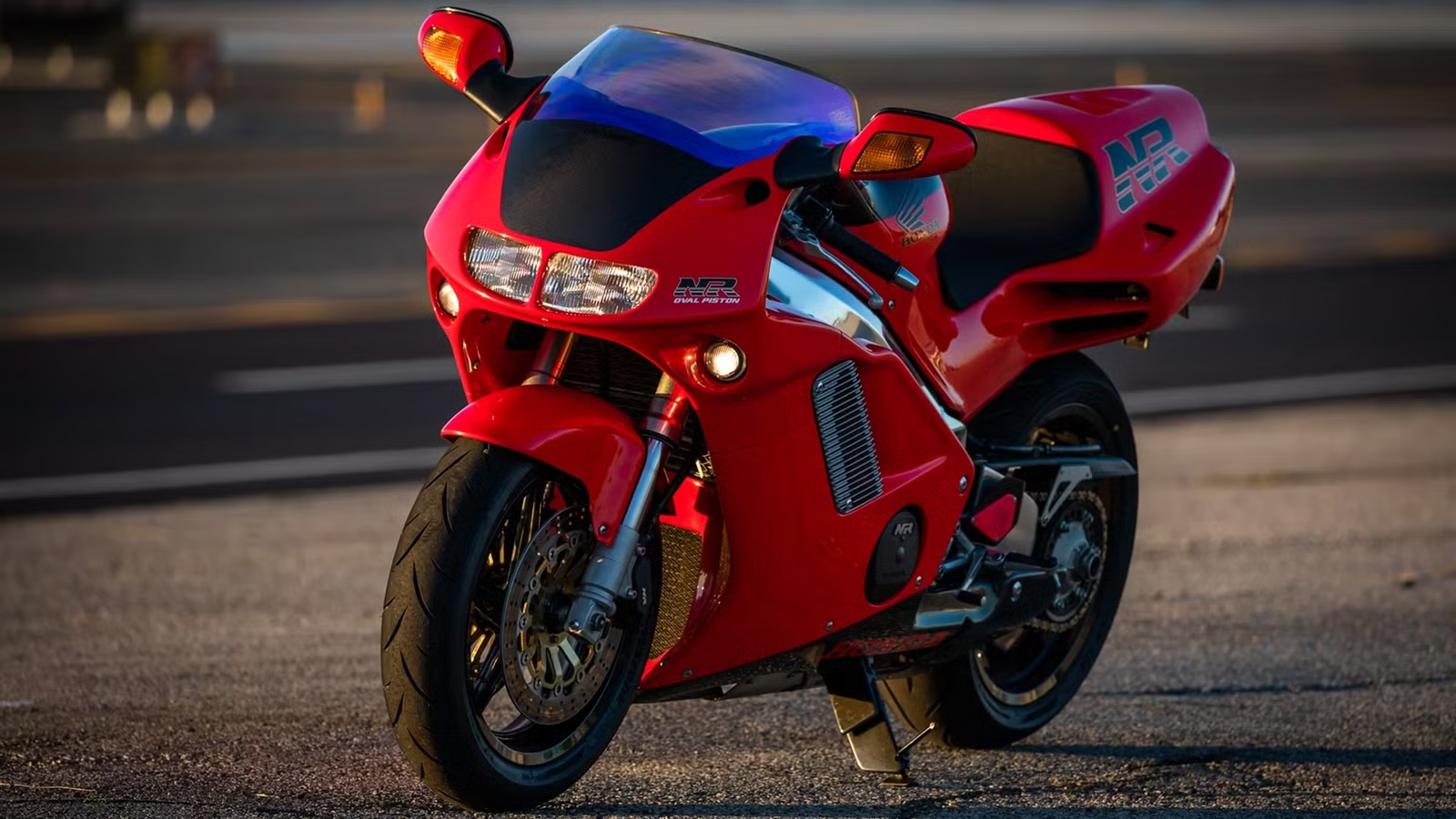
1992 Honda NR750
Price Range: $90,000 – $100,000

One Massimo Tamburini, the famed designer that penned the Ducati 916, took inspiration from the NR750. From its flowing lines, to the under-tail exhaust, you can see hallmarks of the 916 everywhere – an era-defining sport bike which is still arguably the most beautiful motorcycle ever designed.

Underneath its fairings it was also a technological tour-de-force. It featured an oval-piston V4 that rather effectively worked like a pseudo V8. It was fantastically expensive to produce, frightfully unreliable, and Honda only ever built enough of them to satisfy homologation requirements. Suffice to say, it merits the ludicrous price tag for collectors with deep pockets.
3
2002 Honda CBR954RR FireBlade
Price Range: $5,000 – $7,000
This was the last FireBlade famed Honda designer Tadao Baba had a hand in, and it is fair to say he went out with a bang. As other manufacturers seemed to struggle to incorporate modern headlights into motorcycle designs, the CBR954RR showed everyone else the way forward, in what is a thoroughly modern design that has not dated one bit.

Underneath all that, the bike was actually showing its age a bit, and this model wasn’t just the swansong for Baba. It was also the end of the line for the original FireBlade engine, which had reached its performance ceiling. On track, it was outgunned, but in the real world it proved to be one of the more user-friendly superbikes of the 00s. The more powerful CBR1000RR replaced this for the 2004 model year.
2
2002 Honda RC51 (SP2)
Price Range: $4,000 – $6,000

Unlike most homologation bikes, the RC51 was not made in limited numbers, and effectively served as a full production alternative to the aforementioned FireBlade. It beggars belief that at one point in the early 00s you could have walked into a Honda dealership and seen these two bikes sitting next to each other on the showroom floor. Talk about being spoiled for choice.

This V-twin was produced almost exclusively to beat Ducati at their own rule-bending game. While twins were restricted to 1000cc, inline-fours were capped at 750cc, and as a result, Ducati dominated WorldSBK racing, right up until this came out. Honda won two titles with this machine, and proved their point. By 2004, the rules surrounding inline-fours were relaxed, but this affordable homologation special serves as a legacy for this strange period in racing history.
1
2006 Yamaha YZF-R1 LE
Price Range: $12,000 – $14,000
The glaring omission of more modern bikes on this particular list is a testament to the more functional, downforce-obsessed nature of modern sport bike design. Elegance is not rewarded out on track, and improved lap times is the ultimate objective of these machines, after all. As such, this 50th anniversary edition of the R1 is the newest bike here.

It might be two decades old now, but it still looks incredible. Underneath its attractive yellow and black “Speed Block” livery, lies several lightweight components, including forged aluminum Marchesini wheels. It also featured fully adjustable Öhlins suspension, and the most powerful version of the 20-valve Genesis engine which had as much as 180 horsepower on tap with the optional ram-air fitted.
Sources: KBB and Bring a Trailer

Related posts
Latest Post


No Comments