The Used Honda That Still Makes Sense Against Newer Rivals
9 minutes reading
Wednesday, 23 Sep 2026 01:00 0 6 autotech
Buying a Honda, new or used, shows no signs of going out of fashion. According to Honda’s latest U.S. sales report, overall sales (excluding Acura) in 2026 (YTD) are 756,920 models sold. This makes for an increase in sales of 2.4 percent compared with last year, which saw 739,151 models sold by this time in 2025.
However, good buying a new vehicle is, and however popular new Honda models are in the U.S., there is a used sedan from the Japanese marque that makes a good case for not buying a new one.
Front 3/4 action shot of 2020 Toyota Camry TRD driving on roadToyota
Buying a new vehicle doesn’t mean you are automatically buying smarter. Yes, the delivery mileage looks good on the clock, and it feels like it is totally yours, but a lightly used model can offer a lot of the same comfort, safety, and everyday versatility as a current model while avoiding the painful part of new-car ownership: paying for it.
Where this really matters is when newer rivals arrive on the market with higher asking prices but with only slight improvements. A recent used car can still deliver a composed ride, good fuel economy, modern tech, and plenty of space without demanding a monthly payment designed around today’s higher prices. A well-sorted used model can be a sensible choice.
Why First Owners Take The Hit So You Don’t Have To
Front action shot of 2016 BMW 5 Series driving on roadBMW
According to CarEdge, the average five-year residual value for popular auto brands is 54.59 percent; for luxury brands, residual value retention over the same time is 50.63 percent. That means something that cost around $55,000 in 2021, like the base-trim BMW 5 Series, is now much cheaper, but you still get everything that makes the model good. Today, the 2021 530i has an average used price of $24,300 and still has the same 248-horsepower turbo-four under the hood.
The sweet spot, both in the mainstream and luxury used markets, is finding a model that has shed enough of its original value without feeling dated. First owners tend to take the biggest financial hit on vehicles, while if you wait for used prices to drop, you don’t have to take it and still get relatively up-to-date gear, and a lot of the time, very similar powertrains to the new models.
How Much The 2021 Civic Has Dropped — And Why It’s Still Worth Every Dollar
Front 3/4 action shot of 2021 Honda Civic Sedan drivingHonda
While Honda models have a reputation for retaining value well, CarEdge says that, brand-wide, its models retain 60 percent of their original value; models like the 2021 Honda Civic Sedan have now dropped enough in price to make for a very good used deal.
According to Kelley Blue Book’s National Average Fair Purchase Price, a base-trim Civic LX Sedan will cost you $17,800 today; a Sport Sedan will cost you $19,450; an EX Sedan, $19,900; an EX-L Sedan, $20,400; and the Touring Sedan, $21,900. That may not be hugely different from the original MSRP range of between $22,265 and $29,315, but it shows the Civic Sedan’s all-around quality.
The 2021 Civic Has More Cargo Space Than The New Model — And Its Current Rivals
Shot of 2021 Honda Civic Sedan interior showing cabinHonda
The point of a compact sedan is generally to be usable every day, and this used Civic delivers. The ’21 Civic Sedan has a total of 97.8 cubic feet of passenger volume and a maximum of 15.1 cubic feet of cargo space.
In comparison, the 2026 Nissan Sentra gets 14.3 cubic feet of storage space, and the new Kia K4 gets 14.6 cubic feet of storage space. Even the new Civic Sedan gets slightly less than the 2021 model, at 14.8 cubic feet.
Shot of 2021 Honda Civic Sedan trunkHonda
Seating space up front differs between the trims, but all-around, is still spacious. The LX and Sport trims get 39.3 inches of front headroom and 42.3 inches of front legroom, while the EX, EX-L, and Touring trims offer 37.5 inches of front headroom and the same 42.3 inches of front legroom.
In the back, the LX and Sport trims get 37.1 inches of headroom and 37.4 inches of legroom, while the EX, EX-L, and Touring grades get 36.8 inches of headroom and the same rear legroom.
Up To 36 Combined MPG With No Hybrid System Required
Shot of 2021 Honda Civic Sedan engine bayHonda
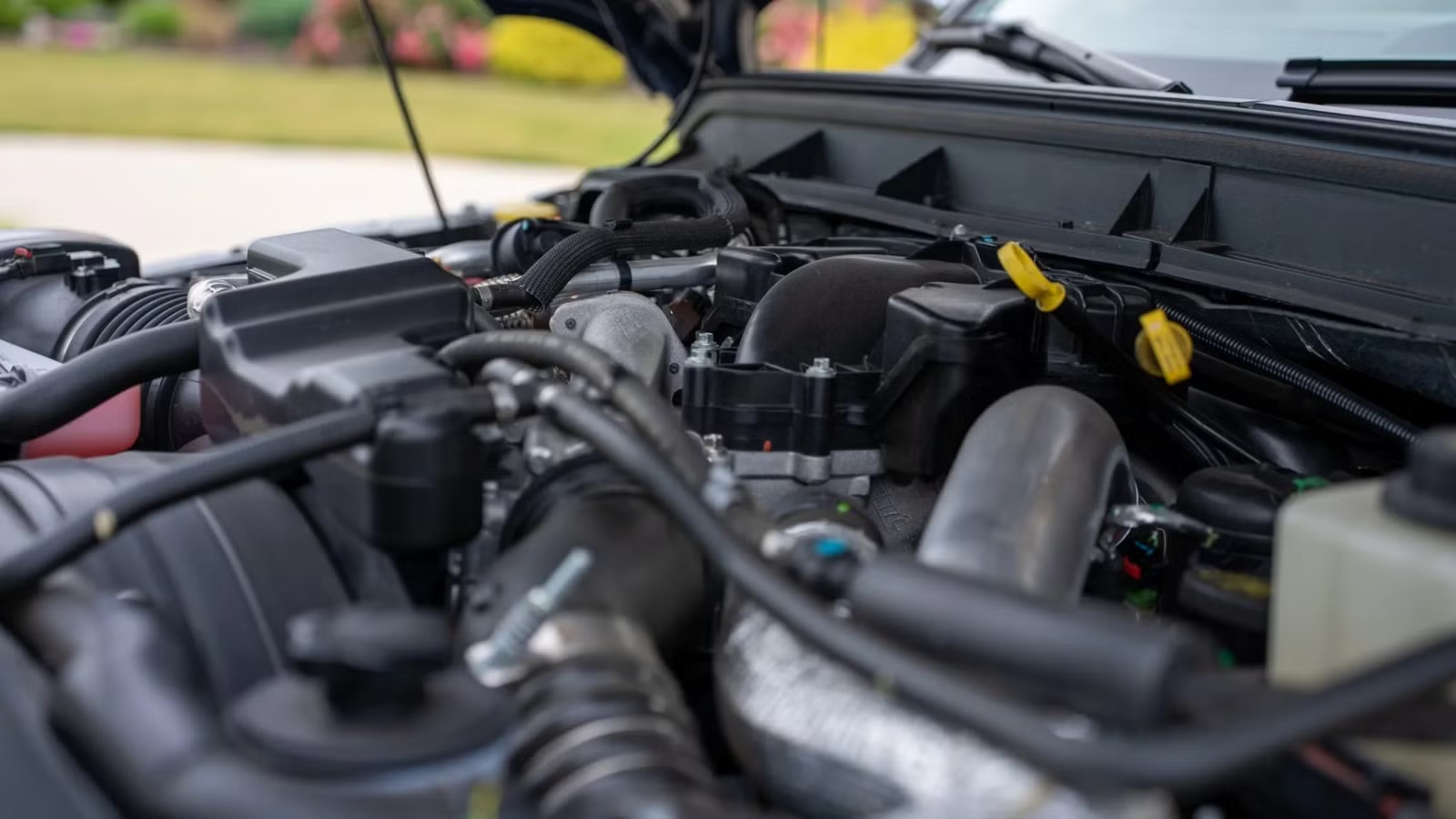
The 2021 Civic Sedan isn’t like a Civic Type R and you won’t get the sportiest ride ever from it, but you will get a trusty, usable amount of power from both engine options. In the LX and Sport trims, a naturally aspirated 2.0-liter inline-four good for 158 horsepower and 138 pound-feet of torque is equipped, while the EX, EX-L, and Touring trims are turbocharged, with a 174-horsepower/162-pound-foot 1.5-liter turbo-four under the hood .
0–60 mph times are relatively tepid at between 7.2 and 8.2 seconds, but fuel efficiency more than makes up for this. According to FuelEconomy.gov, the ’21 Civic Sedan can achieve between 32 and 36 combined mpg without the use of a hybrid system. Turbocharged models are the most efficient and can achieve between 29 and 32 mpg in the city and between 37 and 42 mpg on the highway (up to 36 combined mpg), while naturally aspirated models achieve 32 mpg in the city and 42 mpg on the highway (up to 32 combined mpg).
Profile shot of 2021 Honda Civic Sedan parkedHonda
Neither engine option is overpowered nor highly-strung, and neither works at the edge of its limits. Alongside Honda’s bulletproof reputation and spot-on quality control, that makes the ’21 Civic Sedan a very solid used car. J.D. Power rates the 2021 model 86 out of 100 for reliability, while owner reviews on Kelley Blue rate it 4.7 out of 5 for quality and reliability.
iSeeCars also estimates that the average lifespan of a Civic is 183,603 miles. With an average of 10,887 miles driven a year, this equates to around 16.1 years. They also say it has a 39.7 percent chance of reaching at least 200,000 miles. Buying a 2021 model with even the average amount of miles on the clock (around 55,000 miles) means buying something relatively near to the beginning of its life.
Still Offering Apple CarPlay And Android Auto — For Thousands Less Than New
Shot of 2021 Honda Civic Sedan infotainment screenHonda
It’s not just the price either. The Civic sedan was last updated with a mid-cycle refresh for the 2025 model, and despite the 2021 model being the last MY of the 10th generation, it doesn’t seem that totally out-of-date compared with the current generation (11th).
The maximum touchscreen size you can get is seven inches (in higher trims), but you do still get Apple CarPlay and Android Auto in some grades, available SiriusXM, available Honda Satellite-Linked Navigation, and up to a 10-speaker audio rig.
Proven Engineering Means Fewer Problems As It Ages
Rear 3/4 shot of 2021 Honda Civic Sedan parkedHonda
More importantly, the engines used in the 2021 Civic are familiar. The NA option is part of Honda’s K-Series, while the turbo-four is part of the L-Series, both of which have been widely used across Honda’s lineup and improved over the years.
Out of the two engine options, the non-turbo option is likely the most staunch, thanks to a DOHC, i-VTEC, and no forced induction to complicate things.
Rear 3/4 action shot of 2021 Honda Civic Sedan driving in cityHonda
The rest of the car follows much of the same thought. MacPherson struts up front, a multi-link rear, four-wheel disc brakes, and electric power steering are hardly exotic, but that is the point. The rigid body uses Honda’s ACE architecture, which is renowned for its toughness, and the 2021 Civic was given an IIHS Top Safety Pick designation, courtesy of its crash test ratings and safety equipment.
RepairPal also says that a Civic benefits from generally low unscheduled garage visits per year, at 0.22 versus 0.4 times for all vehicles, and generally less severe problems, with a 10 percent chance of a repair being a major issue compared to 12 percent for all other vehicles.
$368 A Year To Maintain — Less Than Any Other Compact Car In Its Class
Front shot of 2021 Honda Civic Sedan parkedHonda
All of this translates to low all-around costs. RepairPal estimates that it will cost you, on average, $368 a year to maintain a Civic, or much less than the average of $526 to maintain other compact cars. CarEdge rates the Civic “A+” for value, and estimates five-year costs of $12,075 for insurance (based on a clean driving record and good credit) and $1,786 for maintenance and servicing.
FuelEconomy.gov also provides annual fuel estimates, which include $1,750 for the turbo models, and $1,900 for non-turbo models. For the non-turbo models, that means saving up to $1,500 on gas compared to the average modern vehicle over five years, but for turbo models, that works out to $2,500 in average fuel savings over the same time (45 percent highway driving/55 percent city driving/15,000 annual miles).
The 2021 Civic Is Worth A Look Before Buying New
Front action shot of 2021 Honda Civic Sedan driving on roadHonda
For some, a five-year-old Civic Sedan may seem a little dated all-around. Sure, you could go out and buy a new base-trim Sentra for $22,890 and get a 12.3-inch touchscreen and a 149-horsepower inline-four that achieves 30 combined mpg, but you are paying more for a new base-level sedan that is worse with fuel than the more powerful turbocharged 2021 Civic and has a shorter estimated lifespan of 142,522 miles.
Now that the ’21 Civic Sedan has dropped to sensible yet still stable prices, you can get the top trim for less than a lot of new sedans in its class. The Touring is well-equipped for the money, with leather-trimmed seats, heated front seats, a 12-way power driver’s seat, dual-zone auto climate control, and a power moonroof. The appeal overall, not just for the top trim, isn’t just nostalgia for a slightly older Civic and a nice lack of in-your-face tech, but the fact that depreciation has done all of the hard work while the car itself still has so much useful life left.
Base Trim Engine
2.0L Inline-4 Gas
Base Trim Transmission
Continuously Variable Automatic (CVT)
Base Trim Drivetrain
Front-Wheel Drive
Base Trim Horsepower
158 hp
Base Trim Torque
162 lb-ft @ 1700 rpm
Fuel Economy
30/38 MPG
Make
Honda
Model
Civic Sedan
Segment
Compact Hatchback
Infotainment & Features
9 /10
Sources: Honda, FuelEconomy.gov, J.D. Power, RepairPal, IIHS, CarEdge, Kelley Blue Book, and iSeeCars.










No Comments