
The Cruiser That Offers Indian Style With Japanese Reliability
For decades, cruiser buyers have had to make a choice between two ideas. American V-twins offered unmistakable styling, heritage, mechanical character, and plenty of road presence. Japanese cruisers, meanwhile, built their reputations on dependable engines, predictable ownership costs, and the ability to pile on miles without constant drama. That divide has never been quite as simple as the stereotypes suggest, but it has influenced cruiser shopping for generations. So what do you do if you want American swagger and Japanese dependability? Well, you pick the cruiser we’re going to talk about.
Why Style Sells In The Cruiser Segment

Cruisers have always been emotional purchases. A motorcycle in this category is rarely bought solely because it has the best numbers on a specification sheet. The way it looks parked outside a diner, the sound it makes when it fires up, and the sense of occasion it creates at 65 mph all matter. That is where the American V-twins have traditionally held a major advantage. Indian and Harley-Davidson built identities around large-displacement engines, long silhouettes, low seats, and styling that could be recognized from a block away.
But Reliability Has Become An Underrated Protagonist

Japanese manufacturers attacked the same market from another angle where cruisers earned their reputation the boring way: high-mileage engines, low-maintenance drivetrains, and dealer networks that rarely see the same customer twice for the same problem. Lower running costs and stronger resale value became the quiet payoff for less distinctive styling.
Yamaha, Honda, Kawasaki, and Suzuki produced plenty of charismatic cruisers, but reliability became a major part of their reputations. For years, that reliability reputation became an almost invisible benchmark. American bikes were expected to offer more character, whereas Japanese bikes were expected to make fewer demands of their owners.


Indian’s modern revival helped blur that distinction. Polaris acquired the Indian Motorcycle Company in 2011, relaunched the brand in 2013, and developed an entirely new generation of motorcycles around contemporary engineering while retaining the visual cues that made the original marque famous. Under 13 years of Polaris ownership, Indian decided to actually compete on that scorecard instead of ceding it entirely — investing heavily in manufacturing tolerances, quality control, and the kind of unglamorous engineering that doesn’t show up in a spec sheet but shows up 40,000 miles later.
The Indian Chief Vintage Blends Vintage Charm With Rock-Solid Reliability
Base Price: $19,999

The 2026 Chief Vintage is arguably the purest expression of that idea in Indian’s current lineup. It takes one of the company’s most recognizable historic designs and places it on the modern Chief platform rather than trying to recreate an old motorcycle mechanically. It also happens to be the centerpiece of Indian’s 125th anniversary lineup this year.
The Chief Vintage starts at $19,999 plus $725 destination, landing mid-pack in Indian’s Chief family — the same price as the Sport Chief, and a fair bit below the Super Chief. A 125th Anniversary Edition, hand-painted over 14 hours and limited to 250 units worldwide, priced at $24,999. Every Chief Vintage, regardless of trim, ships with Indian’s standard two-year, unlimited-mile warranty — a small detail on paper, but also the first plank in the reliability case this whole bike is built around.
Design That Channels 1940s Indian Heritage

Every Indian revival since the original company folded in 1953 — Gilroy in the late ’90s, Kings Mountain in the 2000s — leaned on the same vocabulary: skirted fenders, an illuminated headdress, spoked wheels, chrome. The Chief Vintage borrows that vocabulary, but design director Ola Stenegärd’s team hand-shaped the fenders in clay, a low-tech, high-precision method stylists have used since the 1930s, to nail the proportions before a single panel reached CAD software.
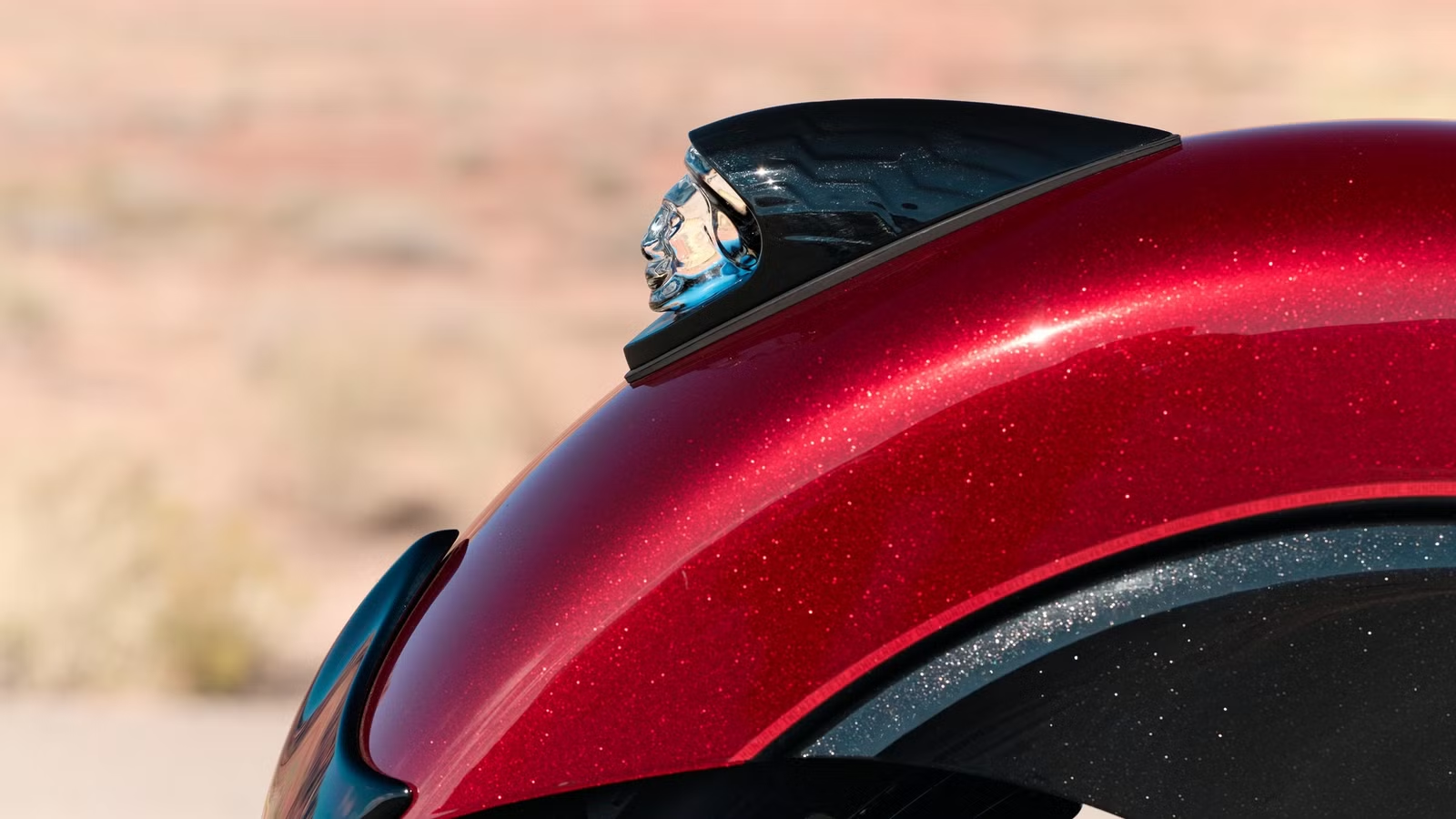
The Chief Vintage’s signature is its deep-draw valanced fenders, a shape Indian introduced in 1947 and never really improved on. They wrap low and full around both wheels, and up front, an illuminated headdress ornament lights the fender the way it did on Chiefs cruising American highways eight decades ago.
Wire Wheels And A Disciplined Blackout Finish Improve The Experience

Here’s where the new Chief Vintage actually breaks from its own recent past: no chrome, no whitewalls, no fringed leather saddlebags. Indian’s designers deliberately stripped all of that away, aiming for what they call “less retro and more classic”. What’s left is wire-spoke wheels tucked under the fenders, a solo tractor-seat-inspired saddle, and a machine finished almost entirely in gloss and matte black — engine, frame, fork, even the badges — with only the cylinder heads, pushrod tubes, and wheel spokes picked out in silver. Buyers choose between two colors, Black Metallic or Indian Motorcycle Red, both understated by heritage-cruiser standards. It’s a more restrained look than older Chief Vintage models wore.
Modern Engineering Hides Under Classic Bodywork

Power comes from Indian’s air-cooled Thunderstroke 116, a 49-degree V-twin displacing 1,890cc. Indian doesn’t publish an official horsepower number, but the EPA rates it around 92 hp. The figure that actually matters here is 120 lb-ft of torque, arriving at a lazy 2,900 rpm — the kind of grunt that makes highway passing a twist of the wrist instead of a downshift.
Heat Management And Rear Cylinder Deactivation

Large air-cooled V-twins inevitably generate heat, particularly when stuck in slow-moving traffic. Indian addresses that with rear-cylinder deactivation, which shuts down the rear cylinder when the motorcycle is stationary under the appropriate conditions. The idea is straightforward: reduce heat reaching the rider at a standstill while also trimming fuel consumption slightly. Reviews of the 2026 model confirm the system activates at stops and displays an indicator on the dash.
Electronic Fuel Injection And Tight Tolerances

There’s no carburetor here to fuss with on cold mornings or at altitude — a closed-loop electronic fuel injection handles that automatically, delivering consistent cold starts and predictable throttle response regardless of elevation. The current Thunderstroke architecture has evolved considerably from the first-generation 111 used when Indian returned under Polaris. The benefit isn’t just easier starting. Electronic engine management provides consistent fueling and throttle behavior across changing conditions, while modern manufacturing tolerances and component design help reduce the kinds of leaks, adjustments, and mechanical annoyances associated with older motorcycles.
Low-Maintenance Belt Drive And Weather-Sealed Wiring

Instead of a chain that needs periodic cleaning, lubrication, and adjustment, the Chief Vintage uses a belt final drive. It is quiet, clean, and well suited to a motorcycle intended primarily for cruising on smooth tarmacs. The electrical architecture is equally modern, even though almost none of it is visible. That means it comes equipped with integrated controls, keyless ignition, LED lighting, and digital instrumentation without disrupting the classic silhouette.
Sturdy Underpinnings Add A Layer Of Dependability

The Chief Vintage rides on a tubular-steel frame, a departure from the old Chief’s aluminum backbone, and it’s over 100 lb lighter than the model it replaces — a meaningful cut for a bike that still tips the scales at 721 lb wet. A 27-inch seat height keeps that bulk approachable at a stop, and the Metzeler Cruisetec rubber is known to hold its line. Suspension comprises a 46mm telescopic fork with 5.2 inches of travel up front, paired with dual, preload-adjustable rear shocks offering 3 inches out back. Braking is handled by a single 298mm floating rotor at each end — a four-piston caliper up front, two-piston in back — with ABS standard.
Electronics Watch Your Back, Too

The tech is there, but it’s just tucked away well enough not to spoil the silhouette. A round 4-inch Ride Command touchscreen packs in GPS navigation and Bluetooth connectivity without looking out of place on a period-styled dash. Selectable Tour, Standard, and Sport ride modes tune throttle response; keyless ignition means the fob never has to leave your pocket, and cruise control takes the edge off longer interstate stretches.
None of the above features changes what the motorcycle fundamentally has to offer, and that is why the Chief Vintage makes such a compelling case. It delivers the styling cues that historically made American cruisers so desirable while borrowing heavily from the modern engineering philosophy that made Japanese motorcycles famous for being easy to live with.
Source: Indian Motorcycle

Related posts
Latest Post


No Comments