
The American V8 That Gives Modern Engines A Run For Their Money
The American muscle car V-8 has a long and meaningful history in the global automotive world. Since its inception, it has promoted accessible top-level performance, competing with European equivalents.

Due to their more affordable nature, American V-8s have always been seen as less prestigious than their European counterparts. As of 2026, there’s a specific engine configuration that changes this narrative, thanks to modern advancements and complementary platforms that prioritize comfort and handling.
How The American V-8 Got Its Start
The American V-8 industry traces its origins to the early 20th century, transitioning from luxury applications to mass accessibility when single-piece block casting enabled low-cost, high-volume manufacturing. What made the architecture famous was its core design philosophy that combines a large displacement block, overhead-valve configurations, and a 90-degree cross-plane crankshaft. This layout delivers low-end torque, mechanical durability, and an iconic uneven exhaust rhythm that defines American muscle performance. The classic pushrod design provided a compact physical footprint that allowed massive power from lightweight engine blocks. This prioritizes displacement and mechanical simplicity over small capacity or high-revving overhead-cam layouts.

Today, the American V-8 faces pressure from electrification and forced-induction downsized engines, leading to significant evolutionary adaptations. Modern iterations incorporate advanced technologies such as variable valve timing, cylinder deactivation, direct injection, and supercharging to meet strict emissions and efficiency standards without sacrificing power. Despite shrinking market shares in passenger cars, the V-8 retains a strong presence in full-size trucks, heavy-duty utility vehicles, and high-performance enthusiast platforms. It remains a durable pillar of American automotive engineering, balancing traditional low-end grunt with modern thermal and electronic efficiency.
GM’s LT4 Closes In On European Performance And Refinement

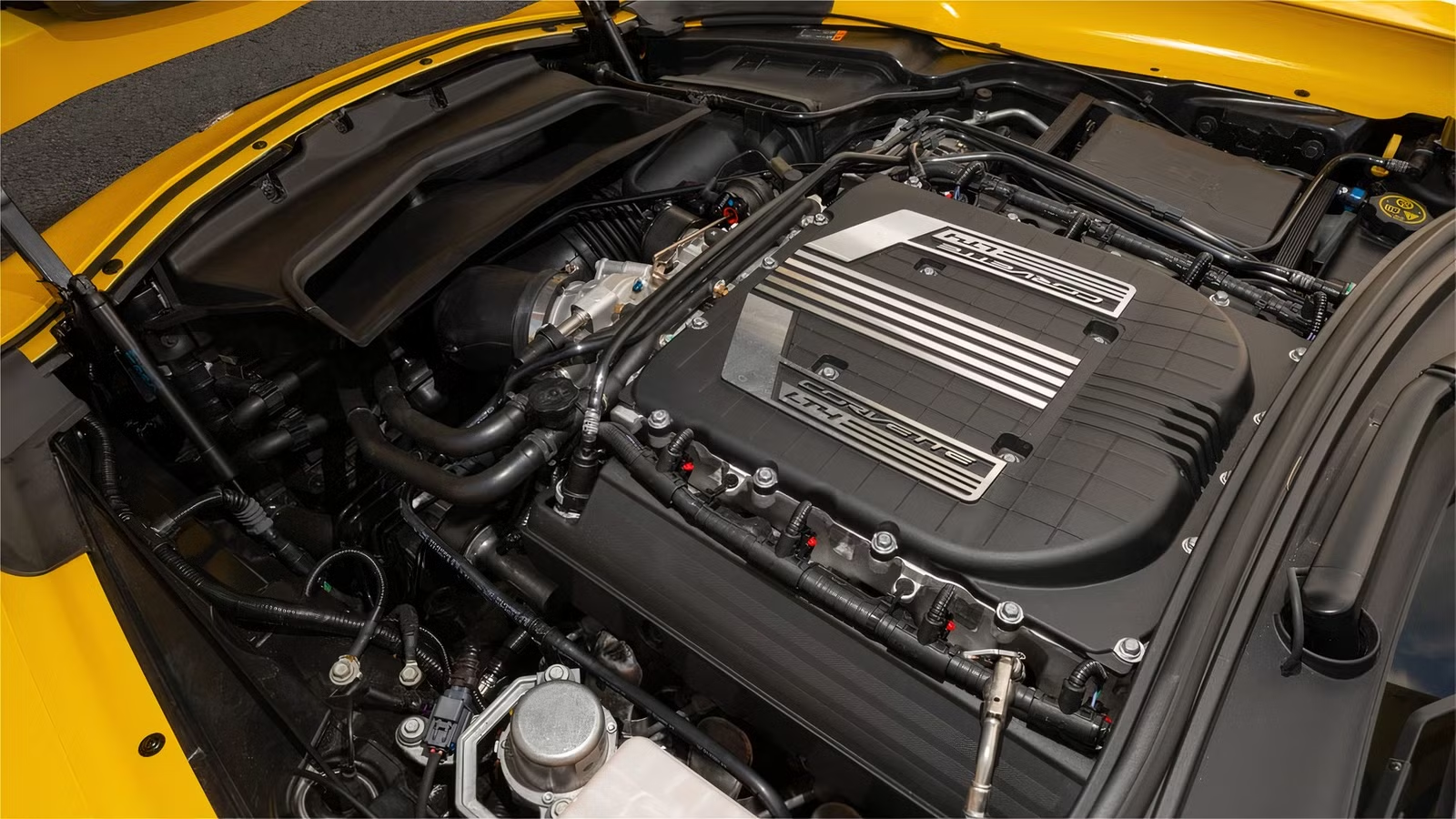
The General Motors LT4 is a 6.2-liter, supercharged Gen-V small-block V-8 engine equipped with a 1.7-liter Eaton supercharger, direct injection, and variable valve timing. Current production and recent vehicles utilizing this powerplant include the Cadillac CT5-V Blackwing and the Cadillac Escalade-V. In standard factory configurations, output ranges from 650 horsepower and 650 pound-feet of torque up to 668 hp and 659 lb-ft of torque in sedan applications. A modified variant delivers 682 hp and 653 lb-ft of torque in heavy SUV applications such as the Escalade. Peak torque typically arrives around 3,600 rpm, while peak power hits at 6,400 rpm.
One of the fastest and most powerful cars employing the LT4 is the Blackwing. Generating 668 hp and 659 lb-ft of torque, it accelerates from 0 to 60 MPH in 3.4 seconds when equipped with the 10-speed automatic transmission, and covers the quarter-mile in 11.4 seconds at a trap speed of 127 to 128 MPH. The brand claims it will exceed a top speed of 200 MPH.
What Makes The LT4 Such A Capable Engine

General Motors bases the LT4’s architecture on a high-strength foundation designed to manage intense thermal loads and internal cylinder pressures. The system is built around a 319-T7 cast aluminum block with six-bolt main bearing caps. The lower end incorporates a 1538MV forged steel crankshaft, forged powdered-metal I-beam connecting rods, and forged aluminum pistons. The pistons feature dished crowns with valve reliefs specifically shaped to optimize fuel atomization from direct injection while maintaining a 10.0:1 compression ratio.
To cool the rotating assembly, the block incorporates dedicated oil-spraying jets targeting the undersides of each piston. Cylinder heads utilize A356-T6 rotocast aluminum, a process that improves casting density and thermal conductivity over conventional methods. Lightweight solid titanium intake valves and sodium-filled exhaust valves maintain valvetrain stability up to the 6,600 RPM redline.
Forced induction is the highlight of the LT4. It comes via an Eaton R1740 TVS 1.7-liter Roots-type supercharger mounted directly inside the engine’s valley, utilizing twin four-lobe rotors with a 160-degree helix twist, allowing it to spin at speeds reaching 20,000 RPM while producing up to 9.7 psi of boost pressure. This compact design keeps total engine height low for vehicle packaging requirements. Air exits the supercharger through a V-shaped discharge window, passing over dual integrated air-to-liquid intercooler cores to reduce charge-air temperatures before entering the intake ports.
What makes the LT4 unique is its synthesis of traditional overhead-valve pushrod packaging with advanced engine management technologies. Unlike typical low-compression forced-induction engines, the LT4 retains a high 10.0:1 static compression ratio made possible by high-pressure gasoline direct injection operating up to 2,900 psi. It integrates continuous variable valve timing via a phaser on the single camshaft, alongside Active Fuel Management cylinder deactivation capabilities. The result is a physically compact package that delivers high low-end torque and top-end airflow while retaining precise combustion control.
The Blackwing’s Suspension Introduces European-Level Handling

The 2026 Cadillac CT5-V Blackwing’s suspension gives the LT4 a level playing field with European performance sedans. It sits on a sophisticated double-pivot MacPherson strut front architecture and an independent five-link rear suspension arrangement. Standard magnetorheological damping via Magnetic Ride Control 4.0 forms the core chassis system. This system scans road conditions every millisecond and adjusts damper rates in less than five milliseconds via accelerometers and magnetic fluid sensors. Stiffer spring rates, hollow stabilizer bars, and rigid aluminum subframe bushings limit body roll while maintaining tire contact under lateral loads. Power transfers to the asphalt through a tuned electronic limited-slip differential operating alongside customized Michelin Pilot Sport 4S tires.
This chassis setup poses a direct challenge to European benchmarks. While European competitors rely on heavy all-wheel-drive systems and complex air suspensions to manage mass and power, the CT5-V Blackwing takes advantage of an exclusively rear-wheel-drive layout paired with precise suspension calibration. The MagneRide 4.0 technology provides a wider operational spectrum than typical multi-chamber air suspensions, isolating high-frequency bump impacts without introducing float. Integrated chassis software features Performance Traction Management. This includes five distinct slip settings to meter power out of corners with greater feedback than competitive stability programs.
The resulting dynamics give the American sedan distinct advantages on road and track environments. Weight savings achieved by omitting front-axle drive components yield superior turn-in crispness, mid-corner balance, and steering feel compared to heavier European rivals. The chassis management allows the vehicle to absorb harsh road imperfections in daily driving while maintaining flat body control during hard track work.
The LT4’s Simple But Costly Servicing Requirements

Routine maintenance for the supercharged GM LT4 relies on the vehicle’s Oil Life Monitoring System to calculate intervals based on engine revolutions and operating temperatures. Under standard driving conditions, oil changes require dexos1 Gen 3 full-synthetic oil, typically 0W-40 or 5W-40 depending on track usage. This occurs every 7,500 to 10,000 miles or once per year. Basic oil change services generally range from $120 to $220 due to the high-capacity dry-sump or wet-sump oil pans requiring nearly 10 quarts of oil.
Engine and supercharger air filters require replacement every 15,000 to 30,000 miles, costing around $100 to $150. Spark plugs and ignition wires need replacement near 60,000 to 100,000 miles, with total parts and labor costs ranging from $300 to $600. Transmission and differential fluid services land around every 45,000 miles for severe driving or track use, running between $250 and $500. Annual ownership maintenance averages between $800 and $1,500, though heavy track usage significantly elevates brake and tire replacement expenses.
Noteworthy Issues That Require Monitoring

Despite robust internal components, the LT4 architecture exhibits several recognized design vulnerabilities. Early production years frequently suffered from thermal heat soak during extended track use, causing the engine control module to retard timing and cut power to protect against detonation. Direct injection also introduces the issue of long-term carbon buildup on intake valves over time. This is caused by fuel that no longer washes over the intake tracts. Valvetrain components present another point of failure; the Active Fuel Management collapsible lifters can fail, leading to stuck valves, misfires, or camshaft lobe wear. High-rpm oil pump failures have affected select model years, causing severe oil pressure drops that threaten total engine lockup. Additionally, supercharger bypass valve actuators occasionally fail, resulting in unexpected loss of boost pressure.
While General Motors issued broad recalls for valve guide wear and engine failures affecting sibling 6.2-liter V-8 variants like the naturally aspirated L87, the supercharged LT4 avoided massive safety recalls targeting its core internal rotating assembly. The primary official actions for the LT4 took the form of Technical Service Bulletins and extended warranty coverage. GM issued specialized TSBs addressing supercharger cooling system bleeding instructions, requiring technicians to vacuum-fill intercooler lines to eliminate air pockets responsible for early thermal throttling. Extended warranty coverage also applied to specific model years to address intercooler heat exchanger designs, while minor recalls on associated vehicles focused on auxiliary hardware, such as transmission control module software updates and fuel pump control modules, rather than structural engine block failures.
The LT4 Doesn’t Have Much Longer To Live

The General Motors LT4 approaches the end of its production lifecycle as GM transitions toward next-generation engine architectures and broader electrification. Serving as the flagship supercharged engine of the Gen-V small-block family, the LT4 remains in production for halo applications. GM has made it clear that it is not developing future iterations or performance upgrades for the LT4 itself. Instead, the automaker focuses resources on its sixth-generation V-8 engine family, which introduces new displacements and updated combustion technologies alongside its Ultium electric vehicle platforms. As stringent federal emissions regulations phase out high-displacement supercharged powertrains, the LT4 stands as one of the final factory-installed, pushrod supercharged V-8 engines in GM history, cementing its role as a legacy milestone for traditional American high-performance engineering.
Sources: General Motors, Motor Reviewer, RepairPal, and the NHTSA.

Related posts




Latest Post


No Comments